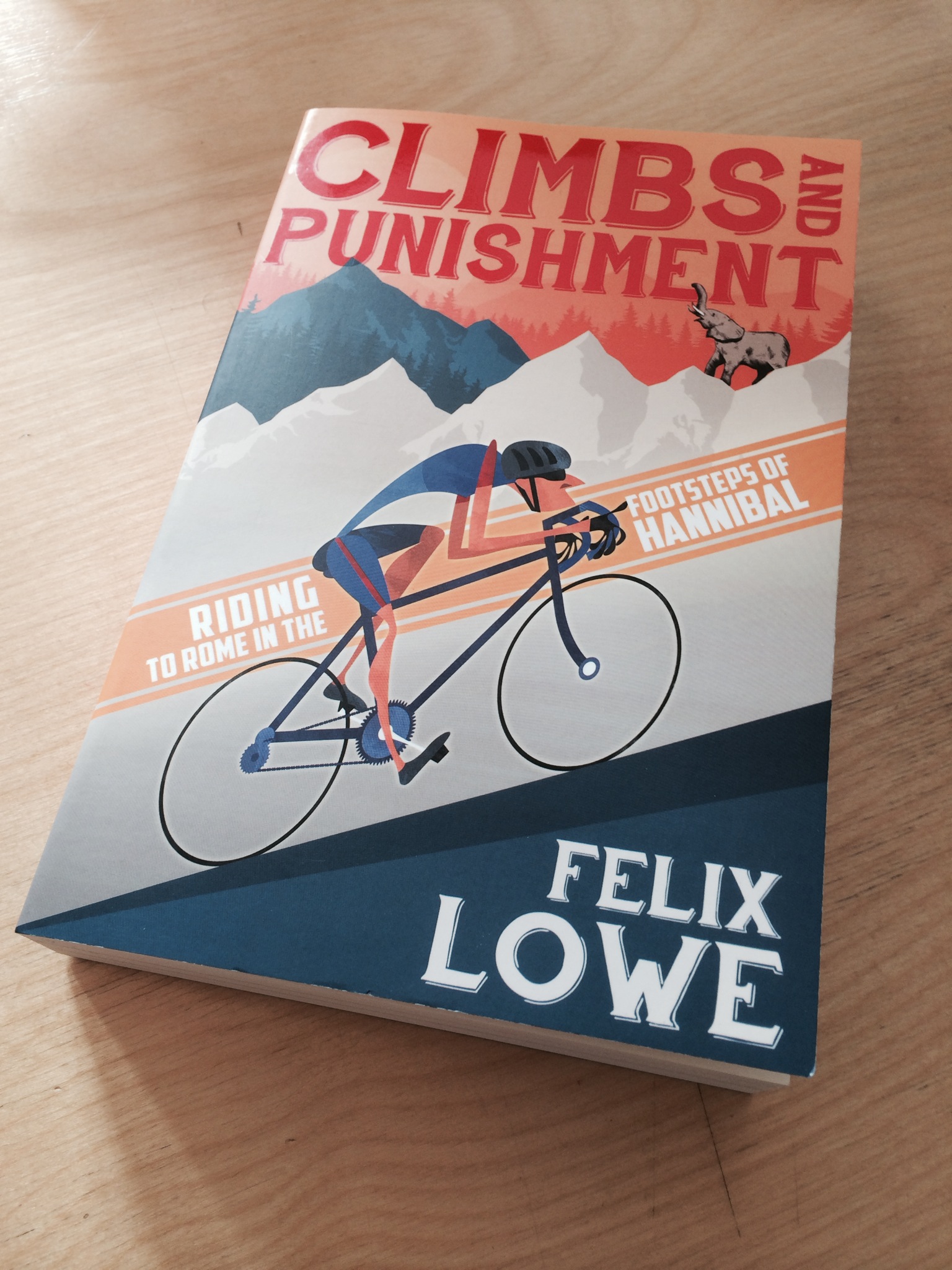
For some reason books about epic cycle rides often struggle to maintain sight of the reason behind the particular journey. Caught up with geography, mileage and the inevitable misfortunes that happen along the way, we are quickly left to forget what the point of the epic ride was in the first place. Context is quickly abandoned in place of stories about encounters with mountains, deserts and (usually) wild coyotes or bears.
Category Archives: Le Tour de France
Yorkshire’s Grand Depart – Interview with Head of Media – Andy Denton
With the Tour de France less than a month away, all cycling eyes are turning to Yorkshire as final preparations are made before some of England’s most green and pleasant land is turned yellow for the couple of crazy days that will be Le Grand Depart.
Leading the team charged with communicating the story of Yorkshire’s time in the spotlight is Head of Media, Andy Denton. The Jersey Pocket caught up with this Kentish Lad who found his home in the Yorkshire Dales and then helped win the bid to bring Froome, Nibali, Contador and everyone else to England’s largest county.
The Complete Book of the Tour De France – Feargal McKay – Book Review
COMPETITION TO WIN A COPY AT THE BOTTOM OF THE PAGE..
As a self-confessed trivia and fact addict, one of my very favourite books as a teenager was Pears’ Cyclopedia. Not a particularly challenging text for an adolescent I will admit but, in pre-internet days, it was the single best source of a wide range of knowledge that I could lay my hands on. Being then of very limited means (variously pocket money, a paper round, a Saturday job as a kitchen porter, eventually a student loan) I tended to buy one every two to three years rather than each annual publishing. I was never disappointed by each new edition that somehow held a world’s worth of knowledge in a pocket-sized paperback. Looking back now from the considerably expanded knowledge base that we can call upon with just a few taps and swipes, it seems as quaintly antiquated as index cards or typewriters (both of which I also cherished at that time) but, judging by the goosebumps which prickled up and down my back earlier this week, the thrill of a receiving a book that portends to hold ‘all the answers’ creates the same feelings of excitement as it ever did.
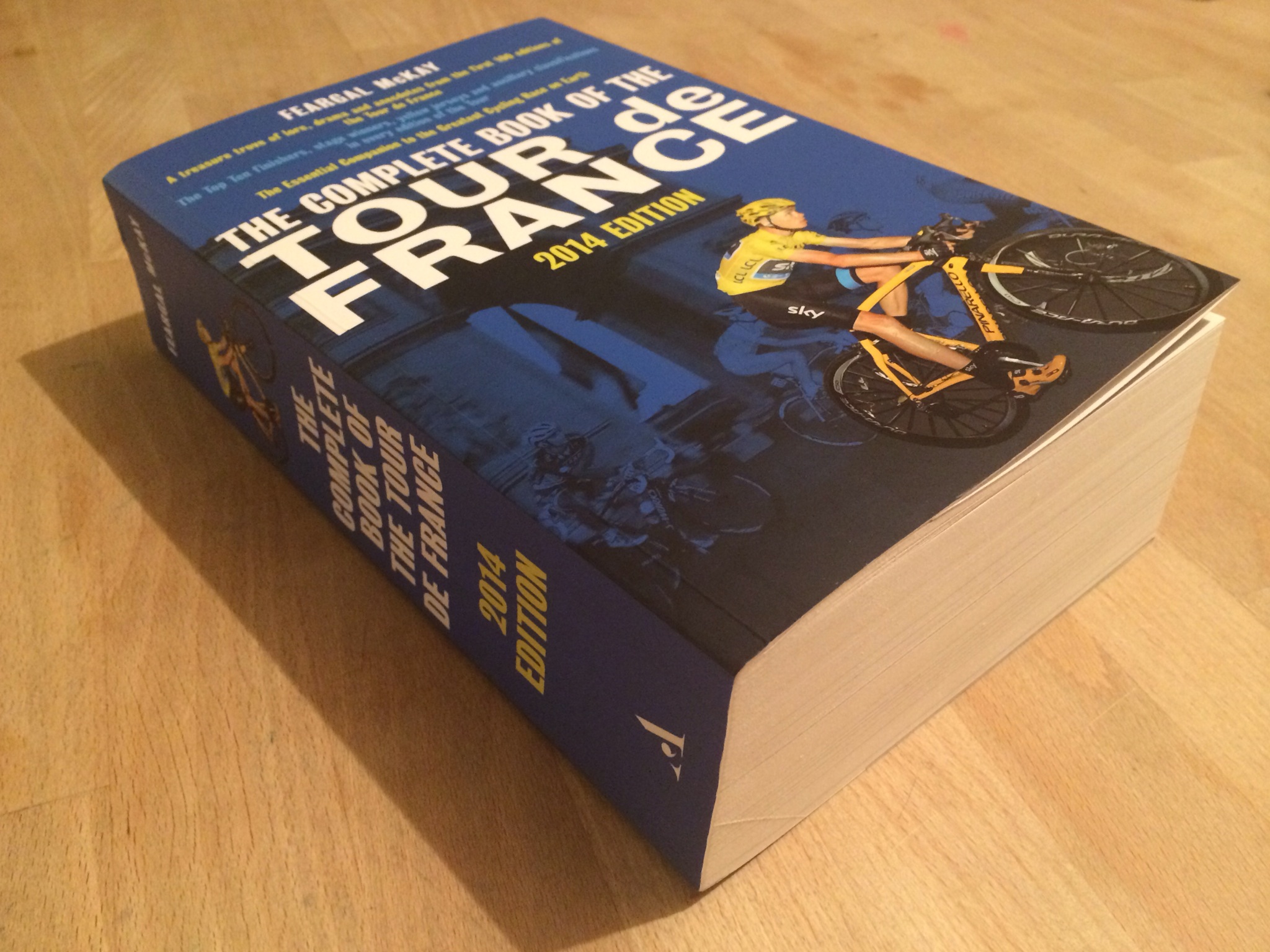
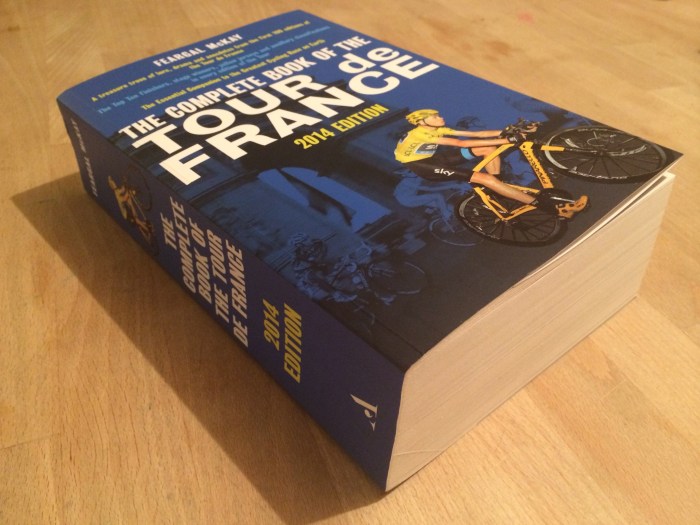
Feargal McKay’s “The Complete Book of the Tour De France” (Aurum Press, £25 Hardcover) is by no means pocket-sized. Even in this pre-release paperback format it weighs something close to an Arenberg cobble and, in the new hardback edition that will be released on June 5th, it would probably do similar damage to a speeding front wheel*. But unlike the famed pave blocks that will define Stage 5 on this year’s Tour, this heavyweight cycling compendium can tell you everything you might ever want to know about the Grand Boucle. The old saying that “Knowledge is Power” certainly becomes more compelling when the source of knowledge that you are quoting from could also be used to knock your enemies senseless with a single blow. Try doing that with an iPhone…
The presentation of apparently endless facts about an annual bike race run in (roughly) the same format for over a century could ostensibly be a dull task to assemble and thereafter be an even duller task to read. Most encyclopaedia’s try to get around this issue by making sure there are a liberal amount of maps, diagrams and illustrations peppering the facts. Pears’ went a degree further by introducing a dozen or so ‘Special Topics’ to each edition. Sitting alongside the more usual Scientific, Historical and Geographical facts, these Special Topics brought some more subjective discussion and debate to the otherwise potentially mundane world of the almanac. More importantly they also delivered some context, personality and story to much of the rest of the book. In order to provide some context to the dry facts and figures that he has meticulously assembled, McKay has also wisely chosen to tell the stories behind the Tour’s various editions and developments, covering its scandals and glories in order provide a definitive statistical account of the Tour and the circumstances under which they were achieved.
And he has done it very well. McKay’s writing has an easy, conversational style that makes you imagine that you are listening to a learned friend telling you about each Tour. Knowing of his Irish background lends an accent to this imagined narration and the book, surprisingly for something that you had expected to be a simple compendium, quickly becomes more of a fireside Jackanory, to be consumed over many evenings, one chapter at a time. Time moves on but the roads and mountains remain and the wheels still turn to conquer them.
So, where to begin? Not necessarily at the beginning. McKay has naturally arranged his book in chronological order (and consumed that way the accompanying narratives would build to give a comprehensive – and comprehensible – understanding of the Tour’s progress through the decades) but one of the real joys of an almanac is that you don’t need to devour it in any particular order. In fact, there is a strong case for saying that you should never actually read it at all. Instead you should either consult it for a particular reason (just who was the Lanterne Rouge in 1937?) or you should just browse in order to allow it to reveal it’s secrets to you in a random, chance-like fashion by flipping pages until a word or name catches your eye. Anquetil, Aucouturier, Alpe D’Huez; Pottier, Pantani, Puy de Dome; Garin, Gimondi, Galibier… It’s an Aladdin’s Cave of Tour History, Tour Geography, Tour Science and Tour Politics. All you have to do is walk in..
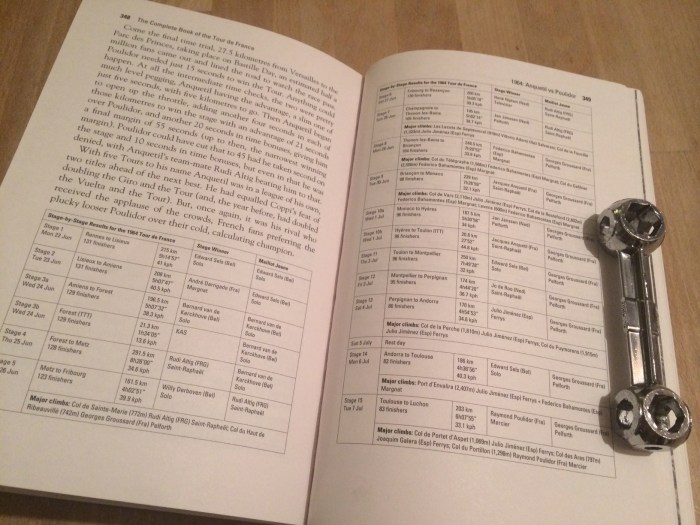
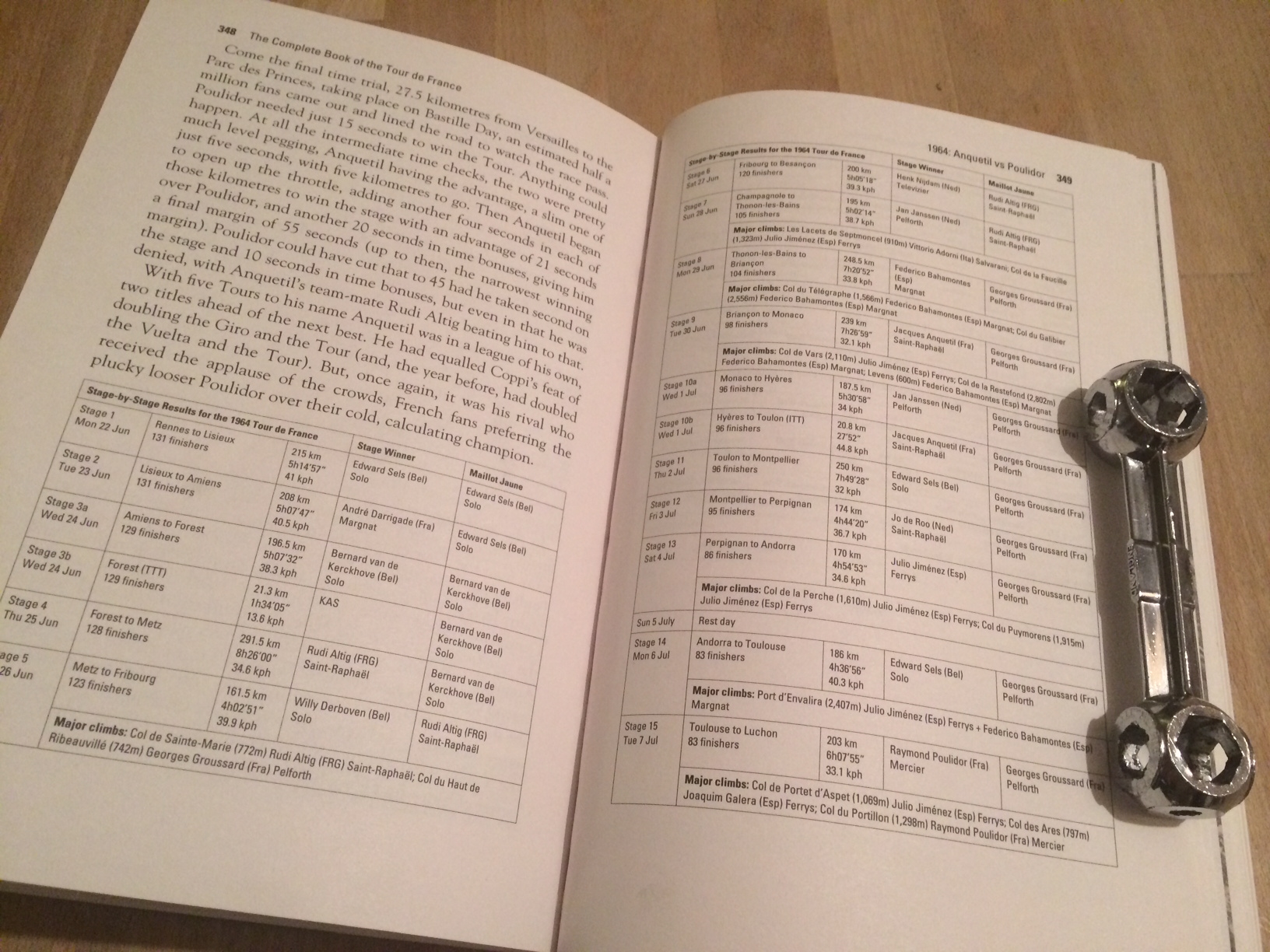
The stories that you find next to the stats change as the motivating forces behind the Tour change from the requirements of marketing to requirements of politics, which in turn give way to commercialisation, which in turn give way to a need for regaining credibility. Throughout the main characters rise and fall as time takes it’s inevitable toll on all and yet the lists goes on. The charts at the end of each Tour story are presented in the same prosaic fashion throughout and, stripped bare of all the drama, intrigue and effort that the narrative has just given us, returns the riders to the immortality of the statistic. All are equal. Geants de la Route.
I would dearly love to see a future edition that included simple maps of each running of the Tour. Done in a consistent way, which was in keeping with the unchanging tables of Stage and Overall Winners, would not spoil the power of their simplicity but would add an extra dimension to the ‘Completeness’ of the book and would help chart the early decades of growth in particular. I don’t think the postmen around the country would thank me for adding an extra 50 or so pages to the already weighty volume but I think the cycling buffs (who will hugely enjoy this excellent book without them) definitely would.
Aurum Publishing are offering a free copy of The Complete Book of the Tour de France as a prize in the very first Jersey Pocket competition. Just send an email to thejerseypocket@gmail.com and a winner will be picked at random on June 5th.
* 02.06.14 update – Aurum have confirmed that the published book will be a paperback, not a hardback as initially intended.

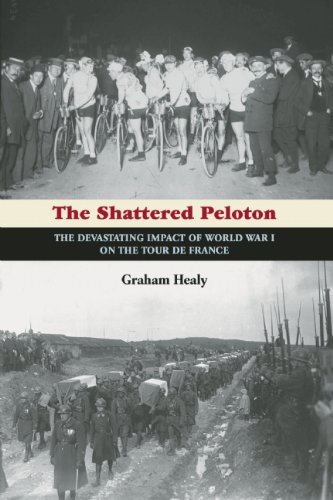
The Shattered Peloton – Book Review – Graham Healy
It’s not often that someone tells you that you are the very first person to have bought their book, but that’s the message I got when I followed a twitter link recently and bought an E-copy of “The Shattered Peloton – The Devastating Impact of World War I on the Tour De France” by Graham Healy (Breakaway Books £7.76 Amazon, £4.90 Kindle edition). Armed with such a privilege I thought that I should shelve everything else I was currently reading and get a review out in double quick time.
Like many others, I am intrigued by the history and geography of Le Tour and the other historical races, and the impact of World War One was clearly a defining moment in many of their infancies. As well as robbing the sport of a generation of young men, the war shaped our perception of many of the areas still visited by the Tour and the Spring Classics today. In this centenary year of the outbreak of hostilities, the Tour has shaped itself in recognition and respect of the upheaval and sacrifice caused by what was known for a very long time simply as “The Great War”. Similarly the 2014 edition of Ghent-Wevelgem was renamed ‘Ghent-Wevelgem in Flanders Fields‘ in tribute. Healy’s book is a wonderful, timely extension of the respect that cycling is paying to the anniversary.
It is also a very good political history book with, amongst other excellent dissections of the ebb and flow of the War on it’s many fronts, one of the most succinct descriptions of how Archduke Franz Ferdinand’s death, which occurred on the same day that the 1914 Tour de France commenced, snowballed into such a mega-conflict a little more than a month later.
Cataloguing the destruction wreaked on any particular set of people by a conflict of such magnitude must have been a relentlessly grim task. The well-researched book opens up doors to give glimpses of riders who have remained unheard of by most for many, many decades, only to have to close them again swiftly as their lives are snuffed out by shellfire, bullet, or bayonet. Professional cycling is a sport inhabited by young fit men and, whilst the book does make mention of some of those who were lucky enough to survive the conflict and resume their careers, most of the tales end in a headstone, a mention in dispatches, or, most poignantly, an assumption of death in lieu of any physical remains.
As we know, war is no respecter of personal history and alongside the names of lesser-known rouleurs are names of giants of the sport who had carved out their legends in the early years of the professional cycling scene before heeding the call to War. Many went eagerly in the first call to arms, in the mistaken belief the War would be brief and decisive. Many cyclists, adventurous men by nature, took to the skies to the early air force regiments where the death toll was even higher than in the trenches.
I was going to mention some of the more famous casualties at this point but, on reflection, that seems to miss the point somehow. You will find them in the book, along with the stories of the lesser lights, but I will leave them all equal in their sacrifice. “Cyclist. Killed in the Great War.” Though some excelled more than others a la velo they all shared the same fate and should be considered equals for that at least.
The Shattered Peloton is a hard-read in the sense that there is no ‘happy ending’. But as a record of achievement, loss and unfulfilled potential, it’s hard to think of another book that is as valid as this one is this year.
As I mentioned earlier, the names of the fallen are many and, in many cases, obscure to modern readers. My sole request for the second edition would be the addition of a index of the riders at the back of the book. Name, Date of Birth, Cycling Honours, Date of Death. I think that would make navigating the bell-tolling pages a little easier, and certainly aid revisiting the text in search of a fact in the future.
The hardcopy of The Shattered Peloton is currently available for pre-order. It will be released on 10th June. The Kindle version is available for download now.
Dear Santa: Bike Books
Christmas is coming. Obviously we are all hoping for a big dump of snow around the 23rd to get us into the festive spirit, and then a week of glorious winter sun between Christmas Eve and New Year’s Day, so that we can get out on our bikes and feel like we have earned some of that mulled wine and chestnuts on our return. But, on the off chance that the weather is miserable for the whole week, it’s important to get some good books laid down in preparation.
I’ve been dropping fairly unsubtle hints about the cycling books I’d like to receive from friends and relatives for Christmas for a good couple of weeks. Items have been added to public wish-lists, printouts have been casually left lying around the house in prominent locations, and specific instructions have been sent to those excellent souls who know the score by now and have already emailed to ask, ‘Which one this this time?’
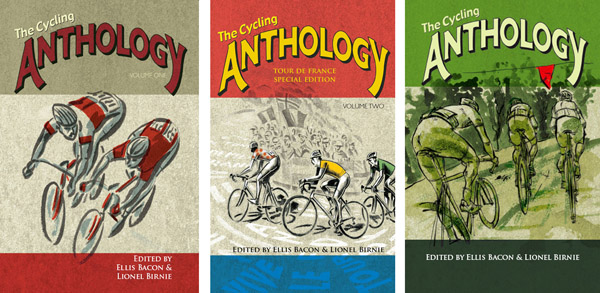
I did wade through a bumper crop last year and this year is likely to be no different; though there is not much room left on the heaving bookshelves of the Jersey Pocket HQ (AKA our compact Blackheath home). With that in mind this year’s first request will be a set of works that hopefully gives maximum bang for shelf-space buck.
Foreign Starts – Grand Tours on Tour
With both the Tour de France and the Giro d’Italia set to start outside of their own borders next year it seems like a good time to have a look at this increasingly regular phenomenon. In 2014 the Giro will spend three days in Ireland during May, visiting both Belfast and Dublin, before Le Tour comes to Yorkshire, Cambridge and London in July. Whilst the Vuelta tends to be much more of an insular affair – having only started outside of Spain twice in it’s 60 year history – a fifth of all the Giro starts since it’s first foray to San Marino in 1965 have been foreign affairs.
The Tour is an even more international event with over 20 foreign starts dating back as early as 1954 in Amsterdam. This began a sequence of around three Tours each decade commencing in foreign parts up until the Millennium. After that they increased again and Tour De France race director Christian Prudhomme clearly stated his aims in 2007 when he said that 3 out of every 5 Tours should begin abroad. Talk during the Armstrong era of a start on American soil may have failed to materialise because of the very real logistical issues of transferring the entire race and it’s vast entourage across 5 time zones of Atlantic Ocean but the appetite to take the Tour ‘on tour’ is self evident.
The Mavericks – Adam Hansen – Seventh Heaven for Grand Tour Glutton
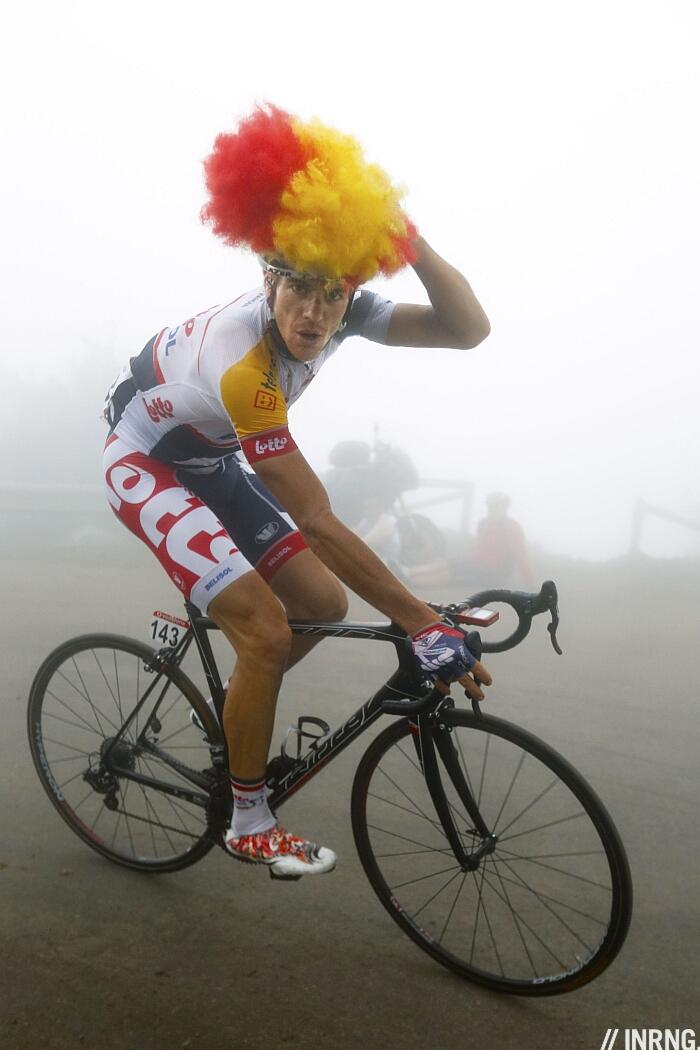
Lotto Bellisol’s Adam Hansen has just completed his seventh straight Grand Tour. Since late 2011 he has ridden the Giro and the Tour twice each and La Vuelta three times – all without a break. He has covered almost 24,000 Grand Tour kilometres in those 2 years and raced an incredible total of 16,059km over 106 days last year alone. In an era of ever increased targeting of races Hansen is a throwback to the classic years of cycling when even the top contenders rode vast seasons covering all events. In a sport renowned as being one of the toughest on the planet, his insatiable appetite for racing the biggest tests over and over again is earning him numerous fans and a reputation of being the hardest of the hard? The Jersey Pocket looked into what makes Hansen tick and found enough surprises to warrant him a place in ‘The Mavericks’.
Hansen has often been marked out as being a bit different. The fact that 32 year old Australian chooses to live in the Czech Republic rather than in one of the usual pro peloton hangouts like Girona or Nice is often used to highlight a non-conformist nature. Never shy in terms of doing things his way Hansen’s unique personality has been enlivening the peloton since 2007. Following spells at T-Mobile, HTC and Omega Pharma Lotto, ‘Croc-man’ (as he is known to his team mates) joined Lotto-Bellisol for the 2012 season, just after embarking on his Grand Tour Odyssey. He seems to be very settled with the Belgian squad and this contentment is showing in both the relaxed nature of his interviews and the increasingly successful nature of his racing. Whilst his commitment and focus at the sharp end of a race should not be questioned that doesn’t stop Hansen from occaisionally reminding us that he enjoys his job too.
Tour de France – Final Roundup – nothing artificial about this race (except the ‘fireworks’)
In the end the promised finale fireworks never came. Not from the top of the Arc de Triomphe after the evening stage on Sunday, where we given a projected feu artifice lightshow instead of some actual gunpowder explosions (the whole show was greeted with polite bemusement rather than rapture in our house), and not from the last few days of racing either where the assumption has been that the riders simply didn’t have enough left in the legs to seriously attack the yellow jersey and so saved what they did have for the scrap for podium and best team places. Another sign of a clean Tour? Maybe..
Tour de France – Stage 15 Roundup – Bang, Froome, straight to the Moon.
The second rest day of the Tour de France marks, for us armchair followers at least, the beginning of the end. Sure, those guys on the bikes still have a mind-bending amount of cycling to do, but if the 3 weeks of the Tour was condensed into just one stage (like when TV scientists cram the whole of Earth’s existence into just one year and we learn that humans popped up at about 3 minutes to midnight on New Years Eve) then we are long past the feed zone and the intermediate sprint. We have already shed three-quarters of the Sky domestiques and we are either hungrily eyeing up the remnants of the breakaway, or wondering if this is the moment when Cadel will start going backwards quickly. Yes, my friends, we are now a ‘select group’ as Phil Liggett would say; we are at the ‘head of affairs’ and, just as someone pops off the front and is ‘free to fly’, the ITV4 cycling coverage will be going into its final, 7 minute long, ad break.
Tour de France – Stage 9 roundup – “Cycling, Bloody Hell!”
As Alex Ferguson sort of once said: “Cycling, Bloody Hell!”
Or as Johnny Rotten didn’t quite say once either: “Ever get the feeling you’ve been treated?”
What an epic weekend! The Pyrenees were meant to play second fiddle to the Alps this year; only two stages and none of the hoo-ha of Mt Ventoux or Alpe d’Huez. I’ll tell you what though – if this is second fiddle then we are in for some virtuoso stuff come next weekend.
The late part of last week played out more to the expected plan. Cav gets his win on Stage 5. Greipel hits home first for Stage 6 and then Cannondale and Sagan beast Stage 7 and he looks to have green pretty much wrapped up within the first week.