The Complete Book of the Tour De France – Feargal McKay – Book Review

COMPETITION TO WIN A COPY AT THE BOTTOM OF THE PAGE..

As a self-confessed trivia and fact addict, one of my very favourite books as a teenager was Pears’ Cyclopedia. Not a particularly challenging text for an adolescent I will admit but, in pre-internet days, it was the single best source of a wide range of knowledge that I could lay my hands on. Being then of very limited means (variously pocket money, a paper round, a Saturday job as a kitchen porter, eventually a student loan) I tended to buy one every two to three years rather than each annual publishing. I was never disappointed by each new edition that somehow held a world’s worth of knowledge in a pocket-sized paperback. Looking back now from the considerably expanded knowledge base that we can call upon with just a few taps and swipes, it seems as quaintly antiquated as index cards or typewriters (both of which I also cherished at that time) but, judging by the goosebumps which prickled up and down my back earlier this week, the thrill of a receiving a book that portends to hold ‘all the answers’ creates the same feelings of excitement as it ever did.

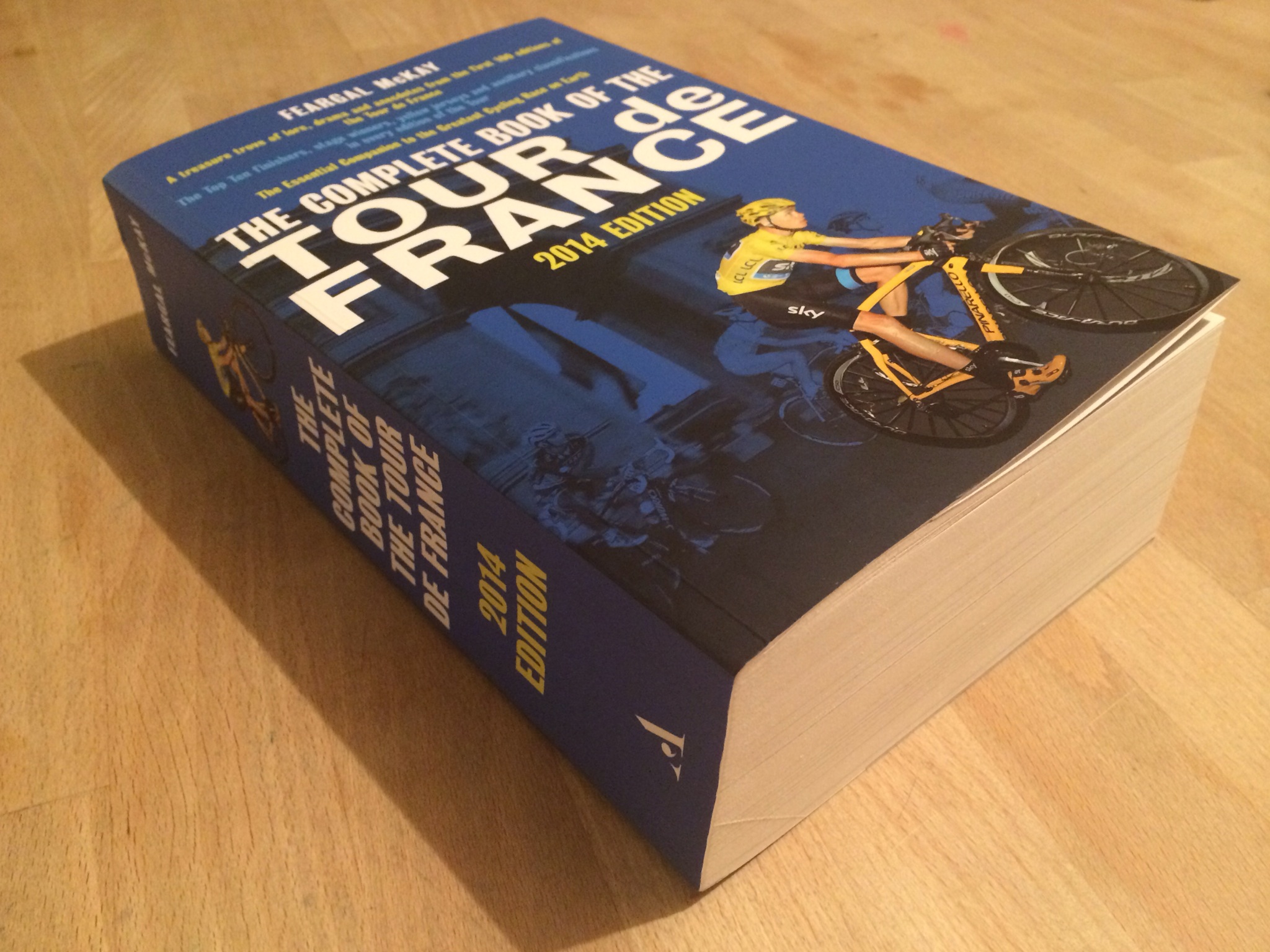
Feargal McKay’s “The Complete Book of the Tour De France” (Aurum Press, £25 Hardcover) is by no means pocket-sized. Even in this pre-release paperback format it weighs something close to an Arenberg cobble and, in the new hardback edition that will be released on June 5th, it would probably do similar damage to a speeding front wheel*. But unlike the famed pave blocks that will define Stage 5 on this year’s Tour, this heavyweight cycling compendium can tell you everything you might ever want to know about the Grand Boucle. The old saying that “Knowledge is Power” certainly becomes more compelling when the source of knowledge that you are quoting from could also be used to knock your enemies senseless with a single blow. Try doing that with an iPhone…
mckay 1

The presentation of apparently endless facts about an annual bike race run in (roughly) the same format for over a century could ostensibly be a dull task to assemble and thereafter be an even duller task to read. Most encyclopaedia’s try to get around this issue by making sure there are a liberal amount of maps, diagrams and illustrations peppering the facts. Pears’ went a degree further by introducing a dozen or so ‘Special Topics’ to each edition. Sitting alongside the more usual Scientific, Historical and Geographical facts, these Special Topics brought some more subjective discussion and debate to the otherwise potentially mundane world of the almanac. More importantly they also delivered some context, personality and story to much of the rest of the book. In order to provide some context to the dry facts and figures that he has meticulously assembled, McKay has also wisely chosen to tell the stories behind the Tour’s various editions and developments, covering its scandals and glories in order provide a definitive statistical account of the Tour and the circumstances under which they were achieved.

And he has done it very well. McKay’s writing has an easy, conversational style that makes you imagine that you are listening to a learned friend telling you about each Tour. Knowing of his Irish background lends an accent to this imagined narration and the book, surprisingly for something that you had expected to be a simple compendium, quickly becomes more of a fireside Jackanory, to be consumed over many evenings, one chapter at a time. Time moves on but the roads and mountains remain and the wheels still turn to conquer them.

So, where to begin? Not necessarily at the beginning. McKay has naturally arranged his book in chronological order (and consumed that way the accompanying narratives would build to give a comprehensive – and comprehensible – understanding of the Tour’s progress through the decades) but one of the real joys of an almanac is that you don’t need to devour it in any particular order. In fact, there is a strong case for saying that you should never actually read it at all. Instead you should either consult it for a particular reason (just who was the Lanterne Rouge in 1937?) or you should just browse in order to allow it to reveal it’s secrets to you in a random, chance-like fashion by flipping pages until a word or name catches your eye. Anquetil, Aucouturier, Alpe D’Huez; Pottier, Pantani, Puy de Dome; Garin, Gimondi, Galibier… It’s an Aladdin’s Cave of Tour History, Tour Geography, Tour Science and Tour Politics. All you have to do is walk in..
mckay 2

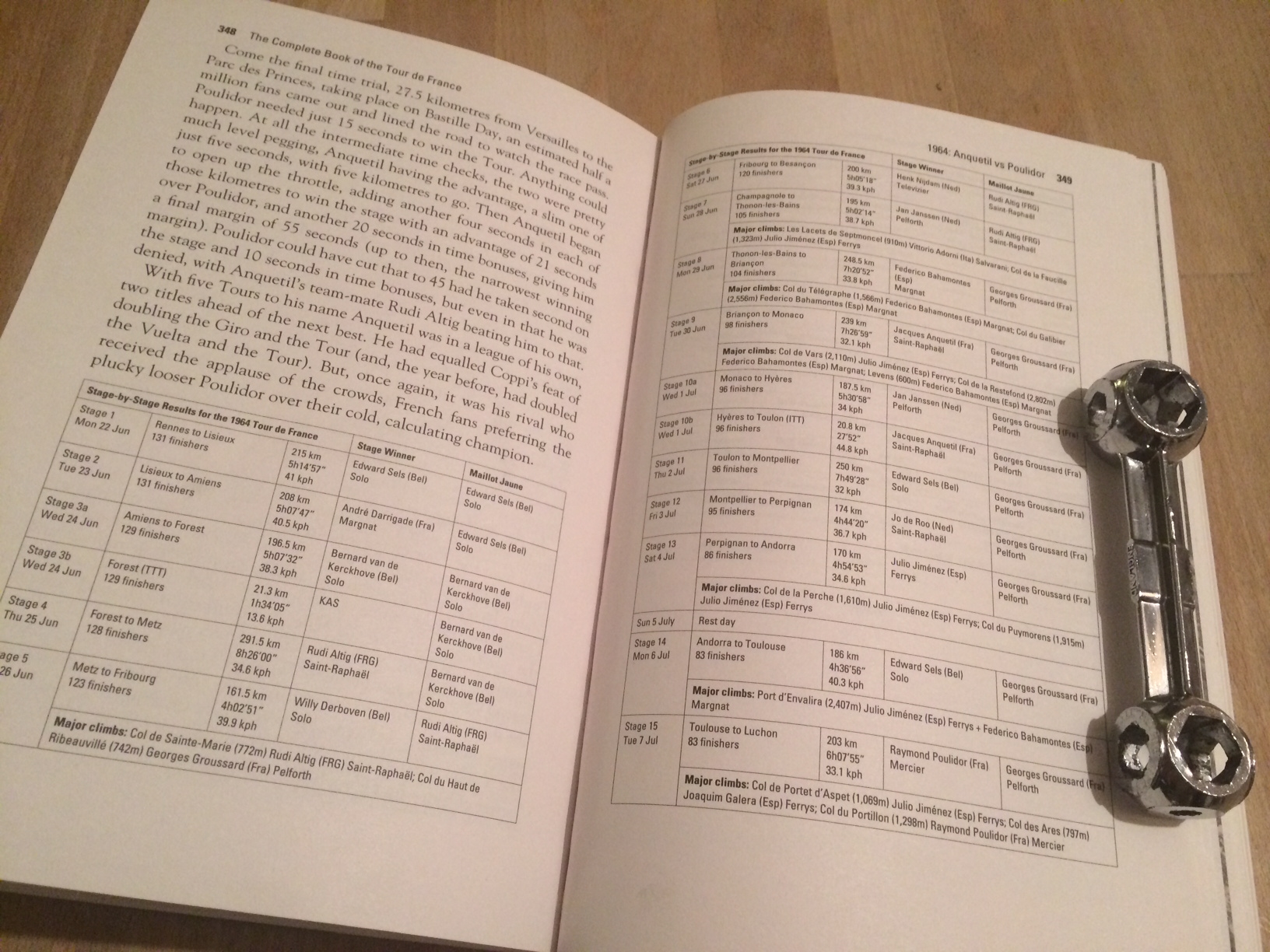
The stories that you find next to the stats change as the motivating forces behind the Tour change from the requirements of marketing to requirements of politics, which in turn give way to commercialisation, which in turn give way to a need for regaining credibility. Throughout the main characters rise and fall as time takes it’s inevitable toll on all and yet the lists goes on. The charts at the end of each Tour story are presented in the same prosaic fashion throughout and, stripped bare of all the drama, intrigue and effort that the narrative has just given us, returns the riders to the immortality of the statistic. All are equal. Geants de la Route.

I would dearly love to see a future edition that included simple maps of each running of the Tour. Done in a consistent way, which was in keeping with the unchanging tables of Stage and Overall Winners, would not spoil the power of their simplicity but would add an extra dimension to the ‘Completeness’ of the book and would help chart the early decades of growth in particular. I don’t think the postmen around the country would thank me for adding an extra 50 or so pages to the already weighty volume but I think the cycling buffs (who will hugely enjoy this excellent book without them) definitely would.

Aurum Publishing are offering a free copy of The Complete Book of the Tour de France as a prize in the very first Jersey Pocket competition. Just send an email to thejerseypocket@gmail.com and a winner will be picked at random on June 5th.

* 02.06.14 update – Aurum have confirmed that the published book will be a paperback, not a hardback as initially intended.
Pantani:The Accidental Death of a Cyclist – Film Review

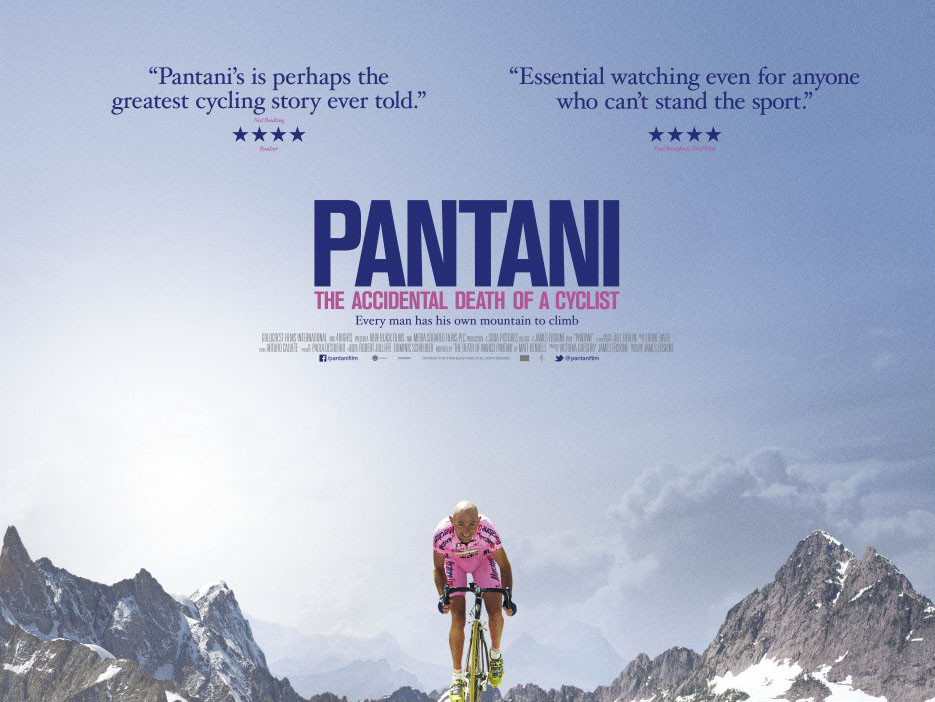
The new Marco Pantani film had its premiere in London’s West-End this week. I went along to see the film and also spoke with director James Erskine about it.

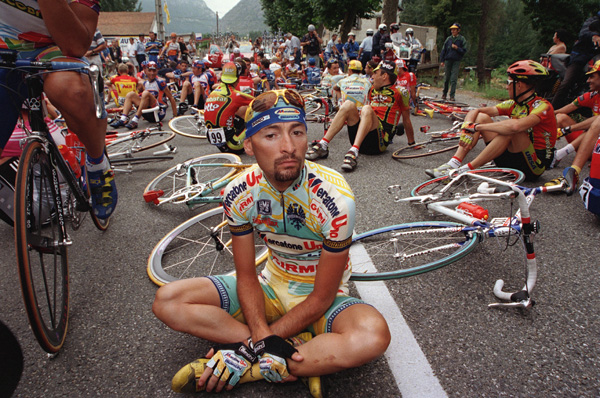
Often alone on the mountain climbs upon which he made his name. Ultimately alone in the Rimini hotel room where he died ten years ago, aged just 34. Always, it seems, alone in his own uncomfortable skin. For a man adored and feted throughout Italy for his cycling achievements and celebrated far further for his exhuberent verve in the saddle, Marco Pantani always remained a loner. Even when he was at the very centre of things – both good and bad – he somehow appeared detached. A riddle. An enigma. And that is what drew many of us to him.

Quad_AW_Pantani_FINAL

James Erskine’s new film, Pantani: The Accidental Death of a Cyclist, makes no judgement upon the man known in turn as Little Marco, Elefantino and Il Pirata, and in the Q&A following the premiere in London on Wednesday night, the write-producer-director Erskine made no bones about that omission saying, “We wanted to make an emotional film and show the human cost.” he explainedIn contrast to many recent cycling films, the director’s own presence is non-existent in the finished piece and the audience are allowed to make up their own minds as the whether he were ‘Pantani The Saint’, ‘Pantani The Sinner’ or someone struggling with both titles and wanting to be just Marco.

Life is much easier when our sporting heroes and villains are one-dimensional. “Four Legs Good. Two Legs Bad.”  is easily modified into “1990’s Bad. 2010’s Good” but we all know how that black and white simplification played out in Orwell’s Animal Farm. Despite everything that has happened since Erskine started making his film 3 and half years ago, Lance Armstrong has managed to continue to polarise opinion, still loved and hated in equal amounts, but Pantani always walked a greyer line. Even before the film starts we bear witness to the truth. The BBFC certificate gives the film a 15 rating, pointedly noting that it includes “Drug Use, Injury Detail”. There you have it: in the most literal black and white. We know he cheated to win. So why do we feel differently about Pantani than we do about Riis, Ullrich, Virenque and Armstrong? Why is there always a question mark with Pantani’s legacy?

The very fact of his untimely death is obviously the key point in that it allows his sporting frauds to be viewed as part of a wider tragedy from which he could not ultimately be saved. Conspiracy theories crop up in the film about his fall from grace in ’99 – the pivotal moment in a career that had already been beset by disappointment and terrible injury – but they seem a side story to the main theme of a little boy lost in the world of men (a phrase which Erskine echoes in our conversation). An innocent. Such a thought would never occur about Riis, Ullrich or Armstrong who were as calculating as they come and who, in the case of Lance in particular, would seemingly stop at nothing to win. They all wanted to lead. Perhaps Pantani just wanted to be followed.

TARASCON/LE CAP D'AGDE

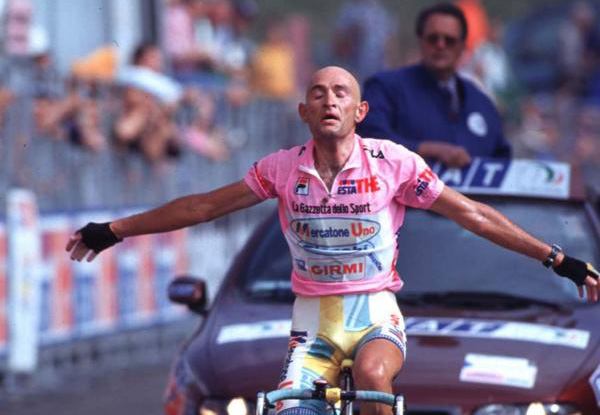
There is also a school of thought that suggests it was Pantani’s destiny to be deified and that the manner of his racing subliminally encouraged this. The repeated rises from the dead to claw back time in the mountain’s desert-like wastelands; the faithful disciples at Carrera who followed their messiah enmasse to the new team of Mercatone Uno; the outstretched arms crossing the winning line matching a crucifixion pose. His passing simply fulfilled this role as a tortured soul who struggled with greater highs and lows than those he conquered at the Galibier and Alpe d’Huez.

For  just one moment in the film we see the anger of Pantani. A still frame of a grimace as he achieves another mountain-top win. For the only time there is fire in his eyes. All the other times, even when battling hard, the eyes are searching for something that is missing. When they close in ecstasy as he wins, he seems to have momentarily found it. But then it is gone again and he is still searching, and we must search with him, for an answer that cannot be found.

The film expertly assembles a remarkable amount of archive footage, talking heads, evocative scenery and subtle reconstruction. The archive material is suitably grainy in quality and breathless in it’s commentary and thus is superbly contrasted by the high-definition vistas of the silent Dolomite and Alpine ranges that punctuate the various sequences. The talking heads are superb with valuable input from Greg Lemond, Evgeny Berzin, Bradley Wiggins and Matt Rendell, whose book The Death of Marco Pantani was a key source for the film. It is Pantani’s family though, and his mother in particular, whose words will last longest in the memory. For all the scientific jargon and shots of blood-spinning centrifuges and syringes which dominate the central part of the film, it is her simple warmth and still raw sadness that touches deepest.

montecampione

Marco Pantani wasn’t the de facto choice of subject when Erskine was first tempted into looking at making a film about cycling. “I’m intrigued by pain,” he says, speaking the day after the premiere from Belfast where he is finishing up his latest movie about the Northern Ireland football team taking on the Brazilians in the ’86 World Cup, “I’m interested in sportsmen absorbing pain and cycling seemed like a good place to look. The Individual versus themselves. A boxing film would have been too obvious.” James doesn’t count himself as a “proper cyclist”, though he watches it a bit and didn’t know of Pantani before being pointed in his direction by cyclist friends in the film industry. “I knew it would have to be someone from the Nineties for there to be enough of the sort of archive material I wanted and then someone suggested Pantani. I started with the obituaries, the English language books and videos. He was some who stood out from the pack. A maverick. Not a rebel but a maverick. Once we found Matt’s book I knew we had a story.”

Erskine tells the story in familiar fashion. The chronological history from birth to death is interwoven with the key achievements and events that defined the career. He likens the format to that of ‘Raging Bull’. We see the pirate conquering The Galibier in ’98 – all yellow wheels and saddle as he floats away in the rain. We see the empty victory atop the Ventoux ahead of Armstrong in 2000. Erskine uses a different filmic device to differentiate each significant win and to individualise them. Deployed partially to help the non-cycling audience they hope to attract and partially to give some texture to what might otherwise become a stylistic monotony of clips, I only noticed it for the first time during the Ventoux segment where I found the device chosen there a bit distracting. I asked James to explain the thinking behind this and highlight the other more subtle tricks they had used.

“We tried to give each segment a different feel to distinguish them. The ’94 Giro segment is quite straightforward but jumps around in time a little. It goes off and looks at something else and then comes back. We cut the ’99 Madonna di Campiglio sequence with whip-panned shots of trees. We were looking to take it faster and faster, punchier and punchier, higher and higher to give that  final hallucinogenic moment before the fall.”

It’s the fall that defines the film of course; Pantani’s dramatic descent into cocaine addiction following his expulsion from the 1999 Giro d’Italia for a high haematocrit level when over 4 minutes in the lead. That is what Erskine felt showed the key elements of Pantani’s character, “He had an extreme psychology. There’s guilt, shame and huge insecurity about a two week ban that many others had at that time too. What mattered to me was why did Pantani take that series of false steps afterwards? Why did he start using cocaine, which increased his paranoia? What was it that took him over the edge when he could have come back just two weeks later and raced hard again? Why did he go bonkers? It was all really intriguing.”

Finding the answers were not so straightforward as asking them. It took a long time to get the family fully on board. “We spent a lot of time talking to them. Being considerate. It was difficult for them to think about EPO and cocaine – they are grieving parents – but they understood that it needed to show both sides of the story. We showed them the film before the press launch in Italy and they did have some issues but I think that ultimately they respect the work.”

The director also delayed the film’s release by a year to ensure that they had all the family material they needed and it was a wise choice given it’s importance in the finished article. The film has already been released in Italy and, despite falling well short of exonerating their saint, it received a warm welcome from the local partisan audiences. The main wonder was why it was a British team making the legacy film. In truth the film benefits from the distance and balance that Erskine gives it and it’s hard to imagine that coming from an Italian source.

Ned Boulting, who along with The Times’ cycling correspondent Jeremy Whittle admirably hosted the audience Q&A  after the screening, said during his brief introduction before the film that this is ‘perhaps the greatest cycling story ever told’. Many, including myself, would take some exception with that but none would doubt that Pantani’s is the one of the great tales of modern cycling and after seeing the film I think that all would agree that here it has been expertly told.


Pantani: The Accidental Death of a Cyclist is released 16th May.|Visit Pantanifilm.com for details of screenings.

The Shattered Peloton – Book Review – Graham Healy

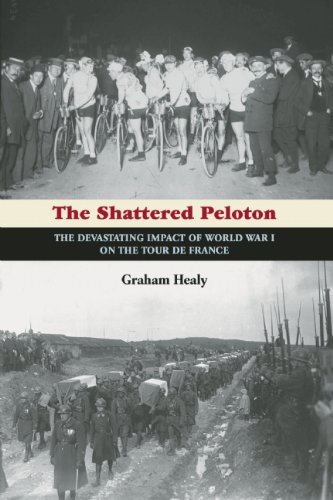
It’s not often that someone tells you that you are the very first person to have bought their book, but that’s the message I got when I followed a twitter link recently and bought an E-copy of “The Shattered Peloton – The Devastating Impact of World War I on the Tour De France” by Graham Healy (Breakaway Books £7.76 Amazon, £4.90 Kindle edition). Armed with such a privilege I thought that I should shelve everything else I was currently reading and get a review out in double quick time.

the shattered peloton

Like many others, I am intrigued by the history and geography of Le Tour and the other historical races, and the impact of World War One was clearly a defining moment in many of their infancies. As well as robbing the sport of a generation of young men, the war shaped our perception of many of the areas still visited by the Tour and the Spring Classics today. In this centenary year of the outbreak of hostilities, the Tour has shaped itself in recognition and respect of the upheaval and sacrifice caused by what was known for a very long time simply as “The Great War”. Similarly the 2014 edition of Ghent-Wevelgem was renamed ‘Ghent-Wevelgem in Flanders Fields‘ in tribute. Healy’s book is a wonderful, timely extension of the respect that cycling is paying to the anniversary.

It is also a very good political history book with, amongst other excellent dissections of the ebb and flow of the War on it’s many fronts, one of the most succinct descriptions of how Archduke Franz Ferdinand’s death, which occurred on the same day that the 1914 Tour de France commenced, snowballed into such a mega-conflict a little more than a month later.

Cataloguing the destruction wreaked on any particular set of people by a conflict of such magnitude must have been a relentlessly grim task. The well-researched book opens up doors to give glimpses of riders who have remained unheard of by most for many, many decades, only to have to close them again swiftly as their lives are snuffed out by shellfire, bullet, or bayonet. Professional cycling is a sport inhabited by young fit men and, whilst the book does make mention of some of those who were lucky enough to survive the conflict and resume their careers, most of the tales end in a headstone, a mention in dispatches, or, most poignantly, an assumption of death in lieu of any physical remains.

As we know, war is no respecter of personal history and alongside the names of lesser-known rouleurs are names of giants of the sport who had carved out their legends in the early years of the professional cycling scene before heeding the call to War. Many went eagerly in the first call to arms, in the mistaken belief the War would be brief and decisive. Many cyclists, adventurous men by nature, took to the skies to the early air force regiments where the death toll was even higher than in the trenches.

I was going to mention some of the more famous casualties at this point but, on reflection, that seems to miss the point somehow. You will find them in the book, along with the stories of the lesser lights, but I will leave them all equal in their sacrifice. “Cyclist. Killed in the Great War.” Though some excelled more than others a la velo they all shared the same fate and should be considered equals for that at least.

The Shattered Peloton is a hard-read in the sense that there is no ‘happy ending’. But as a record of achievement, loss and unfulfilled potential, it’s hard to think of another book that is as valid as this one is this year.

As I mentioned earlier, the names of the fallen are many and, in many cases, obscure to modern readers. My sole request for the second edition would be the addition of a index of the riders at the back of the book. Name, Date of Birth, Cycling Honours, Date of Death. I think that would make navigating the bell-tolling pages a little easier, and certainly aid revisiting the text in search of a fact in the future.

The hardcopy of The Shattered Peloton is currently available for pre-order. It will be released on 10th June. The Kindle version is available for download now.


The Velo House – Birth of a Cycle Club – Part 3

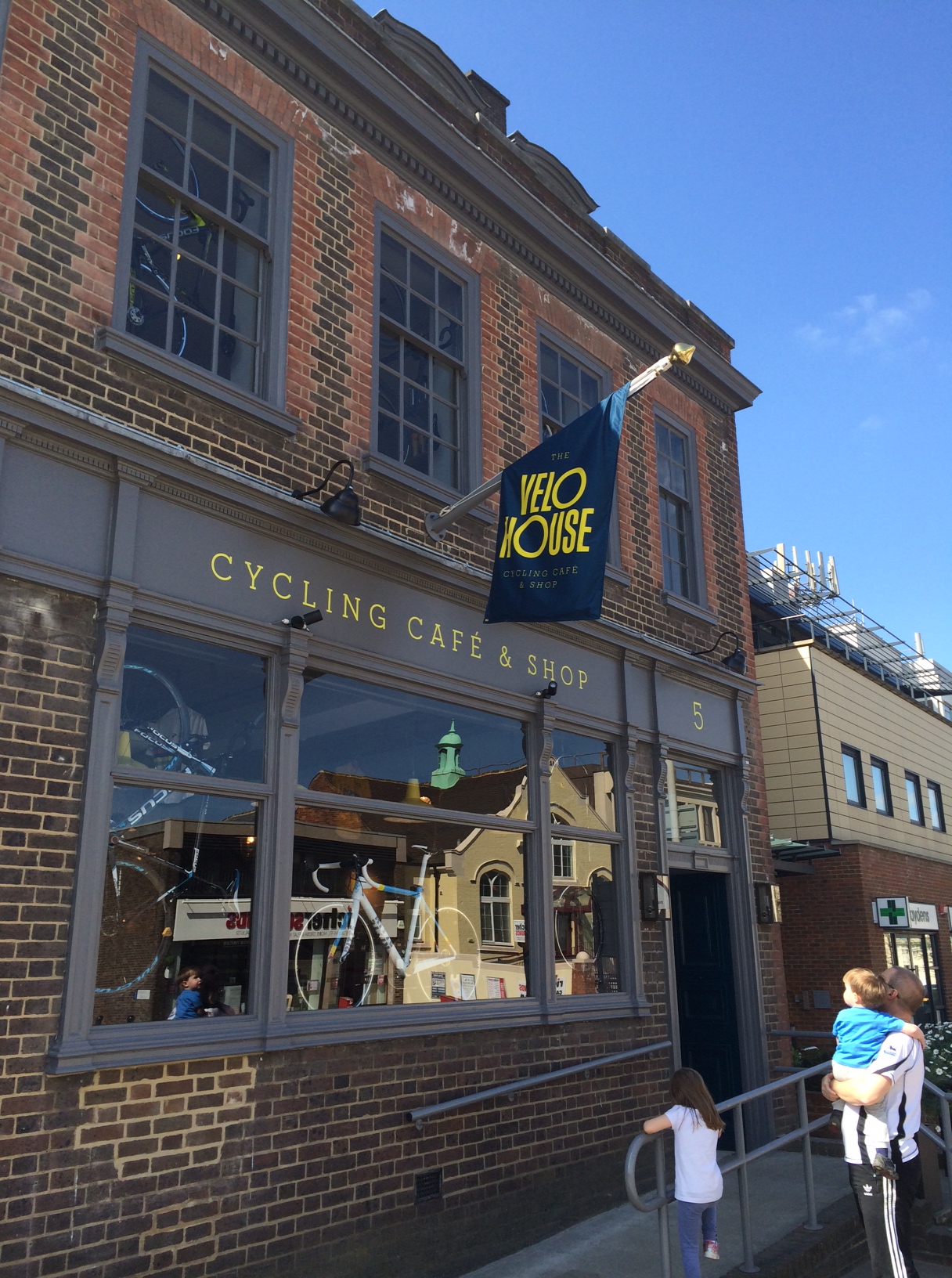
exterior

Read Part I of the VeloHouse story here and Part II here.

April 13th 2014.

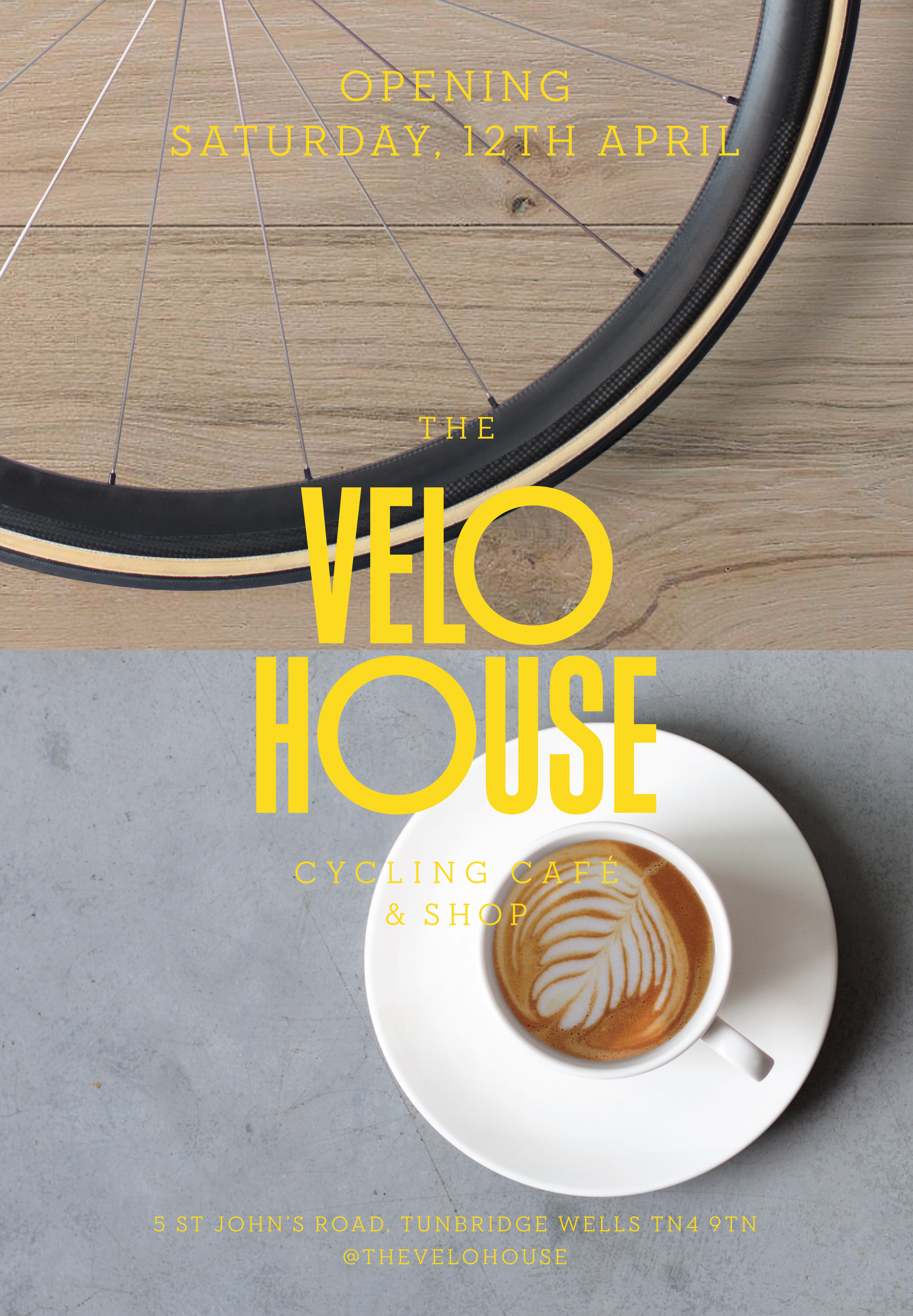
After two years of planning and four months of building, blue skies and Spring sunshine welcomed the opening of The VeloHouse cycle cafe & shop in Tunbridge Wells last weekend. I was more than happy to coincide a visit to the completed project with the chance to take my family to watch this year’s edition of Paris-Roubaix on a big screen with some good food and a few beers close at hand.
 
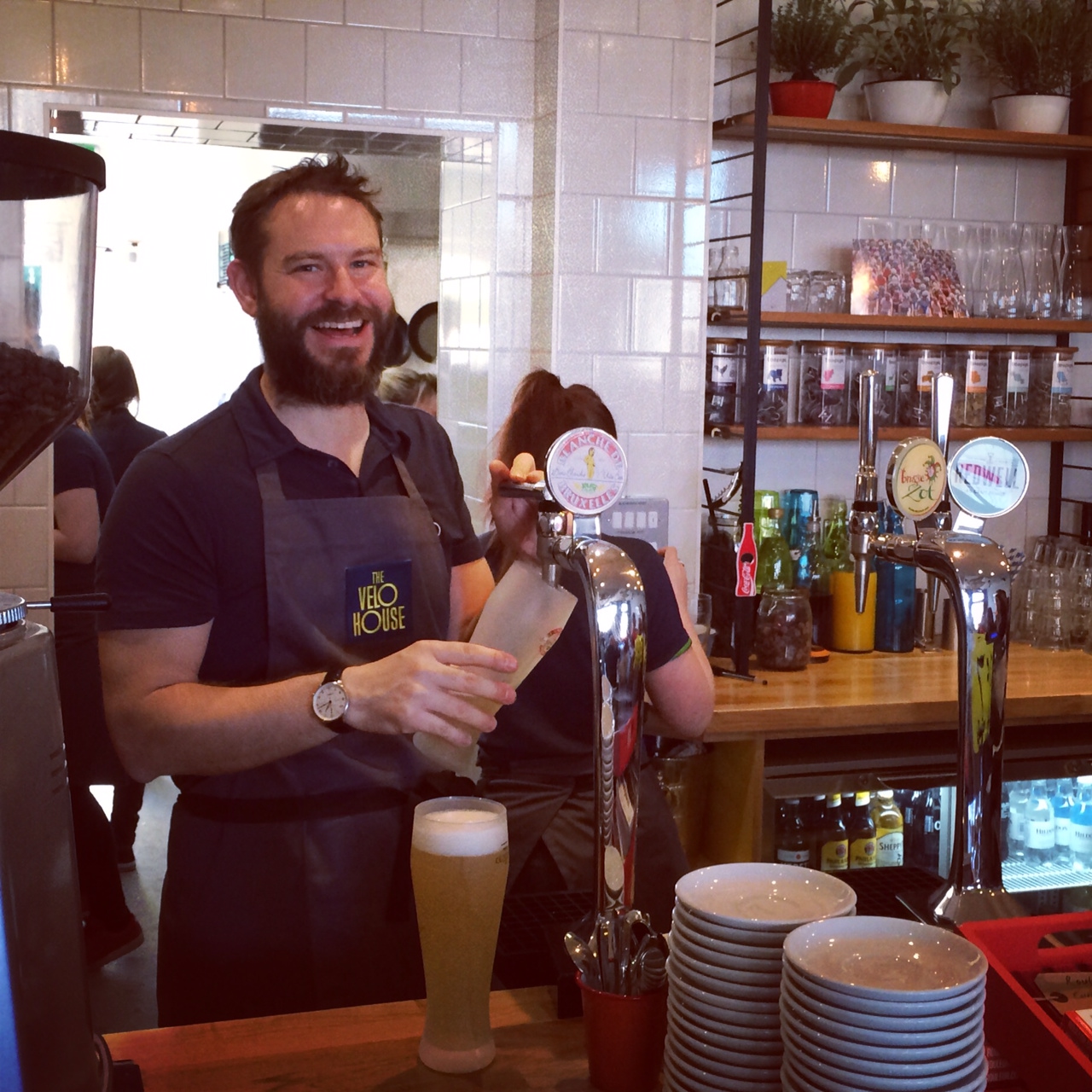
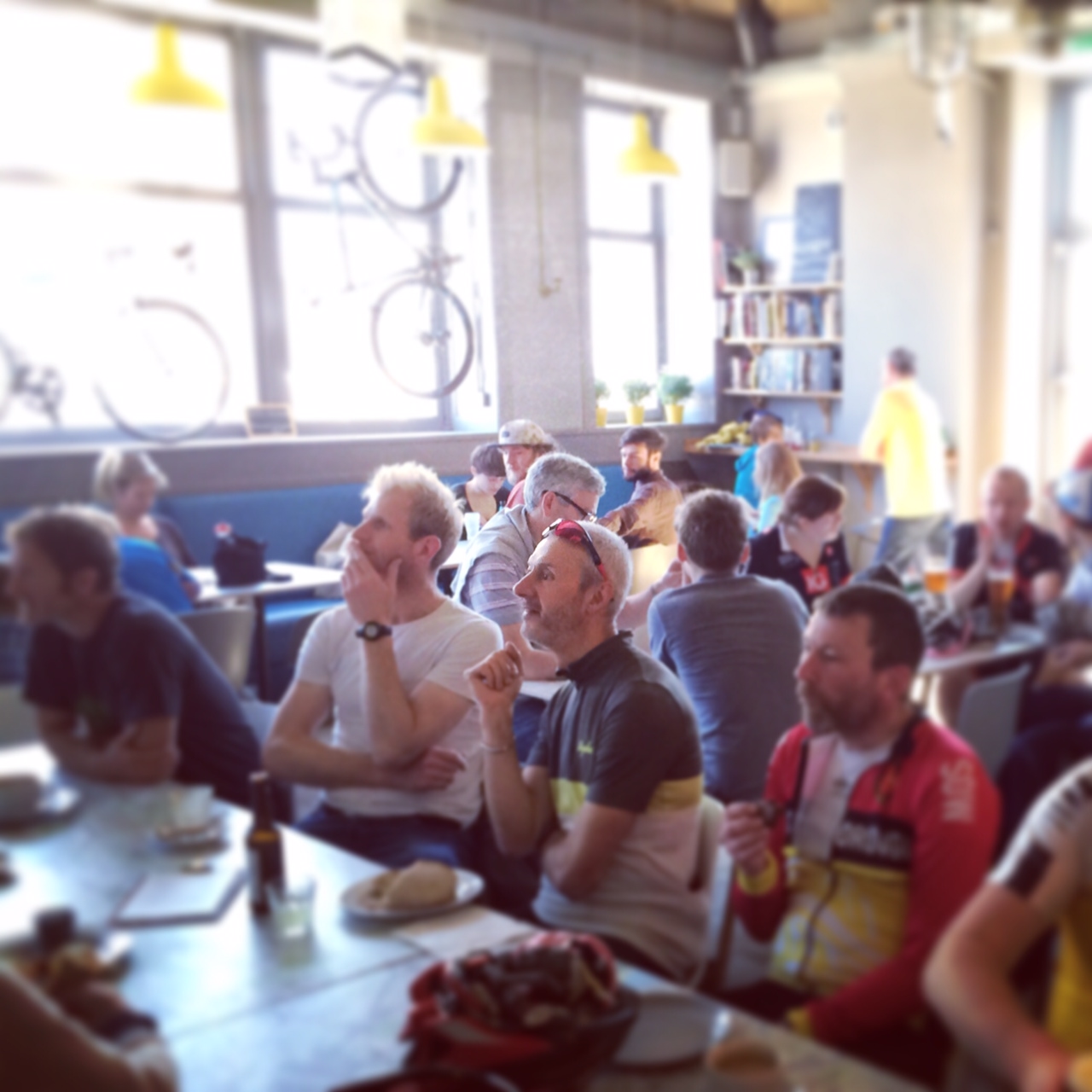
We drove down from Blackheath after cheering on the London marathon runners leaving Greenwich Park on their long, hard journeys around the capital. Having spent the last few months following owner Olly Stevens’ own long, hard journey towards this moment, it was hugely gratifying to walk through the doors a little after noon and not be able to find a free table to sit at. The ground floor cafe, bathed in beautiful sunshine, was packed to the exposed concrete beam ceiling with lycra-clad cyclists, coffee-loving couples and a fair few family groups. Olly, manning the cafe’s bar, with a large team of helpers in the kitchen all decked out in their new VeloHouse uniforms by Vulpine, looked to be in his element.
 
olly at bar
 
Despite being brand new, there was no hint of awkwardness in evidence amongst the staff or customers and the cafe buzzed with an ease-inducing atmosphere. The large, communal main tables and lightly industrial decor lend a welcome informality to the place. The mix of various chairs and banquette seating also set the relaxed tone straightaway. As some of the Sunday cyclists moved off to finish their ride we eventually bagged a smaller table beneath one of the bikes hanging in the main window – a Ritte with a striking paint job – and settled in for the afternoon. Our two boys were quick to spot the day’s free WiFi password – a nod towards Bradley Wiggins’ most famous year – and settled down to amuse themselves until Roubaix really hotted up. They re-surfaced a couple of times with requests for frites, sausage sandwiches or apple juice but were quickly at home in what is a pretty child-friendly venue.
 
Southborough Wheeler’s – one of the many local clubs – were much in evidence and, judging by the beers on their tables, they had already completed their ride for the day. Most were staying on for the race and the sense of the existing friendships that they, and many of the other customers brought, provided a warmer, more approachable atmosphere than is usually found in London’s cycle cafes.
 
cafe crowd
 
As the Pro Teams hit the Arenberg we began the similarly tricky task of picking a way through the food menu and extensive (mainly Belgian) beer list. We paired a non-alcholic Jupiler beer with a Beetroot superfood salad, and a large frosted Blanches De Bruxelles with the VeloHouse club sandwich and a cup of twice-fried frites with the inevitable dollop of mayonnaise. All were excellent. The cakes on display looked equally tempting and, if I had earned them by riding down, I would have been able to give a verdict. Next time maybe..
 
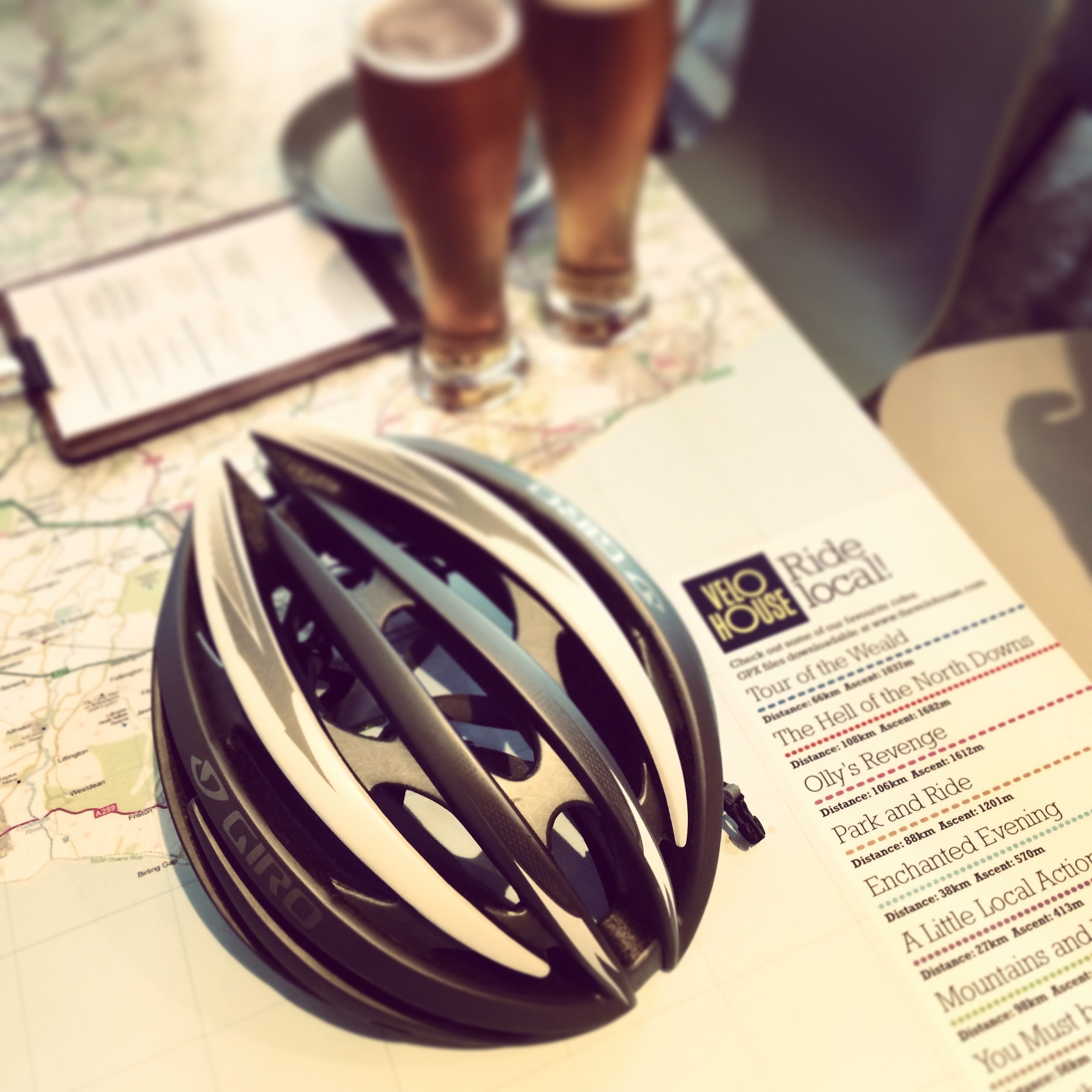
The cafe works really well. There are a few nice simple touches – like the lending library of books and magazines in the corner  – which work alongside the more sophisticated things that Olly had envisaged from the start such as the CCTV showing the bike park at the back. The local area maps printed on the larger tables have also been thought about too and some route suggestions have been included on them. GPX data of the routes – which range from the easy 38km ‘Enchanted Evening’ right through to the arduous sounding 143km ‘Beast of the East’ and the 106km climb-fest that is ‘Olly’s Revenge’ – will be available on the VeloHouse website when it goes live in a couple of weeks.
 
workshop
 
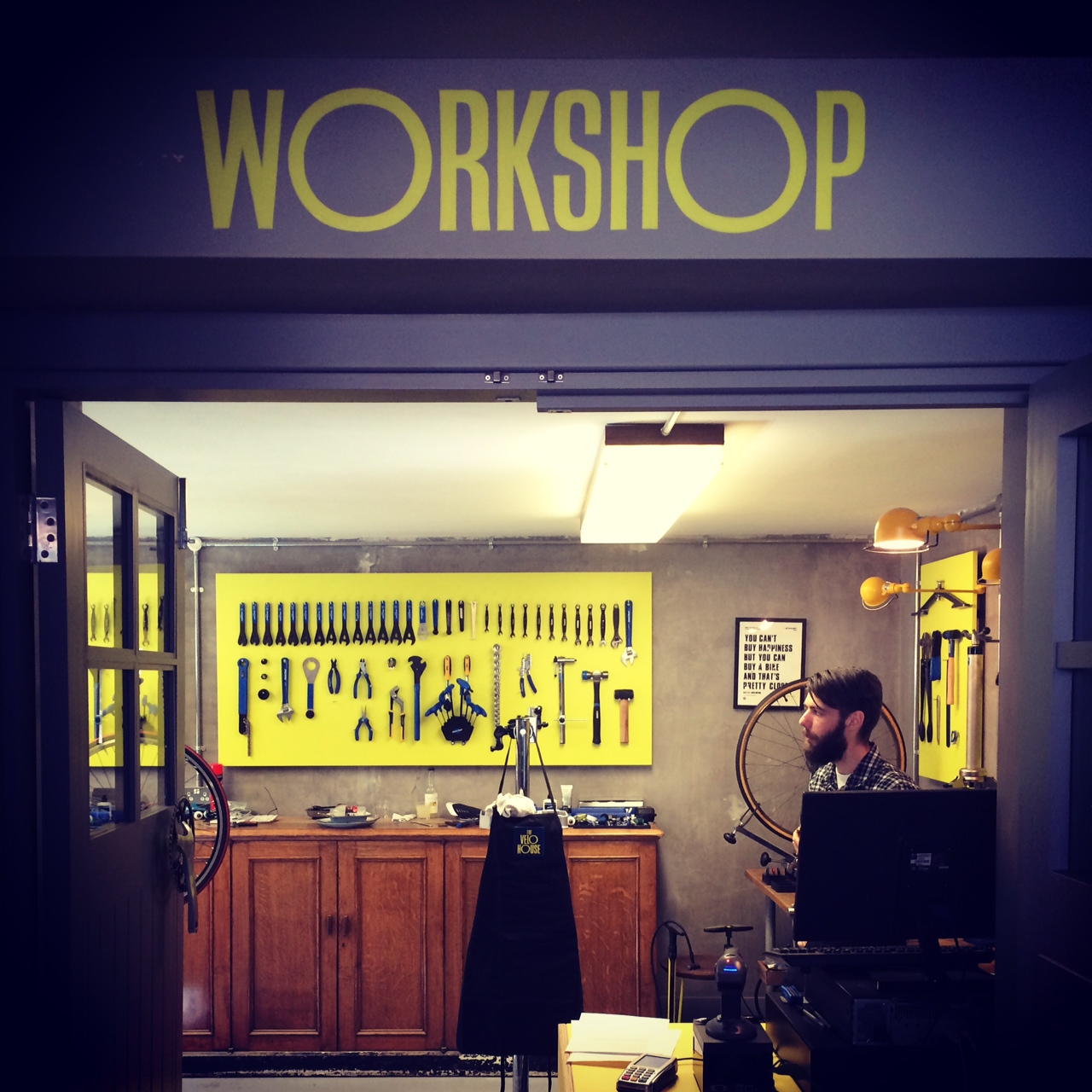
At the back of the ground floor, The VeloHouse mechanics were hard at work in the eye-catching workshop. Simultaneously building up new bikes for the shop upstairs and already with customer’s services and repairs booked in, they looked to be very busy far beyond the opening weekend. The space isn’t hidden away like so many bike shop workshops and they were happy for me to look around and watch them work. Like everything else it’s an integral part of the concept and the workshop in particular will provide a valuable link between the cafe downstairs and the shop space upstairs.
 
With the first and second selections being made in the pave of Northern France and the leading group being whittled down and down, we had to wait for a quiet moment before popping upstairs to check out the shop. There is the well-balanced, tasteful range of bikes on show (which have been covered in previous articles), a sophisticated set of accessories and apparel including some nice bits from POC (which, having laid eyes on some of the kit they are making Garmin-Sharp wear, I never expected to hear myself saying) and also a quieter area with another TV so you don’t miss the action whilst having a browse. We found Olly’s wife, Sophie, chatting with the shop manager and picked her brains about the clothing range and checked out on how the test evening hosting her Kent Velo Girls group had gone earlier in the week. She felt that it had gone really well and was very useful to the VeloHouse team who were sharing their vision widely for the first time.“They know us well so they felt able to give a lot of honest feedback and we are taking that onboard already. Getting more women’s bibshorts is a definite must!”  As well as talking about the POC range we also admired the Cafe du Cycliste ranges, which Olly and Sophie had stumbled on during a trip to Nice. “There was this one guy in a little room selling this brilliant clothing,” she says. “We asked who made it and he looked surprised, ‘C’est moi, naturellement.'” Sophie reckons that their Madeleine gilet is one of the best products in the store.
 
shop shot
 
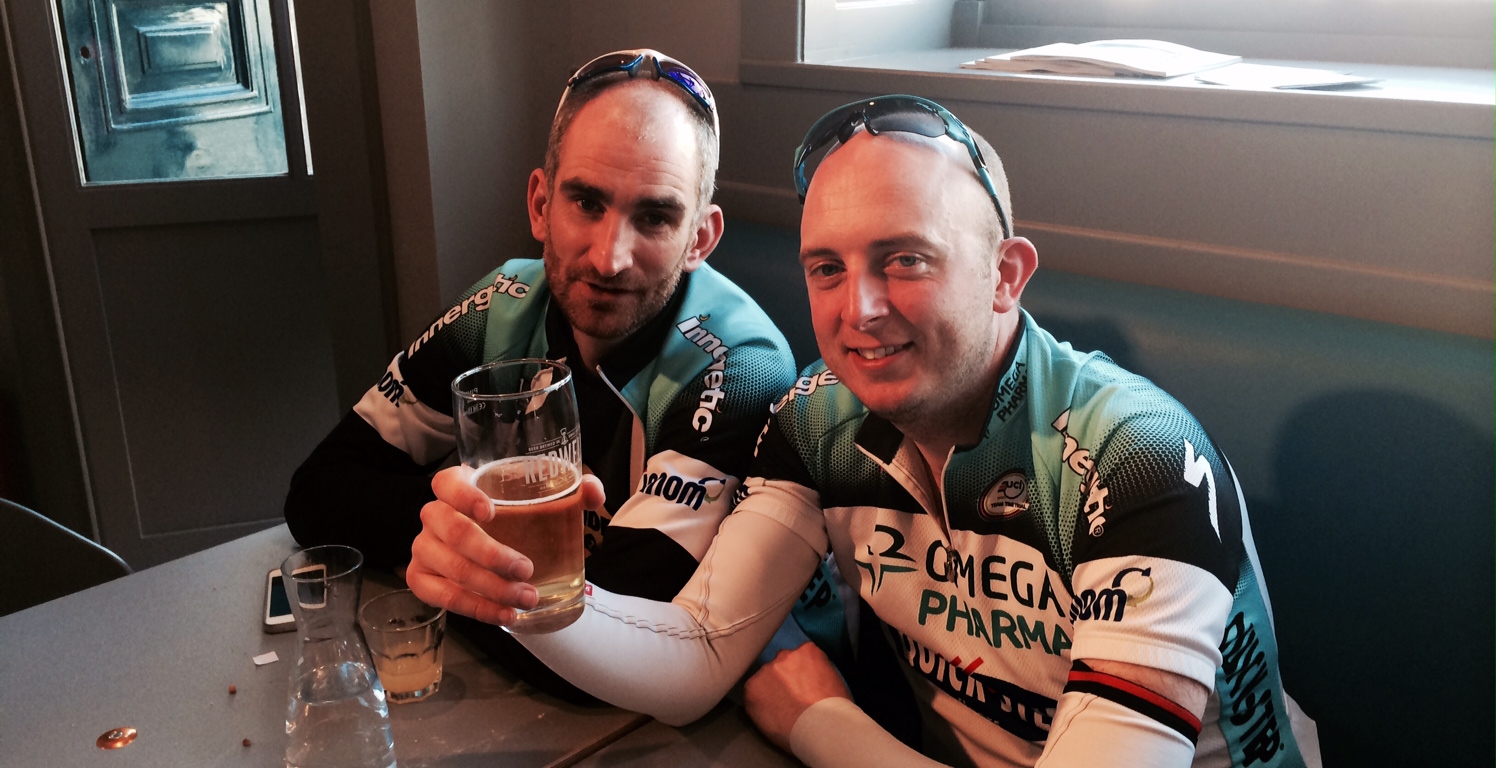
As the afternoon goes on and the secteur numbers count down one by one, more and more people turn their attention away from their food and concentrate fully on the screens downstairs. The whole place momentarily falls silent as Trek’s Hayden Roulston blunders off a kerb and seems to wipe out half the peloton. Greg Van Avermaet’s fall at Bourghelles brought a similar set of winces and groans from the group of assembled patrons. Ian and Tom, a couple of guys clad in full OPQS kit at the table next to us are clearly rooting for Boonen, Stybar or Terpstra but in the main the crowd are happy to see Thomas and Wiggins giving good accounts for the British contingent and just want to witness an exciting race. Ian tells me that he has given up a trip to Roubaix itself to come to The VeloHouse opening, which is a mark of how important it is being viewed in Kent cycling circles. Ian and Tom, who works for Quick-Step flooring here in the UK, are already planning their Grand Tour watching in what they describe as their new ‘local’.
 
Ian and Tom
 
Somewhere around the Carrefour de l’Arbre, Olly was finally able to extricate himself from his hosting duties and, in between beaming smiles, tells me how they ran out of milk a number of times on Saturday, necessitating multiple trips to the local supermarket just to keep the coffees going. “Fifty litres!” he says proudly. All family hands have been to the pump throughout the weekend too, with Olly and Sophie’s teenage daughter Izzy helping out on the cafe. She has also contributed to the project with a few design ideas. One of the first things I noticed on my trip upstairs was a light-hearted set of symbols under the hooks in the fitting rooms indicating Yes, No or Not Sure for possible purchases. “That was one of Izzy’s,” says Olly. It’s a perfect distillation of the un-precious VeloHouse style and is, as with everything almost else, done with an assured graphic sensibility that grounds and links everything in the place.
 
As expected, the realisation of the project did go down to the wire with a predictable last minute rush on the final day enabling the opening on Saturday to happen. The flag went up after dusk on Friday and the European satellite service – making viewing of the increasingly frenetic race possible – was also a last minute install. There is still much shop stock in the basement waiting to be unpacked and I suspect Olly will be tinkering with the layout and presentation of the elements for some time to come. The memorabilia hanging up in the cafe is a little sparse at the moment and needs to be fleshed out a bit in order to make a better contribution to the overall scheme. No doubt this will happen in time and, as mentioned before, the website will follow shortly along with the bike fitting service .
 
table 1
 
By the time Nikki Terpstra churns himself off the front of the leading group and starts his open-mouthed, gulping assault on the final 6 kilometres Ian and Tom are in full celebration mode. Indeed, as the Dutchman hoves onto the famous banked slopes of the Roubaix Velodrome, no-one seems unhappy with the result. Geraint Thomas’ last, short-lived burst in pursuit of Terpstra was of course greeted with an approving cheer but there was no sense of disappointment from anyone with either the day or the race. We had been treated to a magnificent race in an excellent venue and (although it is the the most cliched epithet imaginable) cycling was the real winner on the day.
 
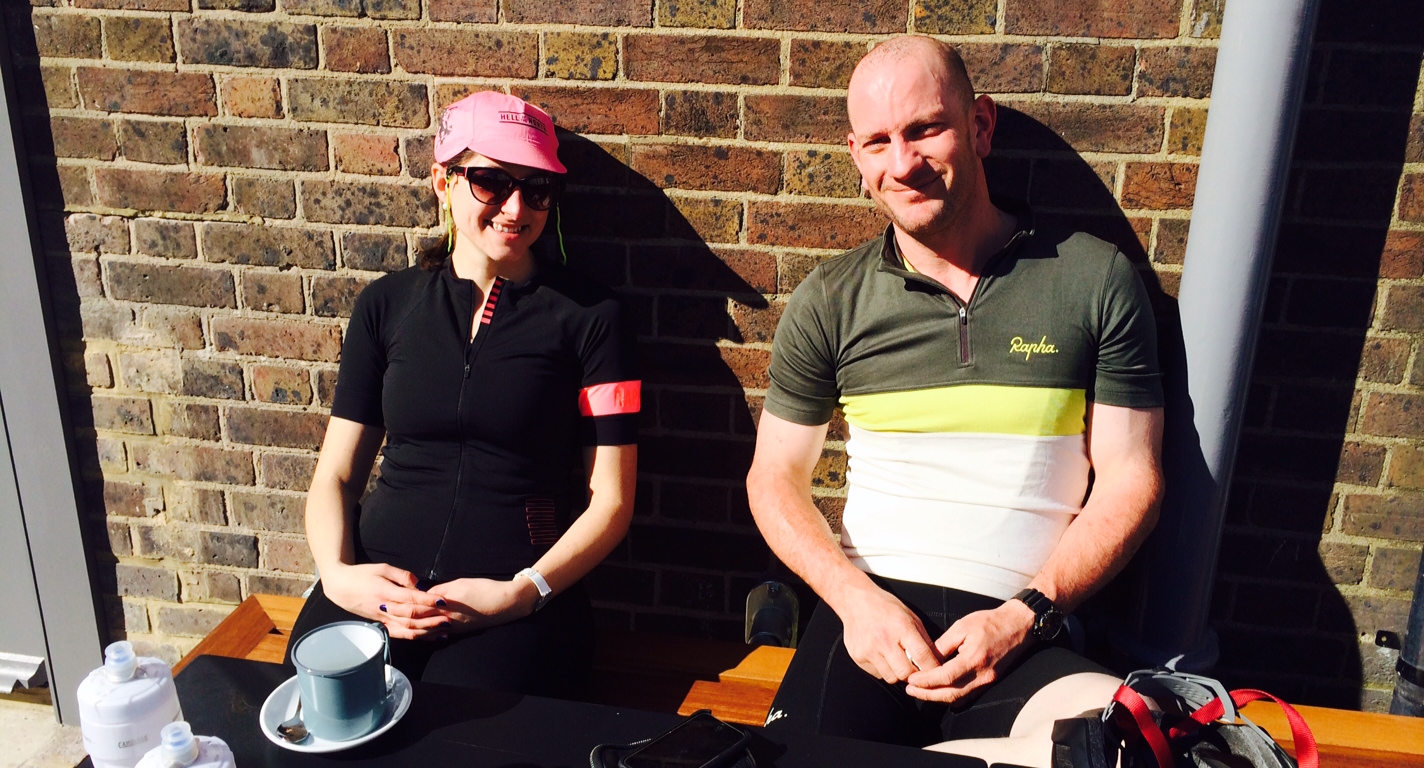
After the race we head outside to take advantage of the tables which are still enjoying the fullness of the late afternoon sun. There we find Laura, a Kent Velo Girls rider, and Ben who are are quick to praise Olly & Sophie’s achievement. “I can see me spending a lot of time here.” says Ben, only half jokingly, “I live and work near here so it will be very tempting.” Laura is equally enthusiastic. She works in the world of cycling retail and knows all about the potential pitfalls of brand building and market position. So, has The VeloHouse got it right for it’s target customer?
 
Laura and Ben
 
I canvassed another cyclist friend, also called Ben, who dropped by a few days later, for his opinion. He was impressed; commenting on the good bikes, the stylish staff and even on the fancy loo’s. He reckoned the hot chocolate was the best he had tasted in years but also felt that the all-important cake needed a little more work. The bottom line though is that The VeloHouse is the best cycling cafe for many, many a mile and our rides out from London into Kent will now need to get a bit longer in order to make this our regular pit-stop.
 
After the rush of the opening weekend, there will inevitably a settling-in period for The VeloHouse and the team. The menu will no doubt develop and the shop inventory will adapt to the needs and wants of the customers. I suspect that the late nights – currently limited to Thursdays – will grow over time if the successes of the Rapha and LookMumNoHands cafes are anything to go by. Olly is planning to show old races and cycling films on these evenings which is great but I’d also like to see special events like talks from the workshop staff or ex pro’s. Perhaps it’s a bit churlish to be asking for more when the place is only a few days old but I do think that Olly still has a few dreams up his sleeve and I’d like to see some more of them.


The VeloHouse is open 8-7 weekdays, (workshop from 7), late till 10 on Thursdays, 9-6 Saturday & 10-5 Sundays & Bank Hols

5 St Johns Rd, Tunbridge Wells.

twitter: @thevelohouse | www.thevelohouse.com


The Velo House – Birth of a Cycle Club – Part 2


the_velo_house-advert croppedRead Part I of the VeloHouse story here.

March 2014.

It’s almost nine o’clock in the evening when I get through to Olly Stevens for a catch-up about how things have been progressing at the VeloHouse project in Tunbridge Wells. The face on our video call looks tired but his day is still far from done. With only a few weeks to go until opening he will be working and emailing until at least 1am tonight. Ours is the second interview he has done since getting back home from the site where up to 16 vans have been playing a daily game of musical chairs in the car park as the building phase nears completion. A new door out to the car park has been completed this week, perhaps easing the congestion a little bit, and it has prompted Olly into a bit of reminiscing: “I used to meet my riding mate in that car park. Fifteen years ago, when I was living in Islington, I’d get the train down on the weekend to do the Ashdown to Lewes run and that would be our meeting point. It was good because it was central and, being the car park of a bank, it was always empty on a Saturday.”

I venture that it must feel good to be coming full circle and to soon have riders setting off from there again, but the difference being that now Olly is the owner of the bank building and the carpark. “Yeah, although we didn’t set out looking for an urban location initially so we didn’t foresee that. Once we decided on this building it really shaped the direction of the project a lot. The building has become a huge part of what the VeloHouse will be.”

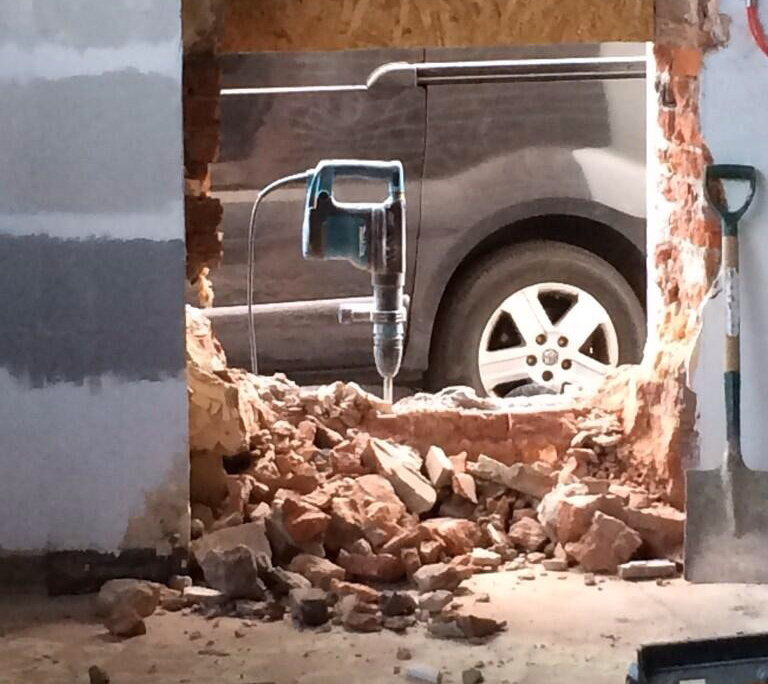
car park photo croppedBreaking through a new entrance to the old car park / new bike park

Having recently spent a lot of time out in the car park (which we really should be calling the bike park by now) directing vans this way and that, Olly has met quite a few cyclists who have seen the poster in the window and pulled up for a chat about what is coming. “It’s been a great eye-opener,” says Olly with a smile, “There have been all sorts of people stopping by, not just members of the local clubs; young people, families, seventy-year old guys who want to show you the bike they’ve been riding for the last 35 years.. There is more interest out there than I expected at the start.”

So will the VeloHouse be organising rides from the famous car-park? “No,” says Olly “We don’t want it to be just about the ‘VeloHouse Club Run’ – we want other clubs and other riders to use us as their base to start and finish their rides at. We want it to be open to everyone.”

Although Olly studied Economics at LSE and headed for the City straight afterwards, putting together a business plan and taking the first tentative steps towards the VeloHouse project were not a straightforward job. It took ‘three to four months’ to put the business plan together as he was ‘really starting from scratch’ and still working at IG at the time.

Originally Olly’s vision was for a mid-ride pit-stop place out in the Kent countryside. “I started out with the name Cog & Sprocket and was thinking of it much more like a country pub. We were still going to have the shop and workshop elements but the cafe side would have been more limited” he confirms. Finding the St John’s Road building and re-thinking the VeloHouse within a more urban location let the project grow in scope and ambition. But not before a frustrating game of ‘chicken and egg’ had to be resolved.

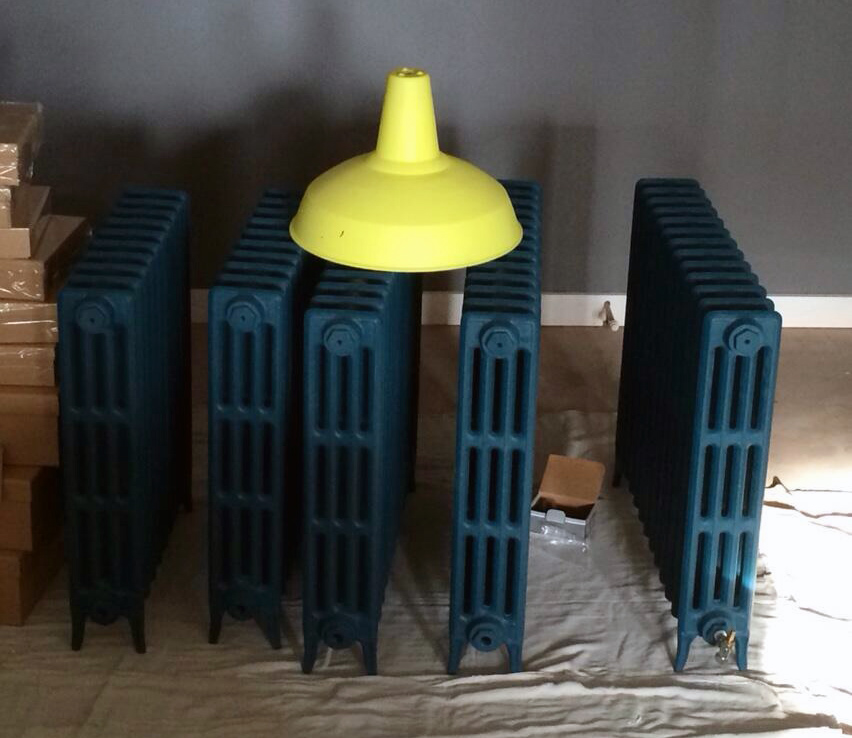
rads and lampVeloHouse signature colours on the radiators and lampshades

The VeloHouse has four main investors who are backing the project. In order to convince them of the project viability Olly had to secure a building. But in order to secure the building, the bank providing the mortgage wanted to know that the required investment was in place. Throughout late Summer and Autumn last year Olly battled to get over this single biggest hurdle. “I had originally approached seven or eight potential investors and four eventually came on board. But at that time it was very hard to move things along. It was probably the time where I most thought that it wasn’t going to happen.”

It was a tough time for Olly personally. “I had left a relatively well-paid job and was putting everything into this new thing. [My wife] Sophie has been my biggest supporter throughout the whole thing but it was difficult for everyone around that time.” Eventually the sticking point was resolved and the building was secured. “We first saw St John’s Road in August and knew it was right. We finally got the keys in early December and started onsite straightaway. The builder that we chose is a friend as well so we were able get underway really quickly.”

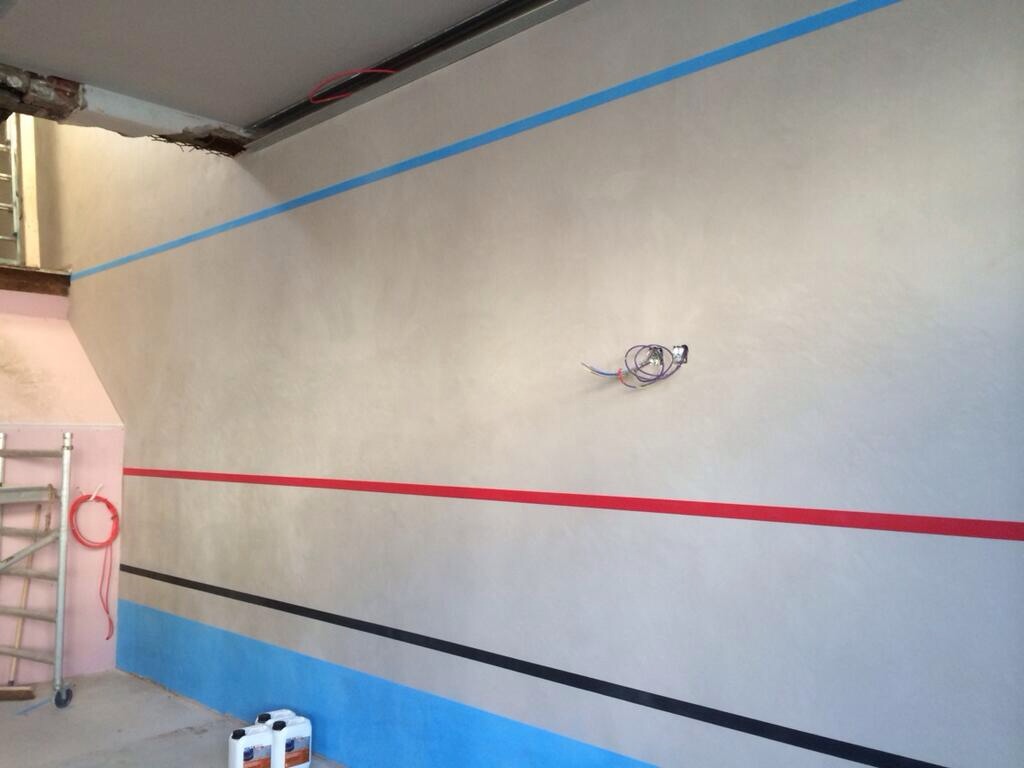
roubaix wallThe completed Roubaix wall awaits a staircase

The thing that strikes me most about talking to Olly about the VeloHouse is how is had grown over time and responded to new challenges or opportunities. We tend to have an idea that new business developments are fixed concepts which are rigidly processed through to inception but the VeloHouse, like many other dream projects, has had to adapt along the way. “We’ve had to shift some things in terms of suppliers who we wanted to work with.” admits Olly, “We’ve had to respect other cycle businesses in the area and not tread on their toes but we’ve also been able to add in products and suppliers that initially we didn’t think we would be able to offer.”

The bike and clothing range that the VeloHouse will open with is a good example of how things shift along the project timeline. A couple of the bike brands Olly was speaking to at our last meet are still unresolved and won’t be there for the opening, but he has been able to agree some alternates, and in one case, pull off something of a coup.

“I approached brands who I believed in.” he explains. “Ones I have used over the years and who support local bike shops – no high volume brands. Sigma Sport gave me good advice in the very early days and Focus were the first people I spoke to. They were very supportive and we’ve not really had to oversell the project to get people on board. “

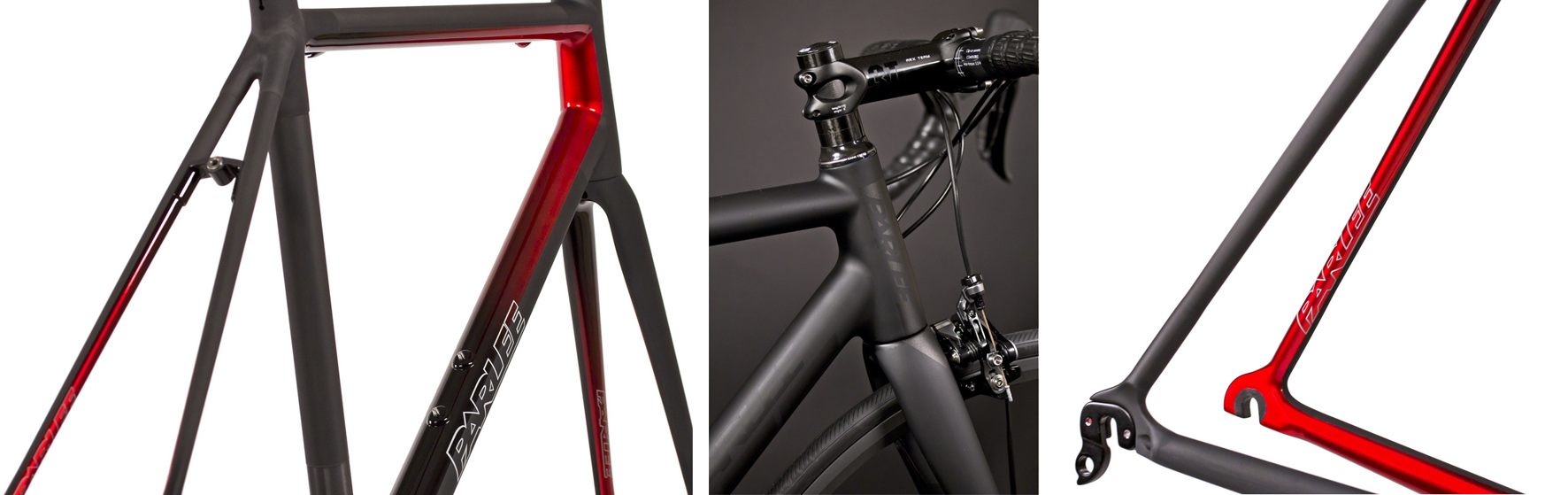
“One of the best surprises along the way has been Parlee,” continues Olly with a hint of pride. “I had approached them earlier but they wouldn’t agree to be a supplier as we are a start-up and had no track history. But when the agent came to meet me – he also represents Lightweight – and saw the space and what we are doing, he changed his mind. He came on the Friday and called back on the Monday saying, ‘The VeloHouse fits in perfectly with what we want to do. When you open everyone will be knocking on your door and we want to be here with you.’ It was really good that someone could see the vision even though the place was still a building site.”

parlee allParlee: seriously desirable carbon frames

This means that the VeloHouse will be one of just a handful of places selling Parlee’s gorgeous high-end carbon framesets in the UK. But Olly is keen to set out his vision that the VeloHouse is not just about super expensive bikes. “We will have a full range for all budgets. We wanted to make sure we have bikes from £600 so we are not too niche. It’s great being able to offer the ten grand dream bikes too but we’ve already got Focus, and have now added Colnago and Scott. Scott have a great range of women’s frames so with all those brands we’ll have something for everyone. “

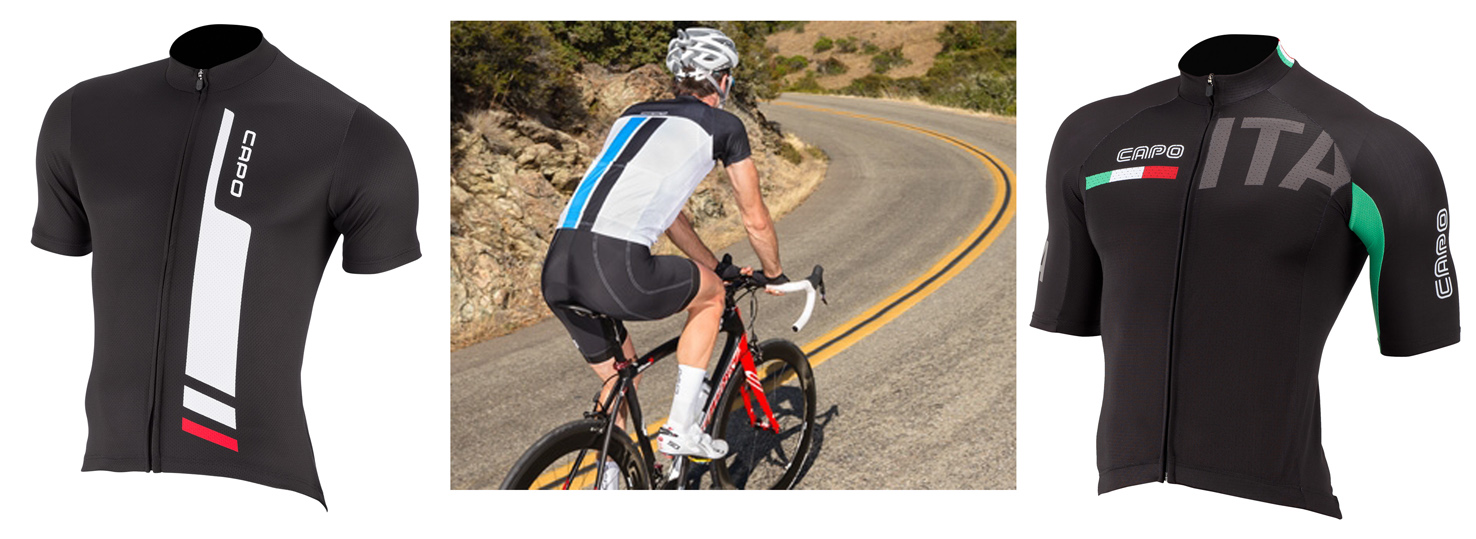
Olly has also been busy on the apparel side and, once again, his personal enthusiasm has paid off. “Gary Vasconi, the CEO of Capo, came over and loved what we were doing so we will be stocking their range too.” I wasn’t familiar with the name so asked Olly to explain more. “They are an American brand – I first saw them in Mellow Johnny’s in Austin – but nearly all their product is made in Italy.” As we have come to expect from the VeloHouse, it’s pared down, graphically restrained and very good quality. Likewise, Olly will be stocking Jersey Pocket favourite Vulpine, which also seems a good fit for the VeloHouse’s subtle approach of restrained design and high aspirations. Vulpine founder Nick Hussey wrote a great blog this week about the contrasting rewards and hardships of taking the plunge of starting your own cycle business. I’m sure Olly would see a lot of familiar things in there already..

capo allCapo’s pared down graphic style seems a good match for the VeloHouse

So what have the next couple of weeks and beyond got in store for Olly and the growing VeloHouse team? I already assume that there will be no letting up in the run-in to opening on Paris-Roubaix weekend but I’m wondering if Olly has taken time to look beyond the light at end of the tunnel, which is looming larger every day, and thought about the wide open spaces of the months ahead.

“My biggest fear is not delivering on what we have promised ourselves; of underwhelming.” he tellingly reveals. “We are fully staffed now with 13 people and training begins next week. We will be having some local businesses come in during the week before opening to test the cafe and the menu, and then we will be hosting Sophie’s cycle club, the Kent Velo Girls, for one of their regular monthly socials to test the evening set-up. There are about 180 of them!”There will be no relaxing before opening, that’s for sure.

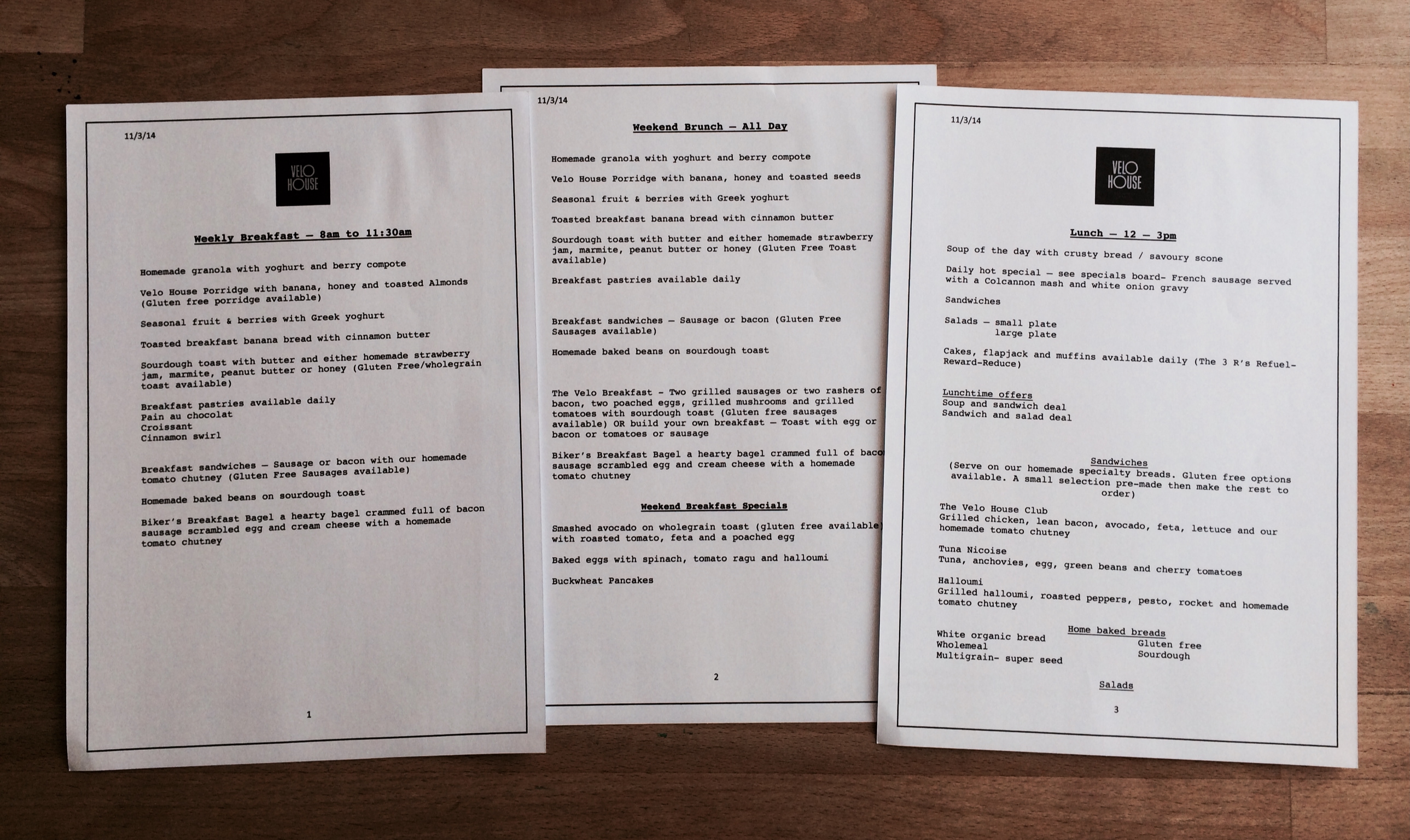
menuThe VeloHouse menu’s is big on energy, flavour and choice

And beyond that? Maybe it’s the tiredness in Olly’s eyes, and hearing that Sophie is also working late tonight on a design project presentation for the following day, that prompts me to ask if he has a holiday planned for later in the year. “Nothing concrete,” he concedes in another clear sign of how something like this takes over your entire life, “but Sophie’s family have a house in France and I’ll join them there at some point for sure.”

I’m relieved that Olly can at least imagine taking some time away from his new venture over the summer. At this moment, with the pressure of delivering the project at it’s height, that is probably the farthest thing from Olly’s mind. He will be 40 shortly after the opening of the VeloHouse and has alluded to the project being a classic case of a mid-life crisis. Starting your own business is a big brave step, but starting your own venue should, in theory at least, be something that you can also envisage enjoying taking part in as well as running. Finding that balance could be the next big challenge for Olly.

In Part 3 (read it here) we will see how the opening went and talk to the VeloHouse’s new staff and customers.

The VeloHouse will be opening in April 2014 at 5 St Johns Rd, Tunbridge Wells. | twitter: @thevelohouse

Interior Design by sgsinteriors and kiwiandpom | Brand Identity by morse studio

The Velo House – Birth of a Cycle Club – Part 1

velohouse-logo-tw-blue_yellow-CS3_twitter_icon

January 2014.

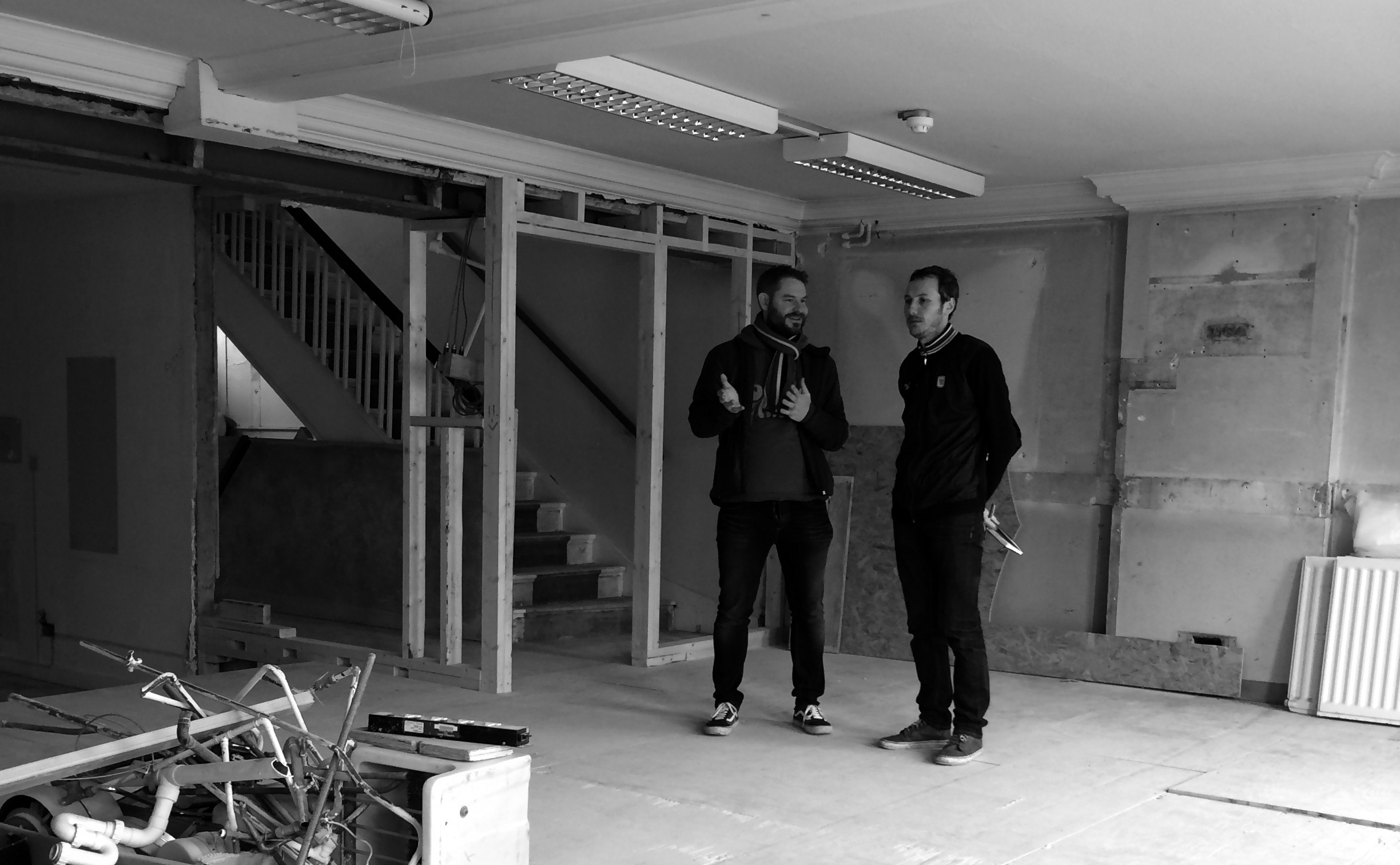
Olly Stevens is standing in a freezing building site, watching his dream slowly come to life. Off to one side, beyond the usual jumble of site lights, half-filled buckets and strip-out detritus, Juan Antonio Flecha’s 2010 Paris-Roubaix Pinarello frameset hangs rather forlornly on an unfinished wall. Aside from that, and a small poster in the window of what was once Tunbridge Wells’ branch of the National Westminster Bank, there are as yet no other physical clues about what he is creating here. For now it is still all in Olly’s head and on the blueprint drawings taped to the walls. He politely asks the builders to give us a few minutes quiet so we can talk normally instead of having to shout over the noise of the machines working on buffing up the mosaic floor that was revealed during the strip-out in December and which Olly decided to keep.

“The cafe servery will be over here, with the kitchen beyond. There’ll be big communal tables down the middle. The stairs will be over there – where they were originally before the bank took them out – going up to our shop space above. The workshop will be through there, behind the new stairs. Outside, we’ll have seating in what was the carpark and secure bike-parking in the enclosed courtyard at the back..”

IMG_8182 crop BW

Olly showing us around the shop space on the first floor

Continue reading

3D printing – cycling into the future, layer by layer by layer

The Future arrived last week. The postman delivered it to my house just as I was going out for a ride. It is, as far as I know, the first bit of 3D printing that has crossed our threshold but, given the way things are going, it’s unlikely to be the last. I delayed my departure a few moments to fix the new part to my bike and set off into Tomorrow’s World.

3D printing has been around in basic forms since the 1980’s but has only really start to gain significant traction in the public consciousness in the last 5 years. As hardware prices fall and material options soar, applications for what has also been termed ‘additive manufacturing’ are now looking immense. A shift of seismic proportions, at least on a par with the home computing revolution, is coming as we will change the way we both perceive and consume manufactured objects. A 3D printer in every home is not such a far-fetched idea and would have profound effects on the way we conduct our lives.

Bike_helmet_Bike_helmet_3D_printed_on_the_Objet500

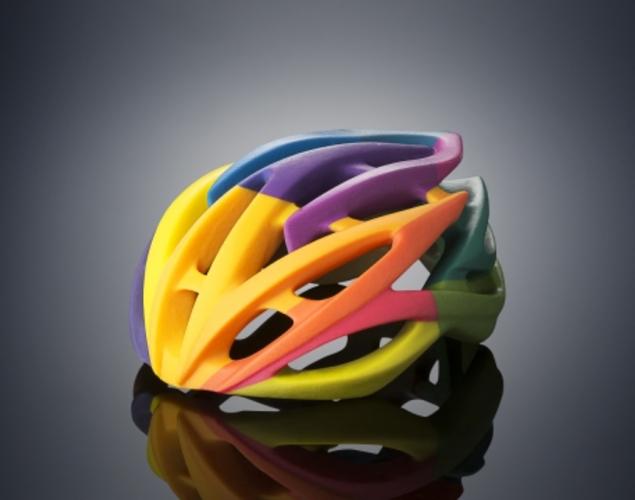
Multi-coloured, multi-material 3D prints will be the next generation. 

Continue reading

Dear Santa: Bike Books

Christmas is coming. Obviously we are all hoping for a big dump of snow around the 23rd to get us into the festive spirit, and then a week of glorious winter sun between Christmas Eve and New Year’s Day, so that we can get out on our bikes and feel like we have earned some of that mulled wine and chestnuts on our return. But, on the off chance that the weather is miserable for the whole week, it’s  important to get some good books laid down in preparation.

I’ve been dropping fairly unsubtle hints about the cycling books I’d like to receive from friends and relatives for Christmas for a good couple of weeks. Items have been added to public wish-lists, printouts have been casually left lying around the house in prominent locations, and specific instructions have been sent to those excellent souls who know the score by now and have already emailed to ask, ‘Which one this this time?’

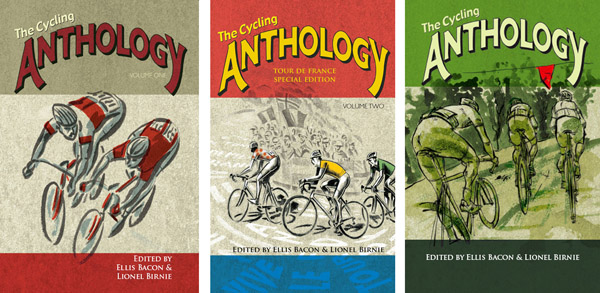
I did wade through a bumper crop last year and this year is likely to be no different; though there is not much room left on the heaving bookshelves of the Jersey Pocket HQ (AKA our compact Blackheath home). With that in mind this year’s first request will be a set of works that hopefully gives maximum bang for shelf-space buck.

2013-09-25-the-cycling-anthology-book-volume-three-3


Continue reading

SPIN x LCF – Christmas Cycling & Coffee Event

What happens when coffee and cycling come together? Normally it’s just a pacier run on the training ride but occasionally it can conjure up an entire event. 

SPIN teamed up with LCF (London Coffee Festival) for a free-wheeling, free-grinding, blend of coasting ‘n’ roasting in Shoreditch this weekend. Catching the Christmas mood (and the Christmas trade no doubt) was a big part of the reason for these happy bedfellows to put on a show together and each was equally represented with about 40 exhibitors each.  Alongside these were a good bar, a couple of food stalls and Rollapaluza. Entry was £1.75 in advance (just the booking fee) or £5 on the door.

christ-thumb

Continue reading

In The Court of the King – An Evening with Sean Kelly

For a man who made a career of letting his legs rather than his mouth do the talking, An Evening with Sean Kelly at Cadence Performance in Crystal Palace this week could easily have been a painful experience for both speaker and audience. Kelly makes no secret of the fact that he is not a natural raconteur but he was most certainly a natural competitor and, just like in his racing, his force of character and professionalism ultimately outweighed any potential shortcomings in what was a very enjoyable and illuminating evening.

Kelly’s autobiography, “Hunger” (£18.99 Peloton Publishing) – short-listed for a number of sports writing awards – is an equal surprise coming from the quiet man of Carrick-On-Suir. Ghost-written by Lionel Birnie, the story of ‘King’ Kelly’s racing career was wrestled from the five times world No. 1 over a two year period, race by race, piece by piece, word by word. A long, hard road with many difficult, bumpy sections along the route. Fittingly for the two-time winner it was a veritable Paris-Roubaix of a task.

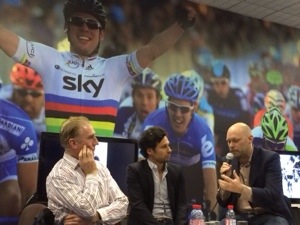
Birnie was alongside Kelly at Crystal Palace, adding context and anecdote to the Irishman’s recollections. Both were ably hosted by Daniel Friebe – author of ‘Merckx’,  ‘Mountain High’ and ‘Mountain Higher’ – who played the role of MC and posed the first 40 minutes of questions. Initially Kelly applied himself slowly to the task, as though lowering himself onto the infamous boil which cost him the 1987 Vuelta; testing the novel pain of speaking in front of 150 people instead of from the hidden confines of the Eurosport commentary box. Or maybe he was just subconsciously following the advice of the old patron Hinault, who often decreed that the first third of a stage would be carried out at a pace of his liking. Everyone held their breath and wondered how it would go.

20131128-213834.jpg

Birnie explains how he wrestled the story from Sean whilst he and Friebe look on. 

Continue reading