Competition Time – 100 Greatest Cycling Climbs of the Tour de France Book

It’s a busy time for cycling publishers at the moment and the Jersey Pocket office is groaning with tomes.. I have another excellent book to give away.

Check out my review here and answer the simple question at the bottom..
20140601-143233-52353671.jpg

The Tweed Run 2014 – Ride Report

I often find that preparing for a ride is almost as much of a joy as the ride itself. The slightly ceremonial laying-out of bibshorts, jersey, bidon and snacks the night before helps to mentally prepare for the task ahead. The selected attire acclimatises the brain to the likelihood of inclement weather, whilst the amount of food and water required conditions the mind to the degree of hardship ahead. When the laying out includes plus-fours, woollen tie, pipe and hip-flask though, you know it must be time for the many pleasures of The Tweed Run.
Continue reading

Giro d’Italia – Final Roundup

Read The Jersey Pocket’s first three Giro Rest Day Roundups herehere and here.
As expected, actually being in Italy during the final week of the Giro affected my ability to follow the race as closely as I could at home. That said, watching some of the stages as they were broadcast live and highlights of others in Italian did give the experience an extra dimension as I fought to extract roughly one word in every fifty from the commentary. The passion for cycling was much in evidence, even it is on the wane from earlier years. In Sicily, where I was for the week, we saw loads of club cyclists out on the roads at the weekends – far more than even in the cycling mecca of Kent. Older guys in the main, their strict adherence to the old-school Euro-gaud look was exemplary and on our back to the airport yesterday morning we even sighted a small, slightly-built fellow with a goatee beard, pirate earrings and a bandana…
Stage 16. Quintana takes pink as controversy swirls around the Stelvio.
The Queen stage of this year’s Giro d’Italia, which included ascents of the Passo Gavia and Passo del Stelvio, were the literal and metaphorical high points of the whole grand tour but poor weather again led to chaotic scenes as confusion about the descent off the highest point in this years race allowed Nairo Quintana and some others to slip away from Maglia Rosa Rigoberto Uran ahead of the crucial last climb of the day.
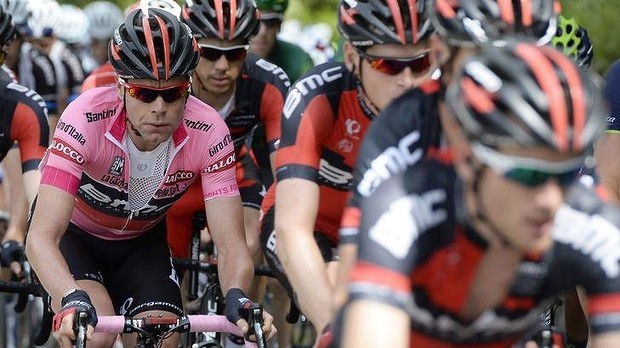
With red flags being waved and misunderstood assertions that race radio had declared the descent neutralised due to the cold and wet conditions, Uran’s OPQS team did not expect attacks and continued to argue the point into the next day, threatening to further derail the Giro. In the short-term at least, Quintana donned the pink jersey that he wrestled from his compatriot Uran by a margin of 1’41” after winning the stage to Val Martello with the improved form that he had threatened to show in the last couple of days.
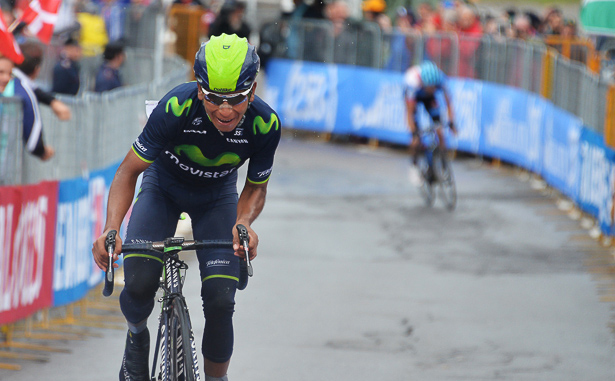
After Sky’s Dario Cataldo claimed the Cimi Coppi prize atop the Stelvio, Quintana broke clear on the descent with team mate Iziguirre, previous Giro winner Ryder Hesjedal and the Europcar pair of Pierre Rolland and Romaine Sicard. The twisting climb of Val Martello soon distanced Iziguirre and Sicard before Rolland too was dropped as Quintana drove the pace in relentless fashion. Hesjedal stuck with him doggedly until the last kilometre and came home only eight seconds back. Rolland was 1’13” further back and then the big gaps started. Uran lost 4’11” on the day, coming in 9th. Kelderman, Pozzovivo and Majka had already crossed with around 3 minute deficits whilst Cadel Evans, the biggest loser on the day, shipped  4’48” to Quintana and from a position of dominance a week earlier now faced a severe test to stay on the podium.
The manner of Quintana’s victory was as emphatic as anything we had seen from him this year but if it was Movistar’s hope to gently bed him in to the role of Grand Tour leader the events of the day conspired against a tranquilo takeover of the Maglia Rosa. The rain storm on the Stelvio that caused the problems may have passed already but the ripples of discontent causes by the neutralisation that never was rumbled on for days, and the tiny Colombian is set firmly at the eye of the storm.
Giro d'Italia 2014 - Tappa 16 Ponte di Legno - Val Martello
Stage 17. Bardiani, again!
Dissent was still swirling around the teams of the GC contenders the following day and Stage 17 to Vittorio Veneto was in much need of a distraction. A huge breakaway of 25 riders provided just such a diversion, building a break of over 13 minutes that all but guaranteed that the day’s winner would come from their ranks.
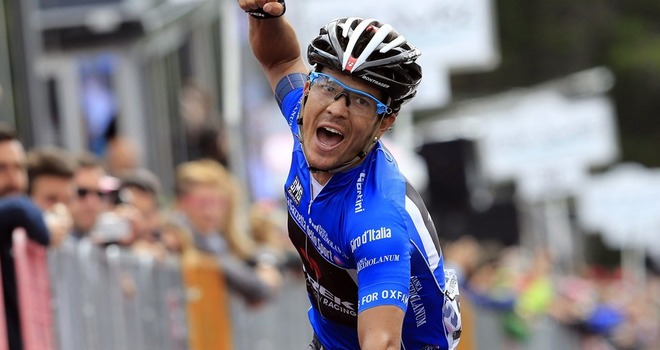
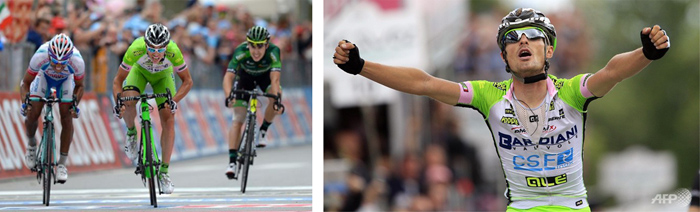
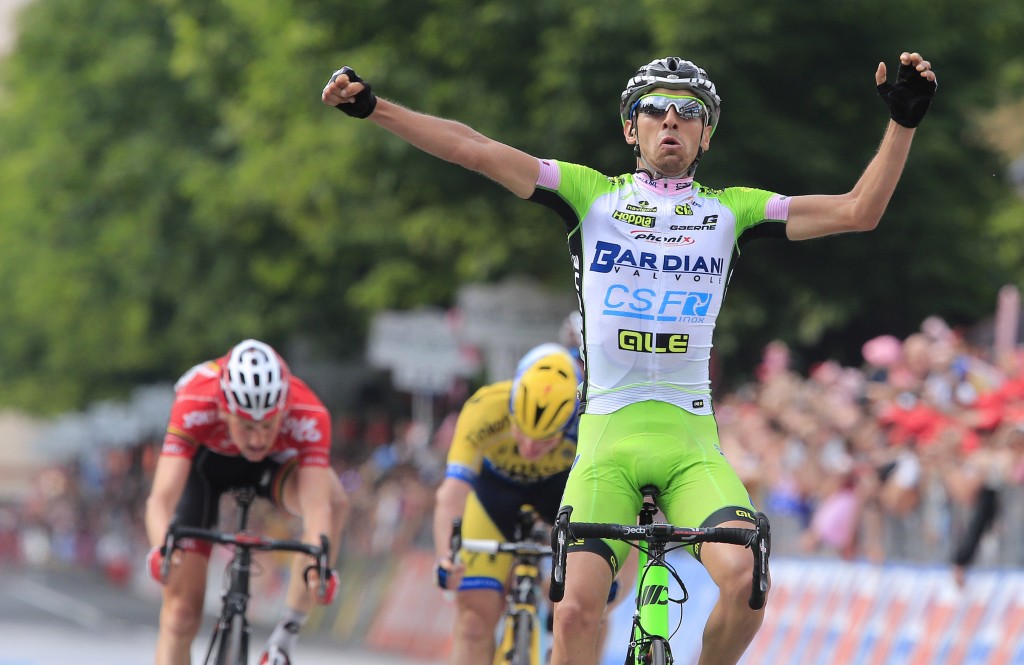
With Thomas de Gendt freed from OPQS domestique duties for the day and Lotto strongman Tim Wellens also featuring heavily in the latter kilometres of the day, the clever money would have probably backed one of those two for the first place. But Italy in general, and Team Bardiani in particular, had cause to celebrate again when Stephano Pirazzi shot off the front of a five man breakaway breakaway and hared for line from a couple of kilometres out. De Gendt, Wellens and their two other companions were guilty of looking around for others to do the work to catch Pirazzi and, though none were more a few seconds off the leader at the finish, the Italian had just enough time for a proper celebration of his first and Bardiani’s third stage win of the Giro. Wellens pipped Jay McCarthy of Tinkoff Saxobank for second with De Gendt finishing an angry-looking fourth ahead of AG2R’s Matteo Montaguti.
The GC boys – including Quintana dressed in a ridiculous head-to -toe pink outfit – rolled in many, many minutes down on the stage winners but all in the same group so no change in the overall.
bardiani
Stage 18. At last, Arredondo
Colombia have had an incredible Giro. Along with Quintana and Uran fighting it out for overall glory and Duarte illuminating the race in Italy, Trek Factory Racing’s Julian Arredondo had been been looking good for the Mountains Prize for some time but had lacked a stage win. Stage 18 would finally be his day.
I only saw the very last few kilometres of this stage and when I did finally get to see something it was initially Cadel Evans struggling in a thinning Maglia Rosa group. By the time Rolland attacked out of that group with 2.5km remaining there was no sign of Cadel. He had gone, and surely also gone was his credibility as a Grand Tour contender. His younger rivals Majka, Hesjedal and Pozzovivo were still there along with Quintana who was content to drop a few secs behind and few others.
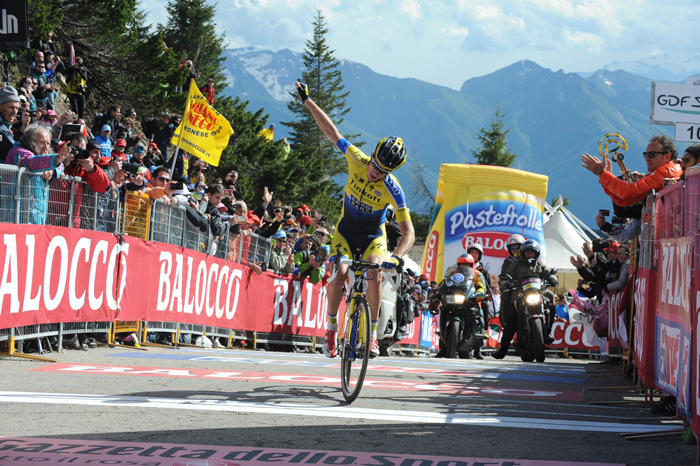
Up ahead Arredondo split off from the day’s early break, first battling with and then distancing Duarte, Pellizotti and Deignan. Having crested all three climbs of the day first and boosted his blue jersey points massively Arredondo also gets the stage win and a lot of prise for his strong ride.
As Duarte beats Deignan for second ace Wellens finally makes a GC group moves and soon overtakes Rolland. At 1200 metres to go, and with the remnants of the breakaway crossing the finish line ahead of them, first Aru and then Uran and Quintana do the same to all place in the top 12.
Overall Rolland moved up to third whilst Evans plummeted to 9th overall. Rolland will still have to work hard for his new podium position with a number of riders – namely Aru and Majka – now snapping at his heels. At the post-race interviews Uran looked haggard and spent; his normally craggy face having taken on an extra unwanted puffiness as well. In contrast, Quintana (albeit with the benefit of a wash and brush up) looked as fresh as the proverbial daisy. Going on this alone it was easy to feel confident of that way the race would good.
julian-arredondo
On a side note, it’s good to see that the awkward mid-massage interview is still alive and well on Italian television. During our time in watching the race on Rai 3 we were treated to numerous members of the Androni Gatacoli team being asked for their opinions about all manner of things whilst having their leg muscles rubbed by large men with calloused hands, baby oil and unspecified vibrating devices…
Stage 19. Strong stuff on the Grappa.
The 26.8km time trial up to Monte Grappa had long threatened to be a paradigm of suspense. Placed squarely within the back-loaded climbing days of the final week, the main contenders for victory – and the main chances for disaster – were always going be setting off in the final few positions, guaranteeing a thrilling finish.
Astana’s Fabio Aru once again looked to have put in a stage winning performance after a face-saving ride by Evans, and Pozzivivo had improved their starting positions on the GC slightly. With Rafal Majka and Ryder Hesjedal in particular having days to forget the minor placings were still very much up for grabs, whilst with only 1’41” separating first and second places Uran’s deficit to Quintana was not yet thought to be insurmountable.
When the dust finally settled and the last man was back in, Aru’s time of 1:05’54” was good enough for second place on the stage and to move into 3rd place overall, at the expense of Pierre Rolland whose 4th place on the stage was matched by 4th place on GC. With just Uran and Quintana left on the climb and both going strongly the drama reached a natural climax.
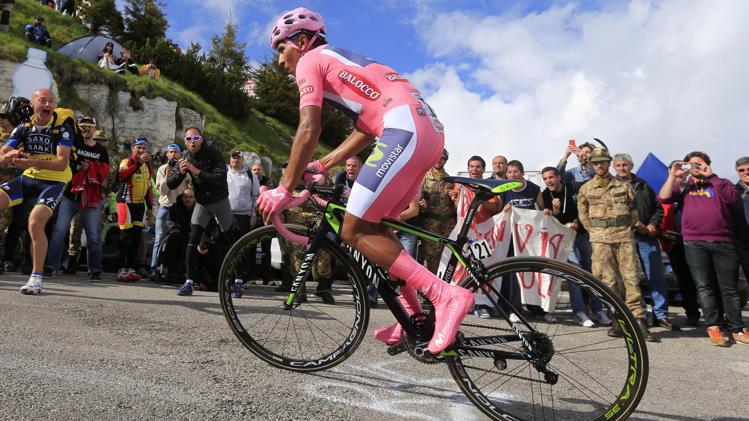
Uran’s excellent effort was just over a minute slower than Aru and slotted him into second place for the couple of minutes that elapsed before Quintana, kitted out shocking pink from head to toe, stormed home to take the stage win by 17 seconds. It was another emphatic show of strength from the Movistar man, who now led Uran by 3’07” with just one last test of climbing to come. Uran, the pink jersey wearer earlier in the race, would have to be looking forwards and backwards as the race ascends the shockingly difficult Zoncolan with the other ‘in-form’ man in the race Aru, breathing down his neck. Both will have to contend with Quintana though, who said he intended to attack on the Zoncolan to cement his likely victory in style.
nairo grappa
Stage 20. Rogers conquers, Bongiorno suffers, Quintana reigns
With the whole race condensed to final monster climb and a breakaway threatening to spoil Quintana’s statement of intent the Movistar team hit the lower slopes with a ferocity that reminded me of darker days when EPO’s blasted Haute Catergory climbs at unseemly paces.   Immediately Quintana and two team mates went clear but with no response coming from their group the impetus faltered and they sat up to wait. It was Quintana who called a halt to the premature attack – perhaps it was shock tactic to scare the others, or a older plan that was made to look a bit silly by the size of the gap to the breakaway who were already battling the upper slopes almost 7 minutes further up the climb.  As with Stage 18 we had two separate races on the road and this time it was the front group who gave most of the action:
The Zoncolan is a crazy climb. It’s crazy steep and crazy popular with fans. But, like the mountain itself, they get a bit crazy sometimes too. Around the steepest sections of the climb, where the roads hits an incredible 22% the break finally splits and Pellizotti, Mick Rogers and Bardiani’s Bongiorno eek out a gap and the crowds swirl around them. It’s so steep that mechanics are carrying spare bikes over their shoulders on motorbikes. With no cars able to make the ascent the crowds are closer than usual and seem to be in a feisty mood. Tinkoff’s Mick Rogers, leading the three away from the Giant Shimano pair of De Gendt and Geschke gives one a huge swipe to clear the narrowest of paths as he and Bongiorno distance Pellizotti.
Away down the mountain the group surrounding Quintana is thinning.. Cadel goes backwards again, his face set so hard in pain and frustration that you can almost hear the inward screams of despair.
Aru is towards the back of the group, looking less than comfortable for once, alongside Rolland but the familiar names are still together. Quintana, sitting just behind his Movistar team mate Igor Anton, who is putting in a massive turn at the front, Uran with his own gregario Walt Poels, Majka and Pozzovivo. Again the crowds get too close for comfort and Poels takes a pair of sunglasses off a spectators face and throws them away in disgust. A fan wrapped in a Colombian flag almost takes out Quintana. Things are getting frantic and, perhaps sensing a moment of distraction Uran sends Walt Poels to the front to inject pace. Suddenly, with just about 5km to go Rolland, Pozzovivo, Majka and Aru are gapped.
With 2.5km to go the crowd issues finally get out of control as a well-meaning spectator pushes Bongiorno, who cannons into the back of Rogers’ bike and loses momentum as he has to put a foot down and loses momentum. It’s awful bad luck for the Italian who never really recovers. Rogers goes on to takes his second stage win but not before having to shout a few choice words at other spectators who again threaten to disrupt his progress with the over exhuberence.
PIC466341650
With Anton now spent and OPQS’s man from the breakaway, Sherry, joining Uran and Poels, Quintana is eventually isolated but never looks vulnerable. There is a thought that Uran could be preparing for an attack on Quintana but when the pace drops a little, allowing Pozzivivo to pace the chasing four closer to him, it was clear that Rigo is more concerned about saving his second place than forging ahead to test Quintana. The pace is upped again by the indomitable Poels (who only runs out of steam inside the last kilometre) to re-gap the chasers before Uran and Quintana ride together up the final ramps. There is no attack from Uran and Quintana is never less than comfortable, even being able to put in a little sprint over the line whilst others are hardly able to stay upright as they finish. Back in the chasing group Fabio Aru does enough to keep his third place with just the ceremonial run to Trieste to come. Barring disaster the 2014 Giro GC is done.
Stage 21. All smiles, even from the impassive Quintana.
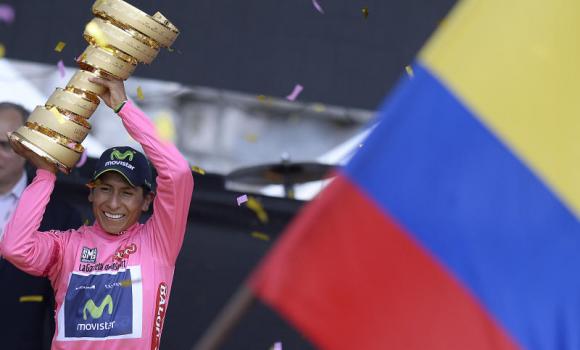
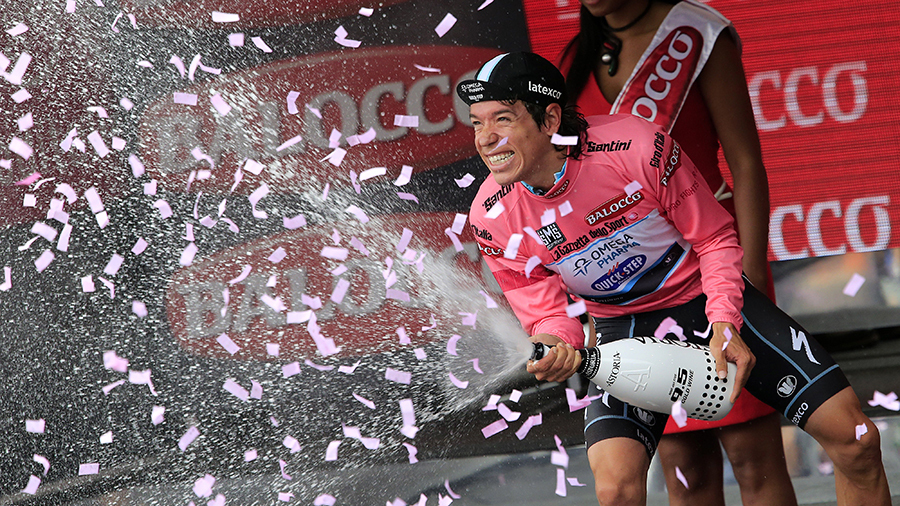
Following the traditional processional stage into the final kilometres outside Trieste, and a bunch sprint that saw Luka Mezgec get a stage win ahead of Nizzoli and Farrar, Quintana allowed his normally impassive visage to slip into the broadest of smiles as, accompanied by his family, he collected the final pink jersey and the mighty spiralled gold trophy of the Giro d’Italia. He also tops the Young Rider category, which Aru inherits.
nairo final
It’s been a generally hugely entertaining Giro stuffed full of interest, intrigue, incident and ridden mostly by up-and-coming riders showing that the guard will change once again in the decades old cycle of dominance. Colombia in particular, appear to have a new Golden Age ahead of them but both France and Italy will also be hugely encouraged by what they have seen in the last month. The race ebbed and flowed wonderfully, even as it built to the expected crescendo in the final week. Sixteen different stage winners, five different Maglia Rosa wearers, cameo turns from likely and unlikely sources, and the ongoing battle with not only the other riders and the terrain but also the less than ideal elements. Calamity and controversy added to the excitement without detracting or tainting (with the possible exception of the spectator push on Bongiorno) the overall results. It has set the Grand Tour season off to a flying start. Bring on Le Grand Depart!

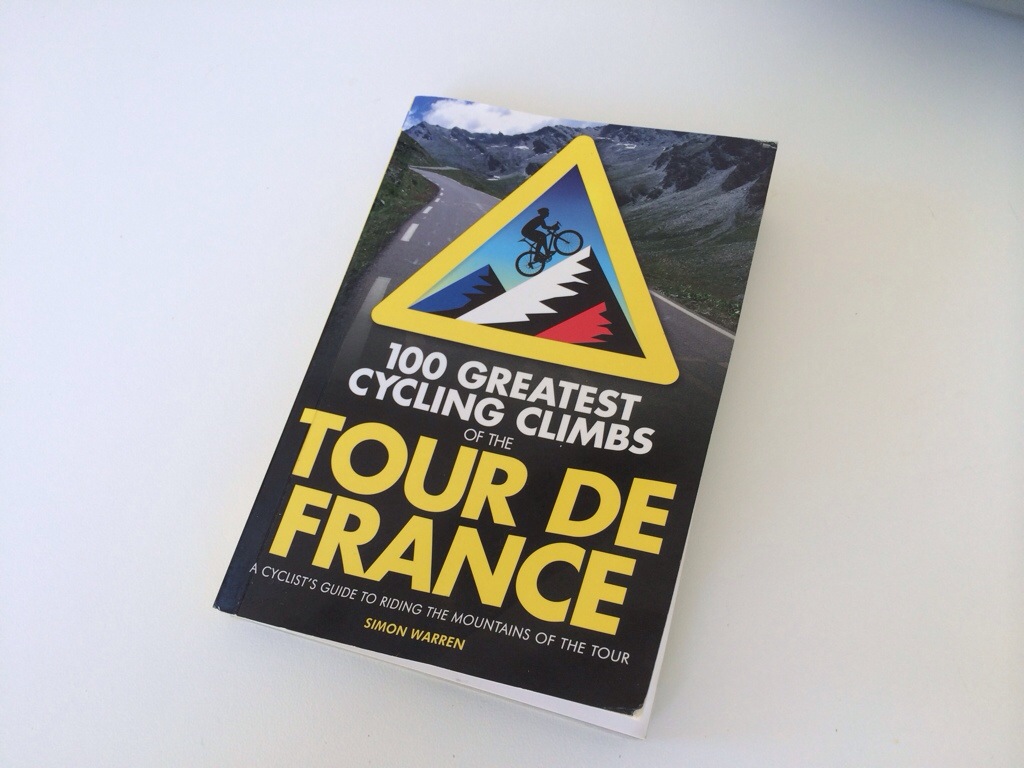
100 Greatest Cycling Climbs of the Tour de France – Book Review – Simon Warren

Whilst some books about the mountains that cyclists seek out to suffer upon are coffee table publications that fall into the (still wonderful) class of ‘road porn’, Simon Warren’s concise book of 100 of the climbs used in the Tour de France over the years is definitely a guide book. It’s not going to be the one you salivate over, turning the pages slowly and reverentially at home – the Mountain High and Mountain Higher series by Daniel Friebe is far better for that – but it is the one you are going to use for planning your trip to either the Pyrenees, Alps or Massif Central, and it is definitely the one you are going to take with you when you do go as it is full of useful info about finding the climbs, linking them together and, most tellingly, it has a list at the back where you can tick off your conquests.

20140601-143233-52353671.jpg


The 100 Greatest TdF Climbs book (Frances Lincoln Limited, £9.99), which was published on last week, is the fourth in the ‘100 Greatest Climbs’ series by Simon Warren. Having filled two books with British climbs and one on the Hellingen of Belgium Warren spent a summer riding and researching the much more challenging routes in this latest edition.

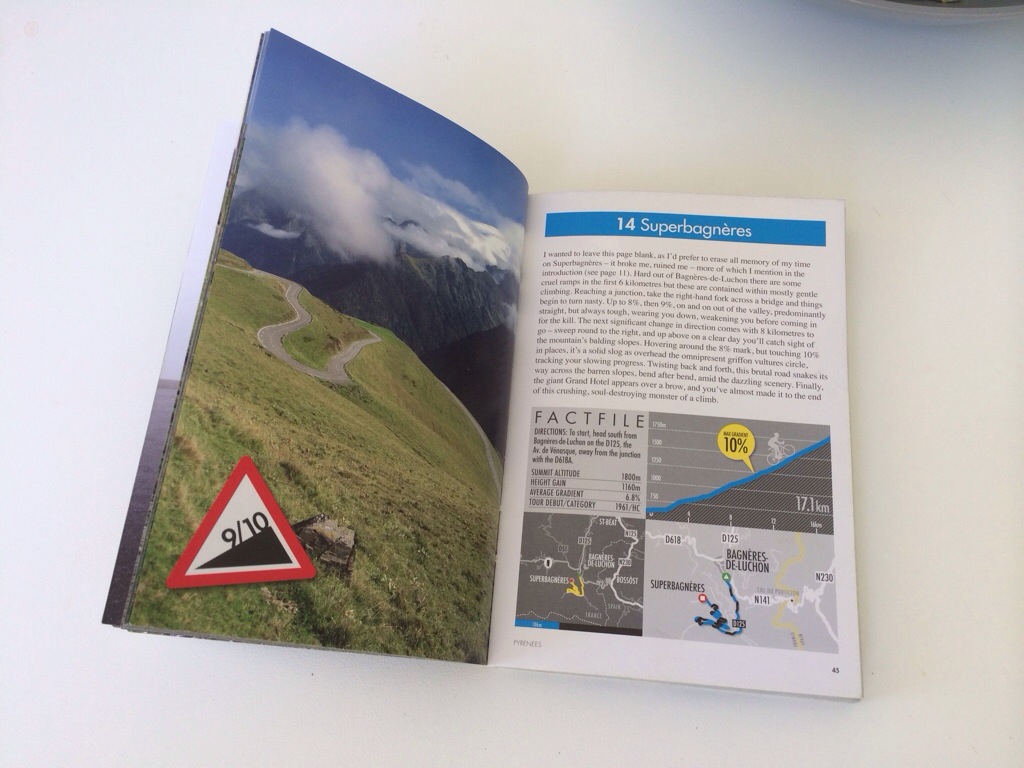
Arranged into six separate geographical areas – Pyrenees, Massif Central, Vosges, Jura, Alpes du Nord and Alpes du Sud – each climb comprises the same double page format. Photo and difficult rating on the left; climb description, info, maps & profiles on the right. Without having tested them it’s hard to comment on the directions but they seem comprehensive and always look to make navigation as easy as posible. Quite a few of the maximum gradients noted on the profiles don’t tally up with those in the description paragraph but this hardly interrupts the usefulness of the book.
20140601-171026-61826349.jpg


The written descriptions are excellent, noting everything from the climb topography and direction to the subtle changes of gradient that interrupt your rhythm and can sap your will. Warren waxes lyrical about some climbs whilst berating others for the unrewarding punishment that they inflicted upon him. Notes often also include optional ascent routes that Warren had to choose between allowing a rider with more time the option to consider multiple ascents.

Obviously the book includes the most famous of the Tour climbs, such as Ventoux, Alpe d’Huez, Galibier and Tormalet, but it’s some of the lesser known climbs that really whet the appetite. All of the above would be on most cyclist’s ‘To Do’ list but mine has now swelled with the addition of quite a few more. Wanting to conquer a climb like Alpe d’Huez or Ventoux because of their infamy is fine but learning that the Pas de Peyrol or the Cormet-de-Roseland are, according to Warren, simply two of the most fantastic roads that you can pedal a bike up is worth the modest cover price alone. It’s definitely worth picking up a copy before this years Tour hits some of the same slopes to give an extra understanding of the stages.

COMPETITION TIME: We have one copy to give away. Just send your name and address, along with the answer to the following question, to thejerseypocket@gmail.com and a winner will be picked at random on Monday 9th June.

How long (in km) is the hors category climb up to Superbagneres?
 

Giro d’Italia – Rest Day Roundup #3

Read The Jersey Pocket’s first two Giro Rest Day Roundups here and here.
We finished our last round-up with the suggestion that we were heading for new territory on the Giro GC and the middle week of the Corsa Rosa eventually provided that, but not before more familiar fare had been dished up. More rain, more crashes, more cautious riding by the top contenders still intent on saving energy for the savagery of the final week.
With the race now firmly ensconced in the North of the country, Stage 10 from Modena to Salsomaggiore was the quintessential sprinter’s stage – the flattest of the whole Giro and the six man break was duly bought with 10km left to run. Suddenly though it was Sky and BMC who were leading the charge up a last small incline near the finish. As the road levelled Bouhanni was back after another late drift to the rear of the peloton. For once everyone was in the mix. Right up until 700m to go when Tyler Farrar came down causing yet another monster crash as the group approached the final corners. Bouhanni was on the right side of it and looked to capitalise with ex Pink Jersey wearer Mick Matthews, Trek’s Nizzolo, Sky’s Swift and Giant’s Mezgec. The latter two again faded at the death leaving Bouhanni to take his third win of the Giro in front of the others. Cadel Evans, also noticeably at the front yet again at the sharp end, was not affected by the crash just behind him and came home 9th. He immediately grabbed a towel from a soigneur and conducted his post-race press conference with it wrapped around his neck like a security blanket. For all the talk that he would consolidate his position this week, something didn’t quite feel right.
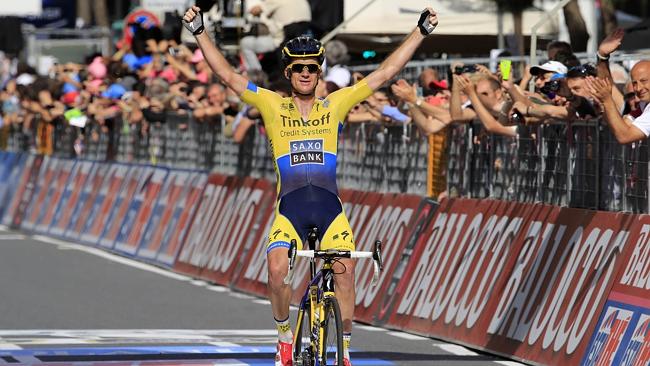
Stage 11 had been talked about as a ‘breakaway’ stage almost as soon as the route was unveiled. With a first pivotal Individual Time Trial the next day, it made sense for an appropriate group be allowed to get away and for the peloton to cruise on behind. Indeed a  big group of 14 was allowed to get away but crucially it lacked one team – Androni – and they felt obliged to chase it down, fuelling the peloton’s pace. BMC were not too impressed but the Italian’s ignored the bigger team’s general protests and caught the break well before the end of the day despite yet more crashes which left various members of the peloton with shredded lycra or, in the case of Adriano Malori and Chris Anker Sorensson a dip in a mud filled ditch to go with their road rash. With a quick up and down before the finish there was still time for a couple more twists. First Moreno of Katusha and Arredendo of Trek followed an attack by Tinkoff’s Roche before the tiny Arredendo went away again with the giant Preidler from the Giant-Shimano team. The little and large duo crested the climb first but was one of the chasers, Mick Rogers of Tinkoff, who launched away on the descent and opened up a sizeable gap. The 3x Time Trial World Champion was almost caught at one point on the 25km run-in, his lead dropping to 10sconds before growing to closer to a minute by the end. After a winter to forget, during which he was provisionally suspended for Clenbuterol before cleared by WADA, Rogers continued the amazing run of form for the Australians in the race. It was clearly an emotional victory for the big man from Down Under.
rogers
As dawn broke on the Time Trial day so did the heavens. An already technical, lumpy course quickly looked to harder than expected as the clouds opened again. The earlier starters suffered most as conditions worsened and those riders who weren’t threatening the overall took their runs so slowly that occasionally small trains formed. Bt not all went quite so piano; Giant rider Tobias Ludvigsson took a horrific spill on the twisty downhill section, going over the side barriers and lying still, yards away from his bike for a long, long time. Again the emergency support was an awfully time coming but later  his team confirmed that his injuries were not too serious.
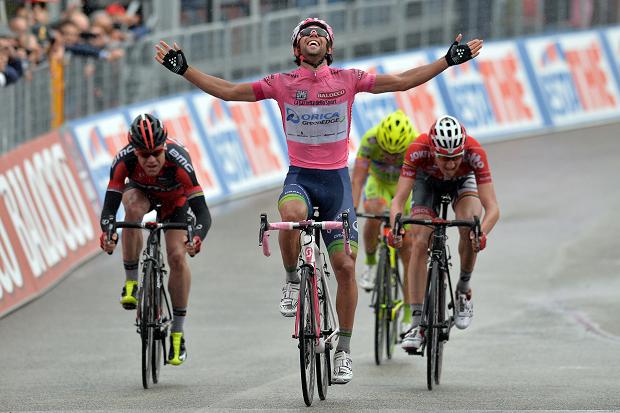
Diego Ullisi of Lampre stunned watchers and pundits alike with a fast time that stood almost to the end when the favourites took to the course. Whilst Quintana again fell short of expectations it was left to others to fill the gap and shake-up the GC. Pozzovivo, Kelderman and Majka all made top 10 as the GC started to take on a more defined look. Uran, starting just ahead of Cadel Evans, stormed the course though and never looked in trouble as he showed off improved TT skills in the drying conditions to register a surprise stage win and thereby Columbia’s first leaders pink jersey. He beat an off colour Evans back into third place as the Australian again flattered to deceive on a race of truth. Evans seemed a yard short the whole way round the course and on the day he was expected to put time into all his podium rivals he lost more than a minute to Uran and only made small gains on others. OPQS riders also came 5th, 6th and 8th in the TT showing the work that the team have put into training for this discipline but equally noticeable Uran thanked his bike. It’s very unusual for a stage winner to thank his equipment so some recognition should be turned in Specialized’s direction for what Uran clearly feels is a ride-winning machine.
uran pink
In line with a lot else this Giro, the prediction about how Stage 13 would pan out did not quite go to plan. ‘Bunch sprint’ was the expected order of the day as, with the real mountains now looming very large, the fast men had their last chance for a win until the final day stage in Trieste. Of course there was an early breakaway but no-one believed it would stick. No one except the members of the breakaway itself it seems. The peloton ambled along, confident of catching their prey before the end in Rivarolo Canavese. The break toiled and eeked out a reasonable but not spectacular lead of around three and half minutes. After good work by FdJ.fr earlier the peloton started discussing who should be doing the chasing and the impetus went our for a while. Surely, someone would pick up the pace in time, they all thought. But no one did. They all left it too late and came in 10 seconds back from the three surviving breakaway members who, as well as contesting the day’s podium places amongst themselves, also showed that sometimes, just sometimes, the break wins out. Marco Canolo of the Pro Continental-level Bardiani team took the win – only his 2nd pro victory in a three year career. For his team, this is massive and even if it was their only one of 2014 it would probably justify their whole season.
Stage 14 was already the third Saturday of this Giro but it was still only the first proper mountain stage. A large breakaway of around 20 formed as crashes in the peloton behind saw the retirements of Orica-Greenedges Peter Weening and Sky’s Kanstantin Siutsou, but it was on the slopes of the penultimate Bielmonte climb (with 40km and a first cat summit finish still pending) that the race really began to split wide open. Whilst Pierre Rolland and Ryder Hesjedahl attacked out of the Maglia Rosa group on the lower slopes, up ahead Nicholas Roche attacked from the breakaway to be the first over the top and down the other side followed by small groups all across the mountain side. For once the drama was played out under brighter skies and the race began to look like a Grand Tour instead of an extended set of early season one-dayers.
After re-catching the Irishman, Giant-Shimano’s Alberto Timmer went solo on the final 11km climb with the multiple chasing groups behind holding station. As Rolland and Hedjedal battled in the middle ground Trek FActory’s Racing Julian Arredondo faltered for the first time after initially upping the pace of the Maglia Rosa group. Nairo Quintana, who had put on a spurt to get up alongside the KOM jersey wearer, didn’t want to take up the pace but the pre-race favourite now looked strong for the first time in the whole race after riding in pain for a few days following an earlier tumble. Pink Jersey wearer Uran marked him as their group passed the steepest pasts of the climb with around 4km to go and they let AG2R take up the pacing for their man Pozzovivo. Pozzovivo didn’t hang about for long though; sensing weakness around him he attacked at 3.5km. Quintana, Uran, Belkin’s Wilco Kelderman and Tinkoff’s Rafal Majka followed initially as Evans began an all too familiar slide backwards but then it was only Quintana and Pozzovivo moving ahead alone.
By now there were a number of distinct races going on on the road with breakaway members in-between who were simply forgotten in the melees. Cataldo and Pantano of Colombia were chasing and caught Timmer ahead at the 2km marker. Hesjedal and Rolland were chasing them a further 1km back and it looked as if the win would come from those front three. Somehow Evans had clawed his back up to Uran, who suddenly seemed bereft of teammates and equally bereft of a kick. Back at the front Cataldo put in the first of the final attacks only for Pantano to counter. Timmer came back to them briefly and the three were together again winding it up for the sprint. Catalado looked the smoothest and a Sky win looked to be on the cards. But, almost from nowhere another breakaway member returns to catch them just as Timmer falters once more. It is Enrico Battaglin from Bardiani, team mate to Canolo who took the surprise win the day before. Surely lightning can’t strike twice – even in this latest rain-soaked Giro. Of course it did. Cataldo was in the box seat and took on the sprint but Battaglin came from behind as the Sky rider seemed to hit a wall with less than 10m to go.
bardiani
Pozzovivo and Qunitana finished just after Hesjedal and Rolland, who came in 2′ 22′” down on the winners with seven others of the breakaway including Roche, Timmer and Lotto’s Tim Wellens crossing before them. Quintana, face as impassive as ever behind his shades, burst for an extra couple of secs over his Italian companion and took back 20 seconds from Evans who still had a little in the tanks at the end. By contrast Uran had nothing left and lost 5 seconds to his older rival when he could not raise the pace in the final straight.
It was a great day’s racing, finally delivering some of the panache and derring-do that we so crave from the mountain stages. The myriad plot lines playing out over the slopes made for compulsive viewing as the very best of the stage racing came to fore; multiple battles being fought by multiple (occasionally overlapping) groups. KOM points, Stage win, GC battles and the simple fight against gravity. Bellissimo!
I’m heading to Sicily tomorrow (Sunday) for a week of family holiday and trying to follow the Italian commentary of the climax to the race. Internet connection permitting I will have added in my thoughts on tomorrow’s finish as the race ascends to the hallowed summit of Plan di Montecampione. Much mention has been made of Marco Pantani in the race this year and the Stage 15 course pays homage to his race winning move there in 1998 on his way to the Giro/Tour Double. Perhaps this is time for Quintana to shine..
Extra Extra! Stage 15 update!

If the Italians can’t have an overall winner in pink in Trieste this time next week, then it’s a safe bet that that the stage win they would most crave for a countryman would be this one. The Plan di Montecampione holds a special place in Italian cycling folklore, more so perhaps than the more famous climbs of the Passo del Stelvio, Gavia or Zoncolan, all of which feature later in this years edition. The tree-lined climb up to the Montecampione is where Pantani sealed his ’98 Giro and is a key part of the homage to him that this edition of the race has sought to become.

Having travelled to Italy myself on this day I missed all of the build-up that the 217km stage might have offered before the crucial last 15km. By the time I reached my holiday villa in Sicily and found Rai 3’s coverage, Lotto’s Adam Hansen and Garmin’s Andre Cardoso were already leading on the lower slopes of the Montecampione. The Maglia Rosa group were 21″ behind with Blue jersey (I still can’t used to this) KOM leader Arredondo bridging up to the front pair.
There was still a lot of action ahead though, as my 3 pages of notes for the next 10miles can attest. Arredondo – so strong at the beginnings of climbs – caught them quickly enough and took Cardozo on with him to test the resolve of Uran and the others. All the GC contenders were still in the thinning chase group who doggedly stuck together almost to the catch, which took place at 9km. Sky, freed from the shackles of overall contention, chanced their arm again: this time it was Ireland’s Philip Deignan who slipped away in a familiar, high cadence style that won him 26″ by the 6km remaining mark.

Behind Deignan, the twenty strong group holding all the main players, started to probe and press the pace. Arredondo soon paid for his earlier efforts whilst Ryder Hesjedal and Ivan Basso also cannot hold the pace which Mick Rogers begins to lay down for his team mate Rafal Majka. Suddenly the group is 14 strong and Deignan’s hard-fought lead begins to tumble fast.

Pierre Rolland makes a slight feint at 5km, a move which which animates Uran, who goes on to make the break that the Frenchman could not quite make stick. Evans, Majka and a much stronger looking Nairo Quintana follow the pink jersey, who eases off once the damage has been done and lets Evans sweat on the front for a while again. The former winners’ pace isn’t enough for Rolland though as he goes again at 4km, taking Colombian Duarte with him as he swiftly catches Deignan.

Astana’s Italian rider Fabian Aru, who has clearly been biding his time in the Uran group, makes his move at 3km prompting a change of pace which, initially, Uran seems most able to match. Quintana waits a little longer, regaining with contact with Uran just as he and Aru catch Rolland and Deignan but whilst they then pause in the regroupement Aru strikes alone for the win.

Quintana, looking well recovered from the injury and cold which affected his first couple of weeks in the race, finally attacks with 1.7km remaining as he looks to start to regain his time losses. Rolland goes with him. Evans has momentarily disappeared from sight and when a moto camera drops back to find him, he is suffering mightily, working like a dog on the front of a group of the young pretenders Keldermann, Majka as well as Pozzovivo, fighting to save his Giro.

Ahead Quintana half springs at 900m trying to catch Aru but he is still lacking the explosive force we saw in 2013 and though he drops his French companion Rolland, he cannot catch the flying Italian. Aru takes an emotional home win and is already fielding questions from the media about Pantani by the time Quintana crosses 22″ later. After Rolland and Duarte cross, Uran comes in ceding just 20″ to Quintana. Evans loses another 32″ to Uran and immediately seeks comfort in his security neck towel/blanket.

At the end of the day Uran had consolidated his lead overall, regaining the minute lead over Evans that he had after the time trial. Aru lay in fourth place 2’24” adrift but Quintana had risen again, up to fifth and now just 2’40 back on his countryman Uran. With the hardest climbing yet come he once again looked like the contender that we all expected before the race.

.


The Complete Book of the Tour De France – Feargal McKay – Book Review

COMPETITION TO WIN A COPY AT THE BOTTOM OF THE PAGE..

As a self-confessed trivia and fact addict, one of my very favourite books as a teenager was Pears’ Cyclopedia. Not a particularly challenging text for an adolescent I will admit but, in pre-internet days, it was the single best source of a wide range of knowledge that I could lay my hands on. Being then of very limited means (variously pocket money, a paper round, a Saturday job as a kitchen porter, eventually a student loan) I tended to buy one every two to three years rather than each annual publishing. I was never disappointed by each new edition that somehow held a world’s worth of knowledge in a pocket-sized paperback. Looking back now from the considerably expanded knowledge base that we can call upon with just a few taps and swipes, it seems as quaintly antiquated as index cards or typewriters (both of which I also cherished at that time) but, judging by the goosebumps which prickled up and down my back earlier this week, the thrill of a receiving a book that portends to hold ‘all the answers’ creates the same feelings of excitement as it ever did.

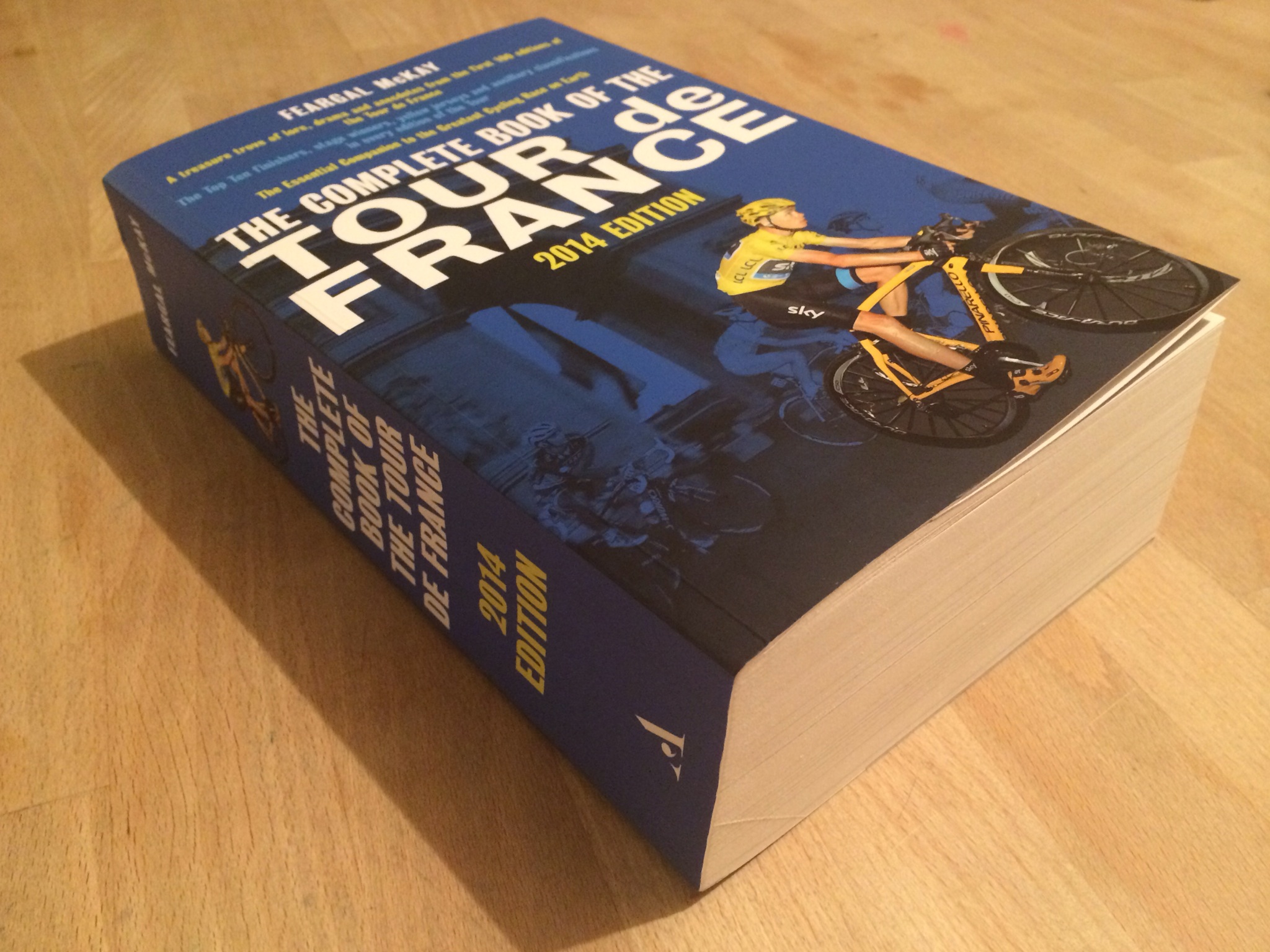
Feargal McKay’s “The Complete Book of the Tour De France” (Aurum Press, £25 Hardcover) is by no means pocket-sized. Even in this pre-release paperback format it weighs something close to an Arenberg cobble and, in the new hardback edition that will be released on June 5th, it would probably do similar damage to a speeding front wheel*. But unlike the famed pave blocks that will define Stage 5 on this year’s Tour, this heavyweight cycling compendium can tell you everything you might ever want to know about the Grand Boucle. The old saying that “Knowledge is Power” certainly becomes more compelling when the source of knowledge that you are quoting from could also be used to knock your enemies senseless with a single blow. Try doing that with an iPhone…
mckay 1

The presentation of apparently endless facts about an annual bike race run in (roughly) the same format for over a century could ostensibly be a dull task to assemble and thereafter be an even duller task to read. Most encyclopaedia’s try to get around this issue by making sure there are a liberal amount of maps, diagrams and illustrations peppering the facts. Pears’ went a degree further by introducing a dozen or so ‘Special Topics’ to each edition. Sitting alongside the more usual Scientific, Historical and Geographical facts, these Special Topics brought some more subjective discussion and debate to the otherwise potentially mundane world of the almanac. More importantly they also delivered some context, personality and story to much of the rest of the book. In order to provide some context to the dry facts and figures that he has meticulously assembled, McKay has also wisely chosen to tell the stories behind the Tour’s various editions and developments, covering its scandals and glories in order provide a definitive statistical account of the Tour and the circumstances under which they were achieved.

And he has done it very well. McKay’s writing has an easy, conversational style that makes you imagine that you are listening to a learned friend telling you about each Tour. Knowing of his Irish background lends an accent to this imagined narration and the book, surprisingly for something that you had expected to be a simple compendium, quickly becomes more of a fireside Jackanory, to be consumed over many evenings, one chapter at a time. Time moves on but the roads and mountains remain and the wheels still turn to conquer them.

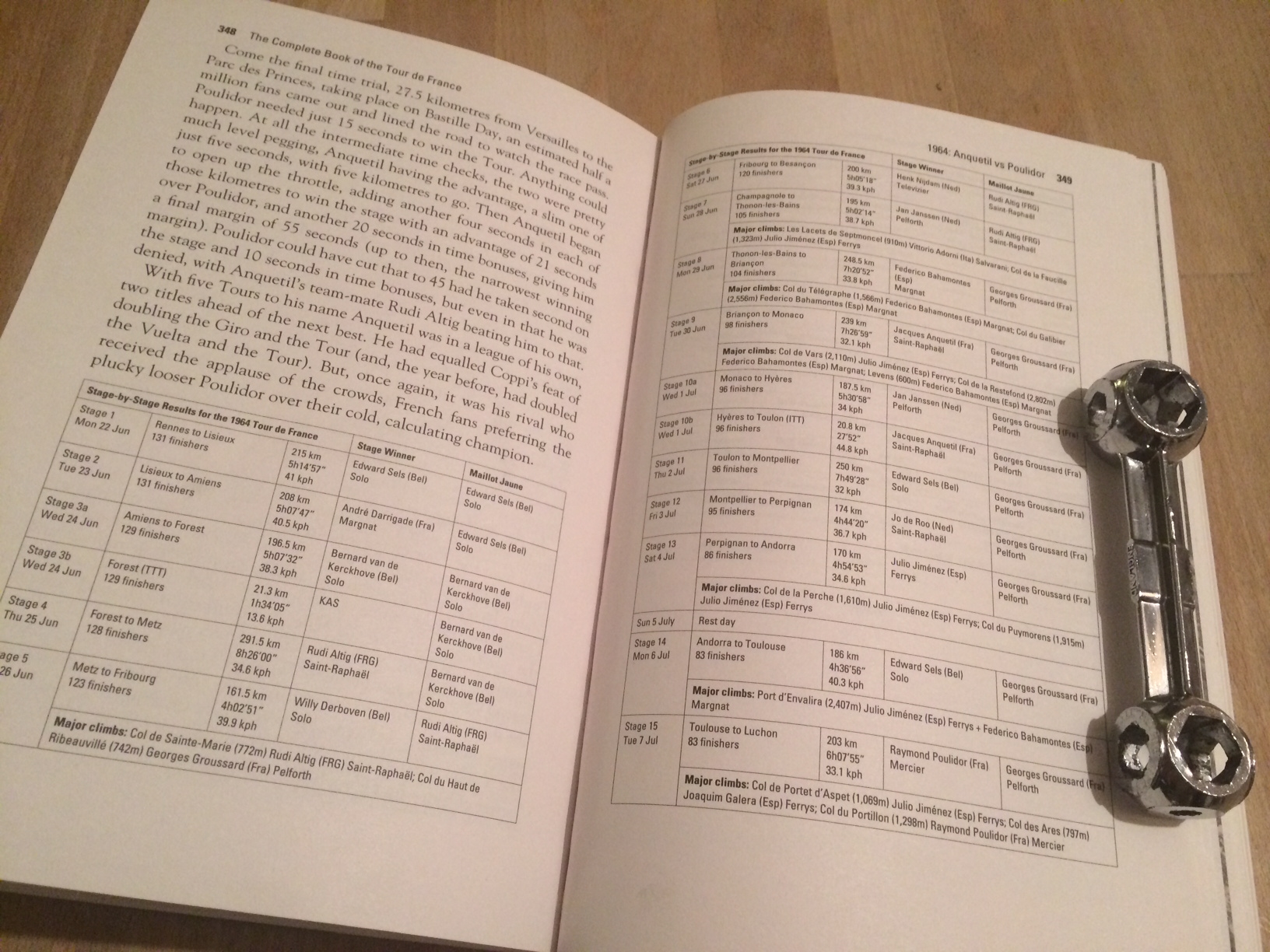
So, where to begin? Not necessarily at the beginning. McKay has naturally arranged his book in chronological order (and consumed that way the accompanying narratives would build to give a comprehensive – and comprehensible – understanding of the Tour’s progress through the decades) but one of the real joys of an almanac is that you don’t need to devour it in any particular order. In fact, there is a strong case for saying that you should never actually read it at all. Instead you should either consult it for a particular reason (just who was the Lanterne Rouge in 1937?) or you should just browse in order to allow it to reveal it’s secrets to you in a random, chance-like fashion by flipping pages until a word or name catches your eye. Anquetil, Aucouturier, Alpe D’Huez; Pottier, Pantani, Puy de Dome; Garin, Gimondi, Galibier… It’s an Aladdin’s Cave of Tour History, Tour Geography, Tour Science and Tour Politics. All you have to do is walk in..
mckay 2

The stories that you find next to the stats change as the motivating forces behind the Tour change from the requirements of marketing to requirements of politics, which in turn give way to commercialisation, which in turn give way to a need for regaining credibility. Throughout the main characters rise and fall as time takes it’s inevitable toll on all and yet the lists goes on. The charts at the end of each Tour story are presented in the same prosaic fashion throughout and, stripped bare of all the drama, intrigue and effort that the narrative has just given us, returns the riders to the immortality of the statistic. All are equal. Geants de la Route.

I would dearly love to see a future edition that included simple maps of each running of the Tour. Done in a consistent way, which was in keeping with the unchanging tables of Stage and Overall Winners, would not spoil the power of their simplicity but would add an extra dimension to the ‘Completeness’ of the book and would help chart the early decades of growth in particular. I don’t think the postmen around the country would thank me for adding an extra 50 or so pages to the already weighty volume but I think the cycling buffs (who will hugely enjoy this excellent book without them) definitely would.

Aurum Publishing are offering a free copy of The Complete Book of the Tour de France as a prize in the very first Jersey Pocket competition. Just send an email to thejerseypocket@gmail.com and a winner will be picked at random on June 5th.

* 02.06.14 update – Aurum have confirmed that the published book will be a paperback, not a hardback as initially intended.

Happy Birthday – Chris Froome

Happy Birthday Chris Froome

  • TdF Winner –  2013

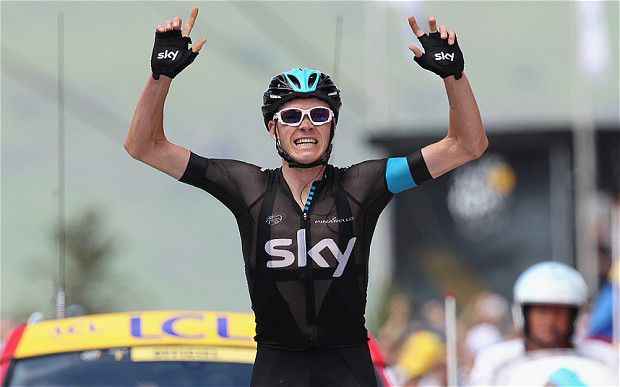
chris-froome2

The shortest palmares so far in the birthday series but I don’t think we will be saying that in a few years time. Froome’s rise from the obscurity of racing in Kenya is a worthy backstory to what could be the biggest marquee in the pro ranks over the next decade. A relentlessly driven, relentlessly polite man, Froome seems to balance the fire and ice needed to be successful champion and a well-repected person.
Giro d’Italia – Rest Day Roundup #2

Read The Jersey Pocket’s first Giro Rest Day Roundup here.
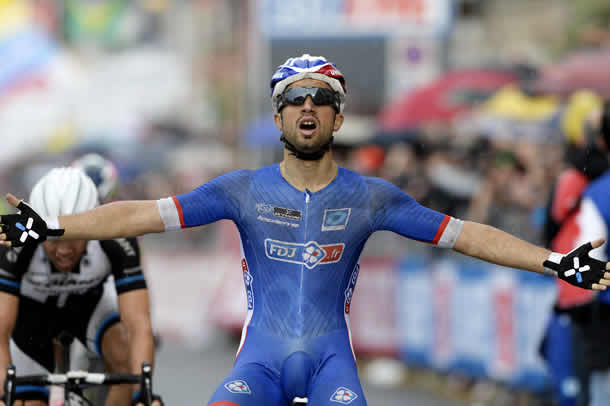
Having flown 2,500km down to the Mediterranean, the gruppo might have been forgiven for thinking that they had left the poor weather behind in Ireland, along with a great deal of good feeling and a fair few hangovers. In fact they were in for a set of rude, and often painful, shocks when the Rain Gods decided that they were having such a fine time following this years Giro d’Italia that they decided to tag along with the transfer and cause chaos for a few more days. Rain in Ireland is one thing it seems. It’s practically obligatory. But rain in Bari, in Viggiano and in Monte Cassino is a completely different story.  
Stage 4. The transfer itself had one significant casualty when Marcel Kittel – plunderer of Stages 2 and 3 failed to make the start. A fever caught during the transfer was blamed and, whilst the German was always expected to pull out of the race early, this seemed entirely plausible given the chance of a third win in a row. Kittel left it until the Tuesday morning to withdraw, meaning there was no time to reprint the points leader’s red jersey with the right sponsor which denied Sky’s Ben Swift a chance to wear it for one day. Given what transpired during the day though, this was the smallest of sideshows in the much larger circus that the stage quickly became. For the rain fell in Puglia and peloton controversially elected to neutralise the racing for almost the entire day.
The problem wasn’t the actual rain itself: it was pretty light stuff that even the shabbiest of rain jackets could deal with. The problem was what the rain was falling onto. Roads that hadn’t seen rain for many months, and which don’t expect a lot of it anyway build up motor oil on their surfaces which isn’t easily washed away. The apparent ease of conditions led to a lot of disgruntled fans berating the riders for their go-slow, especially when, having pootled eight times around the finishing circuit in Bari in seemingly drying conditions, the riders chose to go full gas for the last lap when the rain had restarted. The expected chaos ensued with three major crashes on that single final corner-heavy lap. The build-up to the resumption to racing was increasingly bitter as the initial solidarity of the peloton slowly disintegrated when some teams felt it was OK to race and others – notably OGE and BMC – felt that it was not. The slide-outs that marred the final lap (after the commissaire’s had decreed that the GC times would be taken from the penultimate lap) justified the earlier decision to a degree but a similar amount of ill-feeling remained in the peloton that would now remain throughout the week. Pink jersey leader Michael Matthews had bowed out of the ill-fated sprint safe in the knowledge that his lead was safe for another day at least. Nacer Bouhanni looked to be out of it too having suffered a puncture just at the pace whipped up. In Kittel’s absence Giant-Shimano had transferred their eggs to Luka Mezgec’s basket but gearing problems on the last corner left his final man Tom Veelers alone to continue his lead-out sprint all the way to the line. Bouhanni, paced back on by his entire team, came from as far back as Kittel had done on Stage 3 but the slowing Veelers was no contest and the Frenchman took an emphatic win.
bouhanni
Traversing the length of Italy in a few short days was never going to be all flat and Stage 5 was a day for the rouleurs with a lumpy parcours and an uphill finish. Matthews had targeted this day from early on and he was in the reduced peloton which arrived at the foot of the final climb. Joaquin Rodriguez was looking active but it was Tinkoff leader Nicholas Roche who attacked first. He was reeled in quickly by Cadel Evans who looked good for the win but Lampre’s Diego Ullissi passed him on the last corner to take the first Italian win of this year’s Giro. Matthews was in the same group to retain pink whilst Uran also crossed early to improve his position to fourth.
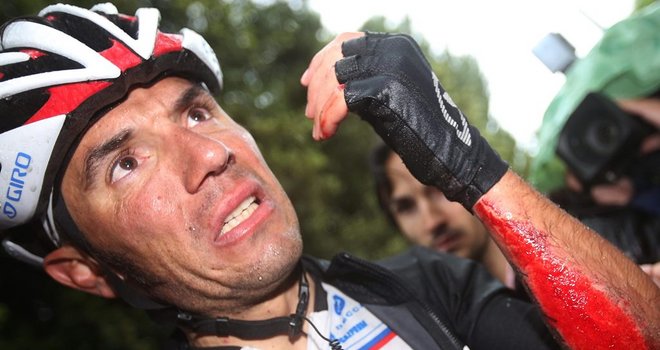
The familiar term The Longest Day is more traditionally associated with the beaches of Normandy but it was equally applicable to another famous WWII battle site on stage 6. The run up from Sassono to the stronghold at Monte Cassino was already slated to be the longest mileage day even before a landslide forced a re-route adding a further 10km to the tally. But once again it was the weather which took the greatest toll. The rain was more severe than the day before but the racing remained on throughout and eventually the peloton caught a 4 man break who had stayed out for over 200km. The pace was whipped up on the approach to the final climb to the famous Redoute and the rebuilt monastery at the top but sadly a significant number never made it up. Two huge crashes at a roundabout near the base of the climb defined not only the day but also possibly the Giro itself. The first crash looked fairly routine; an Astana, Katusha and two Europcars falling nastily at the left hand side of the road. Whilst the camera lingered on the stricken though, much worse was happening ahead. By the time the TV pictures moved on to the second crash some 100 metres ahead, the extent of the drama was self evident. Bikes and bodies clogged the whole width of the autostrada and, as a small group of just eight riders were able to continue unaffected, it was soon obvious that this was a very big, very bad one.
rodriguez
Team Katusha were the most obviously affected team with a number of riders on the ground and one, Giampaolo Caruso, who was motionless for a sickening few minutes before the race doctors belatedly got to him. His team leader Rodriguez, who had looked so spritely the day before, got back on his bike and laboured up the 10km climb like Jesus on his way to Calvary. Tinkoff-Saxo also fared badly with big hope Nichloas Roche eventually losing 15 minutes whilst other battle-scarred riders were still coming in 25 minutes after Matthews who, in that super select group with Uran, Wellens, Santoromito, Evans and a couple of BMC minders, had nipped in front of his countryman for the stage win. Again the fans questioned the decision making; whereas before they felt that racing should have been restarted earlier, now they were calling for the escapee’s to honour a ‘someone crashes so everyone stops racing’ rule. I’m with the folks who said those few guys were in the right positions exactly because this sort of thing happens further back. It’s called racing smart. Behind, the casualties stumbled in one by in; local boy Stefano Pirazzi being physically pushed up the climb by a less damaged teammate; Svein Tuft, Maglia Rosa on Stage 2, pouring blood from acres of road rash. Ben Swift was the last man to cross. It was suitably attritional for this most famous of locations.
After such high drama and tragedy it was always going to be a quieter, more sombre stage that followed. Bouhanni took his second win with a seemingly impossible dash up close to the barriers. Two more riders did not take the start, joining the five who were classed as DNF the day before. Rodriguez retired with broken ribs and fingers along with teammates Caruso and Angel Vicioso who had the worst injury with a complex triple fracture that could yet end his career. Bouhanni brushed all this carnage aside and won with yet another no-holds barred charge that defies logic, reason and sanity. All of which makes him a fantastic sprinter. Matthews held onto his jersey for one more day extending Orica Greenedge’s wondrous run in the lead.
bling matthews
With Stage 8 came the weekend, the sun and finally fireworks of the racing kind. Readers who follow me on Twitter or Instgram will know that I was otherwise engaged on Saturday at London’s annual Tweed Run, meaning that I missed most of the best action of the race so far.  Trek Factory Racing’s Julian Arredondo animated a large part of the day by getting into the early break and surviving as the numbers dwindled until he was still alone with less than 3km to go. On the first of the bigger mountain stages it was clear that attacks and gaps would define the day. Pierre Rolland sought to catch Arredondo first and, for a short time, seemed to have played the winning hand. But the gradients increased as the distance to the line fell and he too started pedalling squares and was overwhelmed by a chasing group a mere 100metres from the line. BMC’s Steve Morabito had brought Evans and the other main players up to the fading Frenchman but it was the Italians who had the last say on the stage. After a cheeky attack by Dani Moreno – no doubt trying to salvage some pride for Katusha after a truly miserable 24 hours, Lampre’s Diego Ullissi jumped again to steal the stage. Once more the peloton splintered in the final yards to give a couple of seconds here and there but, with Matthews still some 35 minutes down the mountain, the pink jersey was undeniably Evans’ to assume.
evans
Orica-Greenege were back to winning ways on Sunday though as Peter Weening successfully tracked down and caught Europcar’s Italian breakaway man Davide Malacarne to be able to contest a two up sprint. Domenico Pozzovivo and Ulissi made it second, thrd and fourth for the Italians with two super strong showings that Cadel could not match at the finish. Uran also finished strngly to make further ready progress and go into the second rest day in second place overall just under a minute down. Meantime the pre race favourite, Movistar’s Nairo Quintana, who had seemed either happy to follow or unable to attack all week was only placed 9th, albeit only 1’45’ down. The tightness at the top of the GC leader board was apparent with only 2 minutes separating the top ten.
With still two weeks and all the proper mountain stages still to come the stage is set for a ding-dong battle between Evans – who has never had to defend a Grand Tour lead before – and the likes of Uran, Quintana and Kiserlovski, who have never won one before. One thing is certain: we are heading into new territory, and with the Gavia, Stelvio and Zoncolan still to exact their own reckoning on the riders we are a long, long way from Trieste.
Forza!
.


Going West – Tour of California Round-up

“Go West, young man, go West and grow up with the country” – Horace Greeley

Read The Jersey Pocket Tour of California preview here.

On the surface of things there is a lot that it could be easy to be disparaging about in the Tour of California. The irony-laden fact that the race is sponsored by the makers of EPO has been covered many times before, for example. There is also the abundance of long straight highways used, the awful stop-motion quality of the on-board camera feed and the somewhat presumptuous assertion that the eight day 2.HC category race is the ‘fourth Grand Tour’. But on the other hand, you have one of the most professionally run races in the calendar, the sublimeness of Pacific Highway 1, the very best online coverage I have ever seen and a strong rider line-up that a number of ‘bigger’ races would love to able to attract. Add in the fact that the favourable time difference means that the majority of live racing is on in the evening for British audiences and you have all the ingredients for an accessible, engaging and enthralling race.

Those of us who chose to follow the sun-baked Californian race more closely than the damp Giro stages last week were amply rewarded. We had British winners on 3 stages; we had young riders showing their elders that the next generation is coming through strong and sure;  we had old hands still chancing their arms and we had star turns taking deserved bows as they crossed the line after epic efforts.
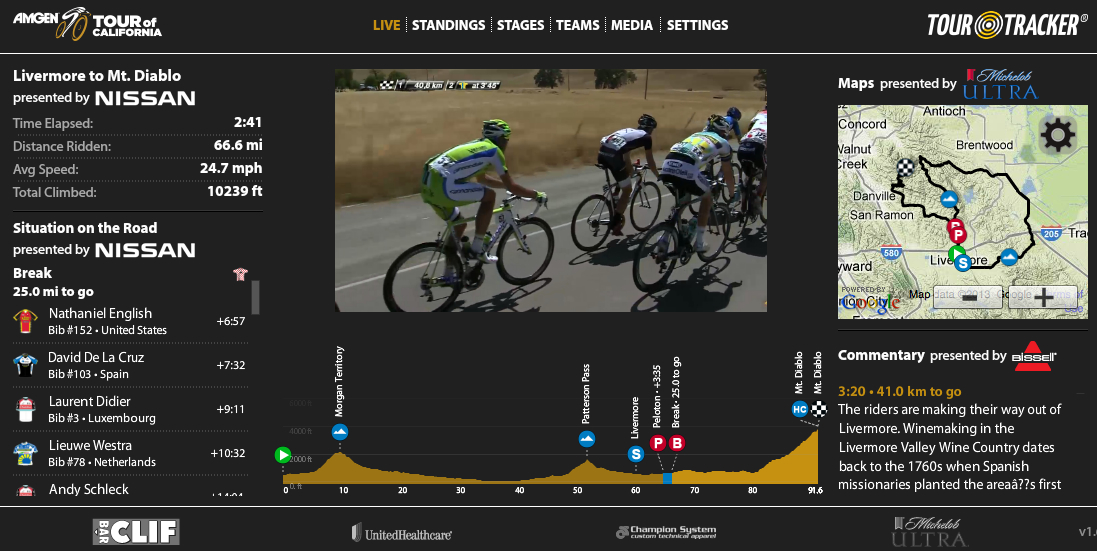
Experience watching ATOC tour tracker

 The first thing we had to contend with was how to watch the race. I’ve been tweeting the praises of the Amgen Tour Tracker (web and app) most of this week for it’s excellent information and relative lack of adverts, but as so often in life you had to take the rough with the smooth. In this case that meant opting for the Phil & Paul (or more accurately in this case Paul & Phil) commentary over the much more engaging and informative pairing of Matt Stephens and Brian Smith over on Eurosport. Over the week Stephens and Smith re-animated the often staid arena of cycling commentary offering the kind of relevant and up-to-date insight that is so often missing these days. I often ended up watching the Tour Tracker video for the sidebar info that came with it, whilst playing the Eurosport audio through another device.

Stage 1 kicked things off nicely: A Mark Cavendish stage win and young British prospect Tao Geoghagen-Hart’s top four on GC –  thanks to bonifications earned throughout a long breakaway – made things look quite rosy in the bright Californian sun. Tao also secured the best Young Rider jersey for his efforts and made a significant mark in his first big race for his new Bissell Development team. Later in the week we saw videos of Tao talking about the new wireless (hell, yeah!) shifting system which they are testing for SRAM. This lad has a big future in cycling, writing and/or presenting. Take note. Cav’s win over John Degenkolb was very close and neither knew who had taken it. Phones were produced, Tour Trackers were checked and a beautifully clear finish line photo was seen by the racers in around 20 seconds. We did get a little tired of still images as the week progressed with the live pictures often freezing due to transmission problems but that one was a peach.

Another young name that came to our attention this week was Lawson Craddock. Riding on Degenkolb’s Giant Shimano team, the 22 year old was hugely consistent throughout the week and rode impressively in the Stage 2 Time Trial to take the Young Rider jersey from Tao with a 13th place overall finish, beating more notable names such as Sagan, Ten Dam, Van Avermaet and Terpstra. It was enough for the youngster to hold onto that jersey and strong finishes later in the week would elevate him to 3rd place on GC by the end of the race. The real star of the Time Trial though was Wiggins who went around the Folsom Circuit at a blistering pace to beat closest finisher New Zealander Rohan Dennis by 44seconds. Taylor Phinney was expected to do better than 3rd at 52seconds back and, though Wiggins took the Yellow Jersey from Cavendish, the young American stole the social media limelight by turning to give a single red rose to podium girl Allison Steinkamp as he departed the podium. 
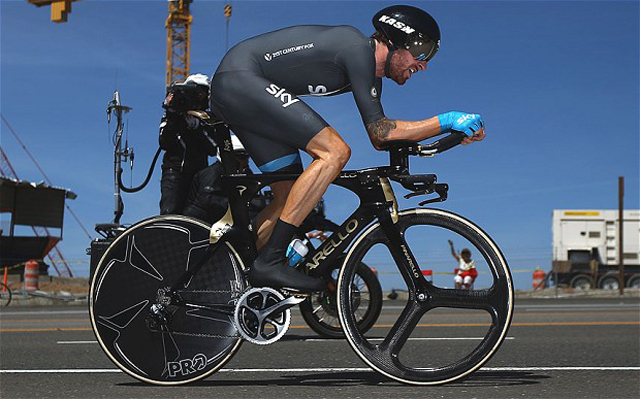
Wiggo ToC

Stage 3 brought the first mountain test and Garmin-Sharp’s Dennis looked to threaten Wiggins on the final climb up Mount Diablo. In a very un Sky-like fashion, it was Sir Brad himself who led the reducing peloton up the slope from the bottom. Despite having no teammates to count on, he looked the personification of assuredness and calm as he smoothly pedalled at high cadence with the air of someone leading out a Sunday club run. Dennis jumped away in the final kilometre to claw back 20 of the seconds he had lost to Wiggins in the Time Trial and, in doing so, made the next few days of racing far more interesting.

The run down Pacific Highway 1 from Monterey to Cambria on Stage 4 was a real treat for the eyes with the rugged coastline providing the most awe-inspiring backdrop. It certainly inspired the five man breakaway who held off the charging peloton just long enough to contest the stage win themselves. Comprised entirely of second tier teams and with a couple of skinny young lads often on the front, it reminded me of last year’s Specialized ad where the young boy is being pursued by Tom Boonen. Tornado Tom was indeed at the head of the chase but even his thunderous thighs couldn’t catch the plucky escapees. Will Routley of Optum took the win.

We were treated to an even greater escape on Stage 5 when Taylor Phinney – perhaps anxious to get back onto the podium to meet Miss Steinkamp again – drove off the front after the last climb of the day and plunged down and along the last 12km to Santa Barbara alone. He TT’d out a gap of 35 seconds by the finish and had time to literally take a bow as he crossed the line. It was a mighty effort and an impressive way for the US to record their only win of the week. 
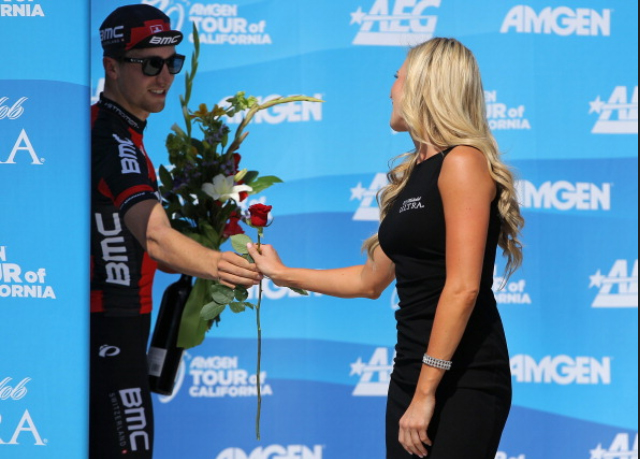
phinney rose

Stage 6 was the second (and last) big mountain finish. The aptly named hors category Mountain High was the destination and Garmin and others were looking to end Sir Brad’s time in yellow. Dennis couldn’t make an attack though and it was left to Tom Danielson to bridge up to the breakaway after earlier attacks from Ben King and George Bennett had shaken things up a bit. This time though Wiggins had a teammate with him and Joe Dombrowski put in a mammoth shift bringing his leader up the final ramps. The stage was won by OGE’s Columbian climber Chaves but Wiggins managed to come home in 5th alongside fellow Brit Adam Yates, who had ignited a splintering of the chasers in the final yards. The small split gained the race leader a couple more precious seconds and the race was nearly in the bag.

Peter Sagan won the sprint after a lumpy Stage 7 into Pasadena had put Cavendish 6’21” behind by the end. Thor Hushovd looked to have been on for the win but Sagan popped out from a hidden viewpoint and shot past the Norwegian champion to rescue an otherwise mediocre week. Danny Van Poppel of Trek Factory racing continued his good week with a 3rd place beating Degenkolb, who had made it to the sprint intact. All that remained then was for a repeat of the Stage 1 showdown on the final stage with Cav and Degenkolb again going head to head. There were worries about Cavendish who had lost his lead-out man Renshaw in the lead-up and who later said he wasn’t feeling too good at the stage start but he produced a great final burst to win by a clearer margin than before. No phones were needed this time. There was some disappointment on the last stage with Tao Geoghagen-Hart crashing hard and coming in 14 minutes down but greater concern was for Belkin’s Moreno Hofland who also crashed breaking a vertebra and ribs. He will be in hospital for a week before he can fly home.
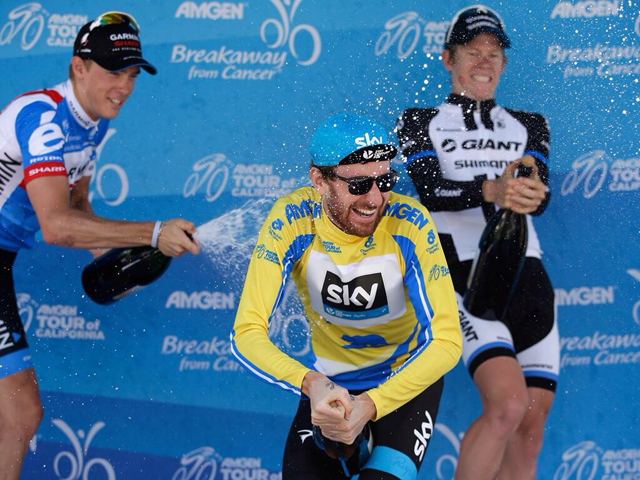
wiggo podium

Brad’s podium smile said everything that was needed about winning a race that was high on his and his team’s agenda. He says that his next race will now be the Tour de France and that he is fully committed to supporting Chris Froome. Indeed, his leading of the peloton up Mount Diablo earlier in the week almost looked to be specific training for leading Froome up some of the Alpine climbs in France in July.  The Tour of California came of age this year with it’s status much elevated by this edition. It also won great respect for being a race where youngsters are being given a chance and are really grasping it. It was hugely refreshing to see. We tip our ten gallon cycling caps to y’all and, like many top riders, I suspect we will be back for more next year.

AmgenTourofCalifornia.com

Pantani:The Accidental Death of a Cyclist – Film Review

The new Marco Pantani film had its premiere in London’s West-End this week. I went along to see the film and also spoke with director James Erskine about it.

Often alone on the mountain climbs upon which he made his name. Ultimately alone in the Rimini hotel room where he died ten years ago, aged just 34. Always, it seems, alone in his own uncomfortable skin. For a man adored and feted throughout Italy for his cycling achievements and celebrated far further for his exhuberent verve in the saddle, Marco Pantani always remained a loner. Even when he was at the very centre of things – both good and bad – he somehow appeared detached. A riddle. An enigma. And that is what drew many of us to him.
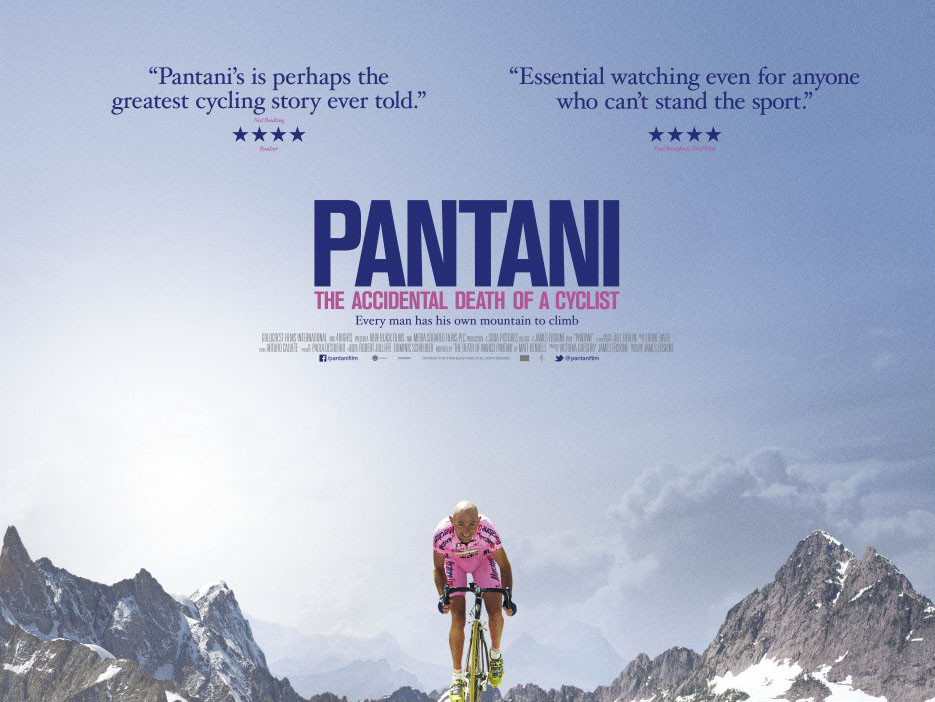
Quad_AW_Pantani_FINAL

James Erskine’s new film, Pantani: The Accidental Death of a Cyclist, makes no judgement upon the man known in turn as Little Marco, Elefantino and Il Pirata, and in the Q&A following the premiere in London on Wednesday night, the write-producer-director Erskine made no bones about that omission saying, “We wanted to make an emotional film and show the human cost.” he explainedIn contrast to many recent cycling films, the director’s own presence is non-existent in the finished piece and the audience are allowed to make up their own minds as the whether he were ‘Pantani The Saint’, ‘Pantani The Sinner’ or someone struggling with both titles and wanting to be just Marco.

Life is much easier when our sporting heroes and villains are one-dimensional. “Four Legs Good. Two Legs Bad.”  is easily modified into “1990’s Bad. 2010’s Good” but we all know how that black and white simplification played out in Orwell’s Animal Farm. Despite everything that has happened since Erskine started making his film 3 and half years ago, Lance Armstrong has managed to continue to polarise opinion, still loved and hated in equal amounts, but Pantani always walked a greyer line. Even before the film starts we bear witness to the truth. The BBFC certificate gives the film a 15 rating, pointedly noting that it includes “Drug Use, Injury Detail”. There you have it: in the most literal black and white. We know he cheated to win. So why do we feel differently about Pantani than we do about Riis, Ullrich, Virenque and Armstrong? Why is there always a question mark with Pantani’s legacy?

The very fact of his untimely death is obviously the key point in that it allows his sporting frauds to be viewed as part of a wider tragedy from which he could not ultimately be saved. Conspiracy theories crop up in the film about his fall from grace in ’99 – the pivotal moment in a career that had already been beset by disappointment and terrible injury – but they seem a side story to the main theme of a little boy lost in the world of men (a phrase which Erskine echoes in our conversation). An innocent. Such a thought would never occur about Riis, Ullrich or Armstrong who were as calculating as they come and who, in the case of Lance in particular, would seemingly stop at nothing to win. They all wanted to lead. Perhaps Pantani just wanted to be followed.
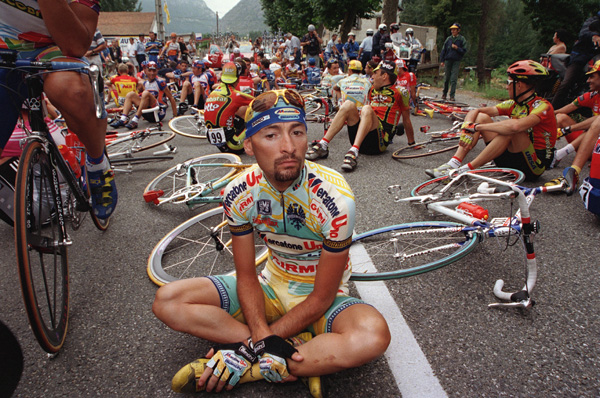
TARASCON/LE CAP D'AGDE

There is also a school of thought that suggests it was Pantani’s destiny to be deified and that the manner of his racing subliminally encouraged this. The repeated rises from the dead to claw back time in the mountain’s desert-like wastelands; the faithful disciples at Carrera who followed their messiah enmasse to the new team of Mercatone Uno; the outstretched arms crossing the winning line matching a crucifixion pose. His passing simply fulfilled this role as a tortured soul who struggled with greater highs and lows than those he conquered at the Galibier and Alpe d’Huez.

For  just one moment in the film we see the anger of Pantani. A still frame of a grimace as he achieves another mountain-top win. For the only time there is fire in his eyes. All the other times, even when battling hard, the eyes are searching for something that is missing. When they close in ecstasy as he wins, he seems to have momentarily found it. But then it is gone again and he is still searching, and we must search with him, for an answer that cannot be found.

The film expertly assembles a remarkable amount of archive footage, talking heads, evocative scenery and subtle reconstruction. The archive material is suitably grainy in quality and breathless in it’s commentary and thus is superbly contrasted by the high-definition vistas of the silent Dolomite and Alpine ranges that punctuate the various sequences. The talking heads are superb with valuable input from Greg Lemond, Evgeny Berzin, Bradley Wiggins and Matt Rendell, whose book The Death of Marco Pantani was a key source for the film. It is Pantani’s family though, and his mother in particular, whose words will last longest in the memory. For all the scientific jargon and shots of blood-spinning centrifuges and syringes which dominate the central part of the film, it is her simple warmth and still raw sadness that touches deepest.
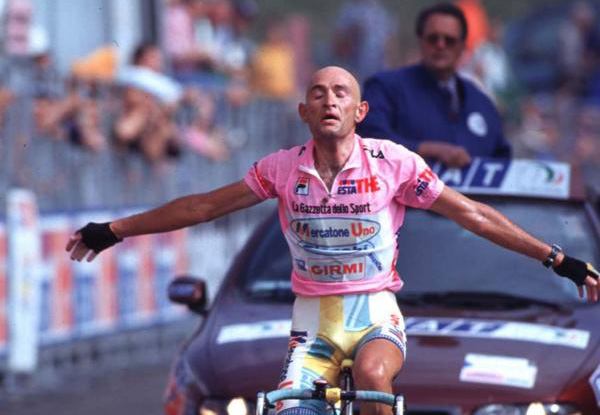
montecampione

Marco Pantani wasn’t the de facto choice of subject when Erskine was first tempted into looking at making a film about cycling. “I’m intrigued by pain,” he says, speaking the day after the premiere from Belfast where he is finishing up his latest movie about the Northern Ireland football team taking on the Brazilians in the ’86 World Cup, “I’m interested in sportsmen absorbing pain and cycling seemed like a good place to look. The Individual versus themselves. A boxing film would have been too obvious.” James doesn’t count himself as a “proper cyclist”, though he watches it a bit and didn’t know of Pantani before being pointed in his direction by cyclist friends in the film industry. “I knew it would have to be someone from the Nineties for there to be enough of the sort of archive material I wanted and then someone suggested Pantani. I started with the obituaries, the English language books and videos. He was some who stood out from the pack. A maverick. Not a rebel but a maverick. Once we found Matt’s book I knew we had a story.”

Erskine tells the story in familiar fashion. The chronological history from birth to death is interwoven with the key achievements and events that defined the career. He likens the format to that of ‘Raging Bull’. We see the pirate conquering The Galibier in ’98 – all yellow wheels and saddle as he floats away in the rain. We see the empty victory atop the Ventoux ahead of Armstrong in 2000. Erskine uses a different filmic device to differentiate each significant win and to individualise them. Deployed partially to help the non-cycling audience they hope to attract and partially to give some texture to what might otherwise become a stylistic monotony of clips, I only noticed it for the first time during the Ventoux segment where I found the device chosen there a bit distracting. I asked James to explain the thinking behind this and highlight the other more subtle tricks they had used.

“We tried to give each segment a different feel to distinguish them. The ’94 Giro segment is quite straightforward but jumps around in time a little. It goes off and looks at something else and then comes back. We cut the ’99 Madonna di Campiglio sequence with whip-panned shots of trees. We were looking to take it faster and faster, punchier and punchier, higher and higher to give that  final hallucinogenic moment before the fall.”

It’s the fall that defines the film of course; Pantani’s dramatic descent into cocaine addiction following his expulsion from the 1999 Giro d’Italia for a high haematocrit level when over 4 minutes in the lead. That is what Erskine felt showed the key elements of Pantani’s character, “He had an extreme psychology. There’s guilt, shame and huge insecurity about a two week ban that many others had at that time too. What mattered to me was why did Pantani take that series of false steps afterwards? Why did he start using cocaine, which increased his paranoia? What was it that took him over the edge when he could have come back just two weeks later and raced hard again? Why did he go bonkers? It was all really intriguing.”

Finding the answers were not so straightforward as asking them. It took a long time to get the family fully on board. “We spent a lot of time talking to them. Being considerate. It was difficult for them to think about EPO and cocaine – they are grieving parents – but they understood that it needed to show both sides of the story. We showed them the film before the press launch in Italy and they did have some issues but I think that ultimately they respect the work.”

The director also delayed the film’s release by a year to ensure that they had all the family material they needed and it was a wise choice given it’s importance in the finished article. The film has already been released in Italy and, despite falling well short of exonerating their saint, it received a warm welcome from the local partisan audiences. The main wonder was why it was a British team making the legacy film. In truth the film benefits from the distance and balance that Erskine gives it and it’s hard to imagine that coming from an Italian source.

Ned Boulting, who along with The Times’ cycling correspondent Jeremy Whittle admirably hosted the audience Q&A  after the screening, said during his brief introduction before the film that this is ‘perhaps the greatest cycling story ever told’. Many, including myself, would take some exception with that but none would doubt that Pantani’s is the one of the great tales of modern cycling and after seeing the film I think that all would agree that here it has been expertly told.


Pantani: The Accidental Death of a Cyclist is released 16th May.|Visit Pantanifilm.com for details of screenings.