
As expected, actually being in Italy during the final week of the Giro affected my ability to follow the race as closely as I could at home. That said, watching some of the stages as they were broadcast live and highlights of others in Italian did give the experience an extra dimension as I fought to extract roughly one word in every fifty from the commentary. The passion for cycling was much in evidence, even it is on the wane from earlier years. In Sicily, where I was for the week, we saw loads of club cyclists out on the roads at the weekends – far more than even in the cycling mecca of Kent. Older guys in the main, their strict adherence to the old-school Euro-gaud look was exemplary and on our back to the airport yesterday morning we even sighted a small, slightly-built fellow with a goatee beard, pirate earrings and a bandana…
Stage 16. Quintana takes pink as controversy swirls around the Stelvio.
The Queen stage of this year’s Giro d’Italia, which included ascents of the Passo Gavia and Passo del Stelvio, were the literal and metaphorical high points of the whole grand tour but poor weather again led to chaotic scenes as confusion about the descent off the highest point in this years race allowed Nairo Quintana and some others to slip away from Maglia Rosa Rigoberto Uran ahead of the crucial last climb of the day.
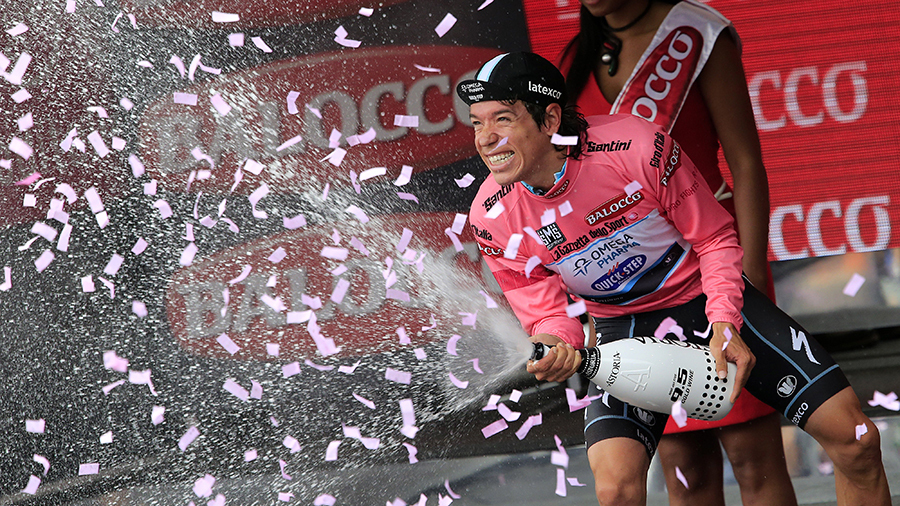
With red flags being waved and misunderstood assertions that race radio had declared the descent neutralised due to the cold and wet conditions, Uran’s OPQS team did not expect attacks and continued to argue the point into the next day, threatening to further derail the Giro. In the short-term at least, Quintana donned the pink jersey that he wrestled from his compatriot Uran by a margin of 1’41” after winning the stage to Val Martello with the improved form that he had threatened to show in the last couple of days.
After Sky’s Dario Cataldo claimed the Cimi Coppi prize atop the Stelvio, Quintana broke clear on the descent with team mate Iziguirre, previous Giro winner Ryder Hesjedal and the Europcar pair of Pierre Rolland and Romaine Sicard. The twisting climb of Val Martello soon distanced Iziguirre and Sicard before Rolland too was dropped as Quintana drove the pace in relentless fashion. Hesjedal stuck with him doggedly until the last kilometre and came home only eight seconds back. Rolland was 1’13” further back and then the big gaps started. Uran lost 4’11” on the day, coming in 9th. Kelderman, Pozzovivo and Majka had already crossed with around 3 minute deficits whilst Cadel Evans, the biggest loser on the day, shipped 4’48” to Quintana and from a position of dominance a week earlier now faced a severe test to stay on the podium.
The manner of Quintana’s victory was as emphatic as anything we had seen from him this year but if it was Movistar’s hope to gently bed him in to the role of Grand Tour leader the events of the day conspired against a tranquilo takeover of the Maglia Rosa. The rain storm on the Stelvio that caused the problems may have passed already but the ripples of discontent causes by the neutralisation that never was rumbled on for days, and the tiny Colombian is set firmly at the eye of the storm.
Stage 17. Bardiani, again!
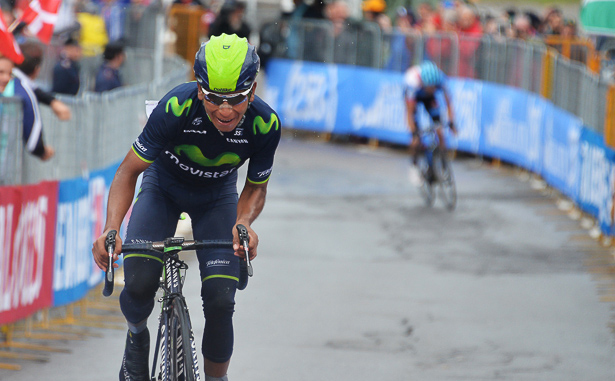
Dissent was still swirling around the teams of the GC contenders the following day and Stage 17 to Vittorio Veneto was in much need of a distraction. A huge breakaway of 25 riders provided just such a diversion, building a break of over 13 minutes that all but guaranteed that the day’s winner would come from their ranks.
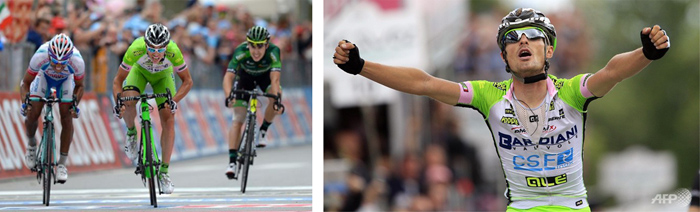
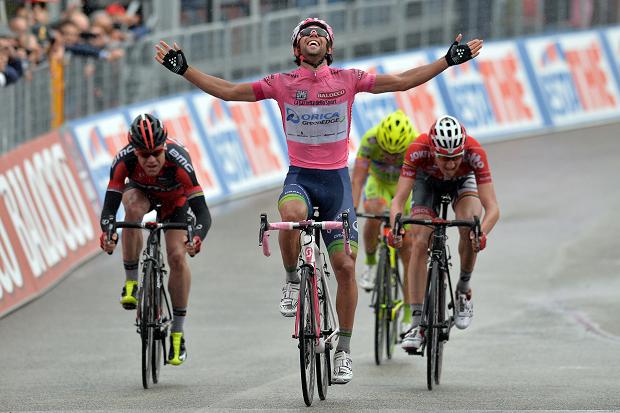
With Thomas de Gendt freed from OPQS domestique duties for the day and Lotto strongman Tim Wellens also featuring heavily in the latter kilometres of the day, the clever money would have probably backed one of those two for the first place. But Italy in general, and Team Bardiani in particular, had cause to celebrate again when Stephano Pirazzi shot off the front of a five man breakaway breakaway and hared for line from a couple of kilometres out. De Gendt, Wellens and their two other companions were guilty of looking around for others to do the work to catch Pirazzi and, though none were more a few seconds off the leader at the finish, the Italian had just enough time for a proper celebration of his first and Bardiani’s third stage win of the Giro. Wellens pipped Jay McCarthy of Tinkoff Saxobank for second with De Gendt finishing an angry-looking fourth ahead of AG2R’s Matteo Montaguti.
The GC boys – including Quintana dressed in a ridiculous head-to -toe pink outfit – rolled in many, many minutes down on the stage winners but all in the same group so no change in the overall.
Stage 18. At last, Arredondo
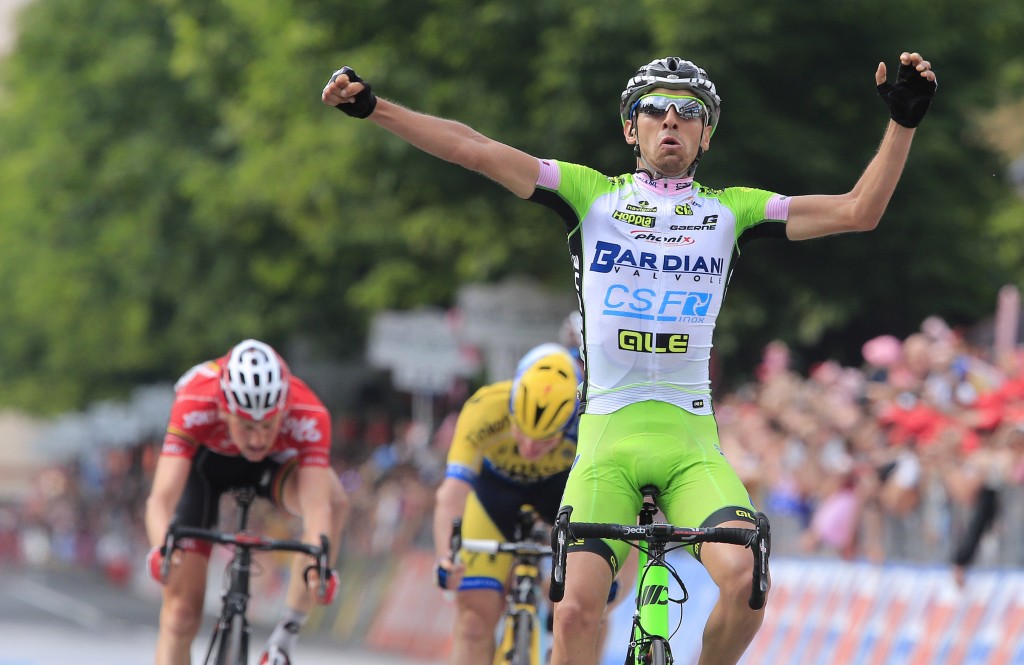
Colombia have had an incredible Giro. Along with Quintana and Uran fighting it out for overall glory and Duarte illuminating the race in Italy, Trek Factory Racing’s Julian Arredondo had been been looking good for the Mountains Prize for some time but had lacked a stage win. Stage 18 would finally be his day.
I only saw the very last few kilometres of this stage and when I did finally get to see something it was initially Cadel Evans struggling in a thinning Maglia Rosa group. By the time Rolland attacked out of that group with 2.5km remaining there was no sign of Cadel. He had gone, and surely also gone was his credibility as a Grand Tour contender. His younger rivals Majka, Hesjedal and Pozzovivo were still there along with Quintana who was content to drop a few secs behind and few others.
Up ahead Arredondo split off from the day’s early break, first battling with and then distancing Duarte, Pellizotti and Deignan. Having crested all three climbs of the day first and boosted his blue jersey points massively Arredondo also gets the stage win and a lot of prise for his strong ride.
As Duarte beats Deignan for second ace Wellens finally makes a GC group moves and soon overtakes Rolland. At 1200 metres to go, and with the remnants of the breakaway crossing the finish line ahead of them, first Aru and then Uran and Quintana do the same to all place in the top 12.
Overall Rolland moved up to third whilst Evans plummeted to 9th overall. Rolland will still have to work hard for his new podium position with a number of riders – namely Aru and Majka – now snapping at his heels. At the post-race interviews Uran looked haggard and spent; his normally craggy face having taken on an extra unwanted puffiness as well. In contrast, Quintana (albeit with the benefit of a wash and brush up) looked as fresh as the proverbial daisy. Going on this alone it was easy to feel confident of that way the race would good.
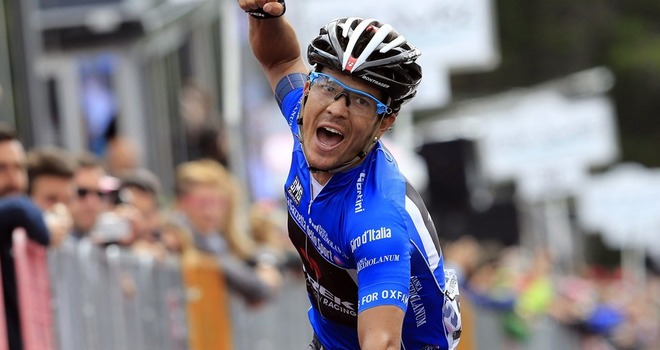
On a side note, it’s good to see that the awkward mid-massage interview is still alive and well on Italian television. During our time in watching the race on Rai 3 we were treated to numerous members of the Androni Gatacoli team being asked for their opinions about all manner of things whilst having their leg muscles rubbed by large men with calloused hands, baby oil and unspecified vibrating devices…
Stage 19. Strong stuff on the Grappa.
The 26.8km time trial up to Monte Grappa had long threatened to be a paradigm of suspense. Placed squarely within the back-loaded climbing days of the final week, the main contenders for victory – and the main chances for disaster – were always going be setting off in the final few positions, guaranteeing a thrilling finish.
Astana’s Fabio Aru once again looked to have put in a stage winning performance after a face-saving ride by Evans, and Pozzivivo had improved their starting positions on the GC slightly. With Rafal Majka and Ryder Hesjedal in particular having days to forget the minor placings were still very much up for grabs, whilst with only 1’41” separating first and second places Uran’s deficit to Quintana was not yet thought to be insurmountable.
When the dust finally settled and the last man was back in, Aru’s time of 1:05’54” was good enough for second place on the stage and to move into 3rd place overall, at the expense of Pierre Rolland whose 4th place on the stage was matched by 4th place on GC. With just Uran and Quintana left on the climb and both going strongly the drama reached a natural climax.
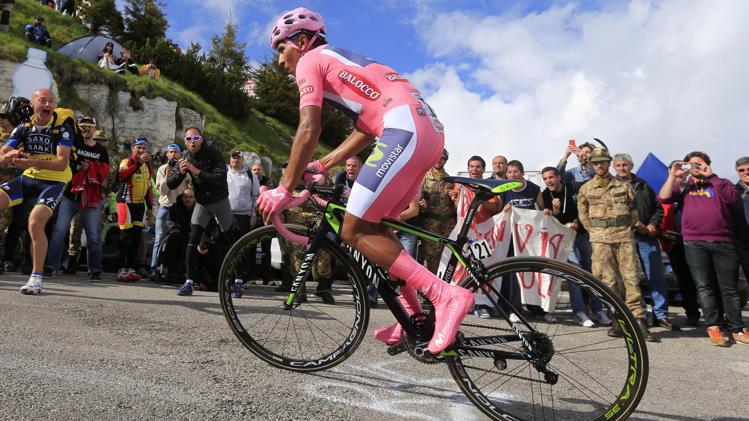
Uran’s excellent effort was just over a minute slower than Aru and slotted him into second place for the couple of minutes that elapsed before Quintana, kitted out shocking pink from head to toe, stormed home to take the stage win by 17 seconds. It was another emphatic show of strength from the Movistar man, who now led Uran by 3’07” with just one last test of climbing to come. Uran, the pink jersey wearer earlier in the race, would have to be looking forwards and backwards as the race ascends the shockingly difficult Zoncolan with the other ‘in-form’ man in the race Aru, breathing down his neck. Both will have to contend with Quintana though, who said he intended to attack on the Zoncolan to cement his likely victory in style.
Stage 20. Rogers conquers, Bongiorno suffers, Quintana reigns
With the whole race condensed to final monster climb and a breakaway threatening to spoil Quintana’s statement of intent the Movistar team hit the lower slopes with a ferocity that reminded me of darker days when EPO’s blasted Haute Catergory climbs at unseemly paces. Immediately Quintana and two team mates went clear but with no response coming from their group the impetus faltered and they sat up to wait. It was Quintana who called a halt to the premature attack – perhaps it was shock tactic to scare the others, or a older plan that was made to look a bit silly by the size of the gap to the breakaway who were already battling the upper slopes almost 7 minutes further up the climb. As with Stage 18 we had two separate races on the road and this time it was the front group who gave most of the action:
The Zoncolan is a crazy climb. It’s crazy steep and crazy popular with fans. But, like the mountain itself, they get a bit crazy sometimes too. Around the steepest sections of the climb, where the roads hits an incredible 22% the break finally splits and Pellizotti, Mick Rogers and Bardiani’s Bongiorno eek out a gap and the crowds swirl around them. It’s so steep that mechanics are carrying spare bikes over their shoulders on motorbikes. With no cars able to make the ascent the crowds are closer than usual and seem to be in a feisty mood. Tinkoff’s Mick Rogers, leading the three away from the Giant Shimano pair of De Gendt and Geschke gives one a huge swipe to clear the narrowest of paths as he and Bongiorno distance Pellizotti.
Away down the mountain the group surrounding Quintana is thinning.. Cadel goes backwards again, his face set so hard in pain and frustration that you can almost hear the inward screams of despair.
Aru is towards the back of the group, looking less than comfortable for once, alongside Rolland but the familiar names are still together. Quintana, sitting just behind his Movistar team mate Igor Anton, who is putting in a massive turn at the front, Uran with his own gregario Walt Poels, Majka and Pozzovivo. Again the crowds get too close for comfort and Poels takes a pair of sunglasses off a spectators face and throws them away in disgust. A fan wrapped in a Colombian flag almost takes out Quintana. Things are getting frantic and, perhaps sensing a moment of distraction Uran sends Walt Poels to the front to inject pace. Suddenly, with just about 5km to go Rolland, Pozzovivo, Majka and Aru are gapped.
With 2.5km to go the crowd issues finally get out of control as a well-meaning spectator pushes Bongiorno, who cannons into the back of Rogers’ bike and loses momentum as he has to put a foot down and loses momentum. It’s awful bad luck for the Italian who never really recovers. Rogers goes on to takes his second stage win but not before having to shout a few choice words at other spectators who again threaten to disrupt his progress with the over exhuberence.
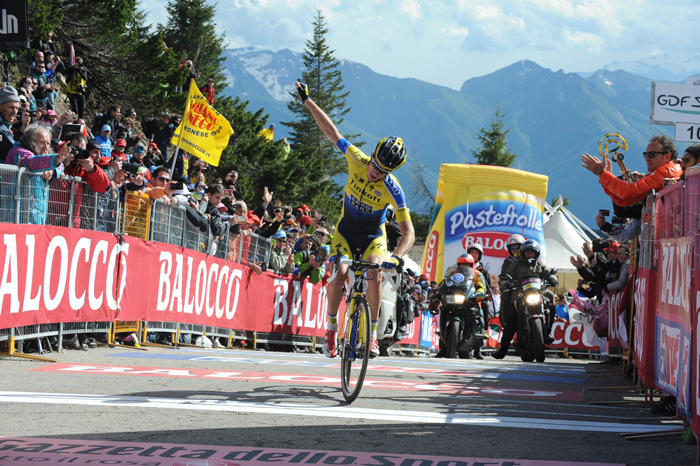
With Anton now spent and OPQS’s man from the breakaway, Sherry, joining Uran and Poels, Quintana is eventually isolated but never looks vulnerable. There is a thought that Uran could be preparing for an attack on Quintana but when the pace drops a little, allowing Pozzivivo to pace the chasing four closer to him, it was clear that Rigo is more concerned about saving his second place than forging ahead to test Quintana. The pace is upped again by the indomitable Poels (who only runs out of steam inside the last kilometre) to re-gap the chasers before Uran and Quintana ride together up the final ramps. There is no attack from Uran and Quintana is never less than comfortable, even being able to put in a little sprint over the line whilst others are hardly able to stay upright as they finish. Back in the chasing group Fabio Aru does enough to keep his third place with just the ceremonial run to Trieste to come. Barring disaster the 2014 Giro GC is done.
Stage 21. All smiles, even from the impassive Quintana.
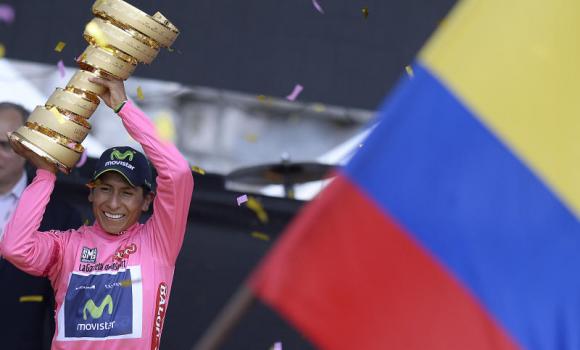
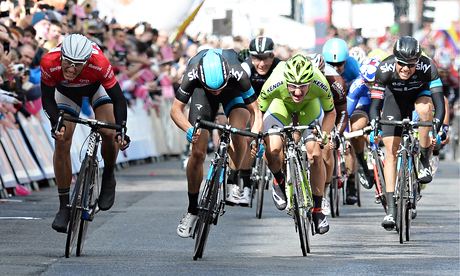
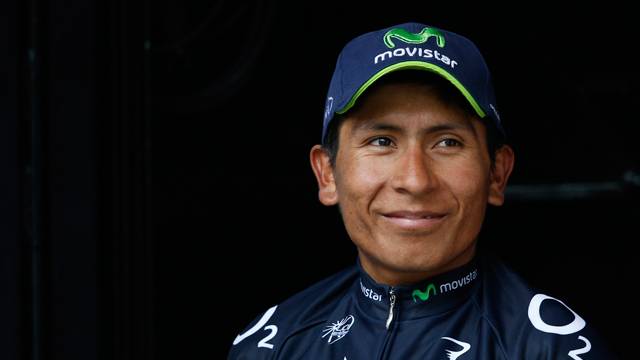
Following the traditional processional stage into the final kilometres outside Trieste, and a bunch sprint that saw Luka Mezgec get a stage win ahead of Nizzoli and Farrar, Quintana allowed his normally impassive visage to slip into the broadest of smiles as, accompanied by his family, he collected the final pink jersey and the mighty spiralled gold trophy of the Giro d’Italia. He also tops the Young Rider category, which Aru inherits.
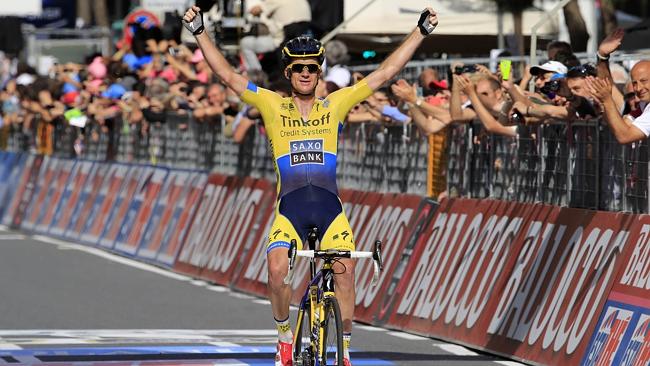
It’s been a generally hugely entertaining Giro stuffed full of interest, intrigue, incident and ridden mostly by up-and-coming riders showing that the guard will change once again in the decades old cycle of dominance. Colombia in particular, appear to have a new Golden Age ahead of them but both France and Italy will also be hugely encouraged by what they have seen in the last month. The race ebbed and flowed wonderfully, even as it built to the expected crescendo in the final week. Sixteen different stage winners, five different Maglia Rosa wearers, cameo turns from likely and unlikely sources, and the ongoing battle with not only the other riders and the terrain but also the less than ideal elements. Calamity and controversy added to the excitement without detracting or tainting (with the possible exception of the spectator push on Bongiorno) the overall results. It has set the Grand Tour season off to a flying start. Bring on Le Grand Depart!
 The Massif Studio Blog