
With both the Tour de France and the Giro d’Italia set to start outside of their own borders next year it seems like a good time to have a look at this increasingly regular phenomenon. In 2014 the Giro will spend three days in Ireland during May, visiting both Belfast and Dublin, before Le Tour comes to Yorkshire, Cambridge and London in July. Whilst the Vuelta tends to be much more of an insular affair – having only started outside of Spain twice in it’s 60 year history – a fifth of all the Giro starts since it’s first foray to San Marino in 1965 have been foreign affairs.
The Tour is an even more international event with over 20 foreign starts dating back as early as 1954 in Amsterdam. This began a sequence of around three Tours each decade commencing in foreign parts up until the Millennium. After that they increased again and Tour De France race director Christian Prudhomme clearly stated his aims in 2007 when he said that 3 out of every 5 Tours should begin abroad. Talk during the Armstrong era of a start on American soil may have failed to materialise because of the very real logistical issues of transferring the entire race and it’s vast entourage across 5 time zones of Atlantic Ocean but the appetite to take the Tour ‘on tour’ is self evident.
Tag Archives: procycling
The Mavericks – Adam Hansen – Seventh Heaven for Grand Tour Glutton
Lotto Bellisol’s Adam Hansen has just completed his seventh straight Grand Tour. Since late 2011 he has ridden the Giro and the Tour twice each and La Vuelta three times – all without a break. He has covered almost 24,000 Grand Tour kilometres in those 2 years and raced an incredible total of 16,059km over 106 days last year alone. In an era of ever increased targeting of races Hansen is a throwback to the classic years of cycling when even the top contenders rode vast seasons covering all events. In a sport renowned as being one of the toughest on the planet, his insatiable appetite for racing the biggest tests over and over again is earning him numerous fans and a reputation of being the hardest of the hard? The Jersey Pocket looked into what makes Hansen tick and found enough surprises to warrant him a place in ‘The Mavericks’.
Hansen has often been marked out as being a bit different. The fact that 32 year old Australian chooses to live in the Czech Republic rather than in one of the usual pro peloton hangouts like Girona or Nice is often used to highlight a non-conformist nature. Never shy in terms of doing things his way Hansen’s unique personality has been enlivening the peloton since 2007. Following spells at T-Mobile, HTC and Omega Pharma Lotto, ‘Croc-man’ (as he is known to his team mates) joined Lotto-Bellisol for the 2012 season, just after embarking on his Grand Tour Odyssey. He seems to be very settled with the Belgian squad and this contentment is showing in both the relaxed nature of his interviews and the increasingly successful nature of his racing. Whilst his commitment and focus at the sharp end of a race should not be questioned that doesn’t stop Hansen from occaisionally reminding us that he enjoys his job too.
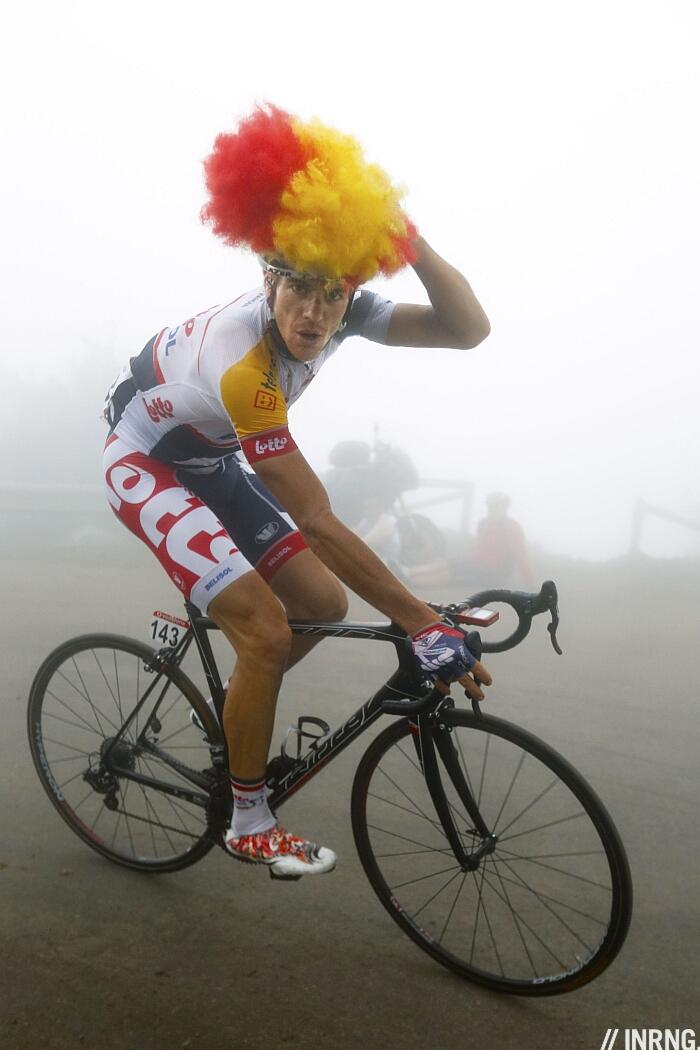
Adam Hansen – Doing things his way at La Vuelta. Alto de L’Angliru 2013
None More Black – the shifting spectrum of the pro peloton
“It’s like, how much more black could this be? And the answer is none. None more black.”
Nigel Tufnell. Spinal Tap.
The recent news that Cannondale’s new 2014 kit design will be a mainly black affair has been greeted by cycling’s fashion watchers with barely more than a raised eyebrow. ‘Copying Sky’ is the main criticism that most can muster and, given that nearly all pro teams are seeking to reproduce the British team’s training programmes or marginal gains techniques in some shape or form, that in itself is hardly a withering accusation. But, after years of what has often amounted to an arms race of garishness, is there more to this latest rejection of what has been termed elsewhere as ‘Euro Gaud’ than simply aping the most successful team around?

Colour Me Bad.
On one level Cannondale’s rejection of bright colour is an obvious way of turning their back on the team’s most recent incarnation as Liquigas. Constrained by the corporate colours of the Italian energy company, the team’s lime green kit was up there with the lurid pink of Lampre and the Day-glo yellow of ViniFantini for eye-watering loudness. Indeed, some lesser Italian races – when the finishes were often contested between multiple members of these three teams – were such a visceral assault on the eyes that they should really have carried some kind of warning for viewers of a sensitive disposition.
 The Massif Studio Blog